
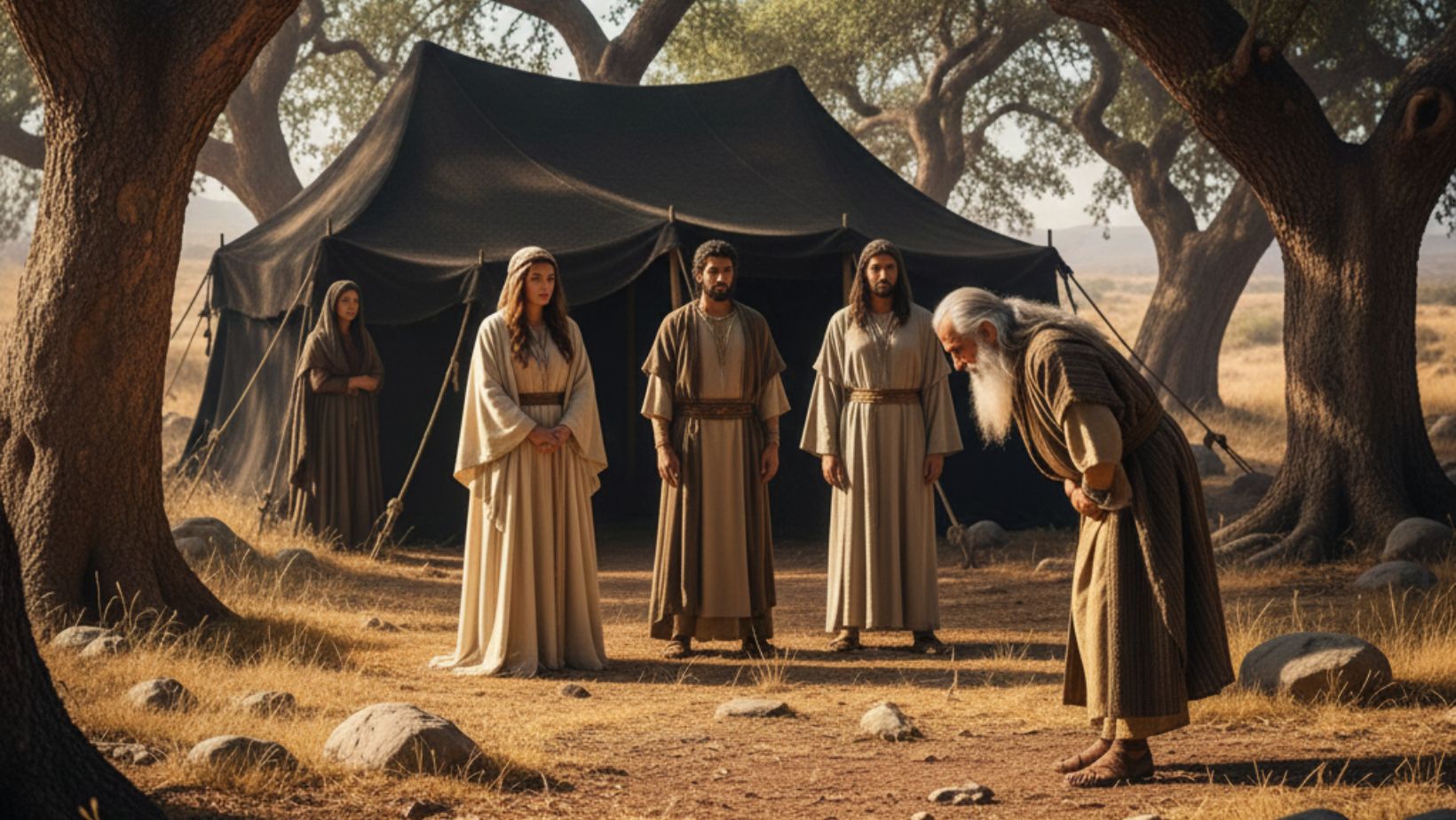
Genesis 18 presents a profound encounter between the divine and the human, highlighting themes of hospitality, divine promise, and intercessory prayer. The chapter opens near the great trees of Mamre, where Yahweh appears to Abraham in the form of three visitors. Abraham displays exemplary hospitality, rushing to serve them. During the meal, the Lord reaffirms the promise of a son to Sarah, who laughs in disbelief given her advanced age, prompting the rhetorical question, “Is anything too hard for the Lord?” The narrative then shifts as the visitors look toward Sodom. God decides to reveal His judgment against Sodom to Abraham, prompting a remarkable dialogue where Abraham intercedes for the righteous within the city, appealing to God’s justice. The chapter concludes with the departure of the Lord, having agreed to spare the city if even ten righteous people are found.
1. The Hospitality of Abraham (Genesis 18:1–8 NIV)
1 The Lord appeared to Abraham near the great trees of Mamre while he was sitting at the entrance to his tent in the heat of the day. 2 Abraham looked up and saw three men standing nearby. When he saw them, he hurried from the entrance of his tent to meet them and bowed low to the ground. 3 He said, “If I have found favor in your eyes, my lord, do not pass your servant by. 4 Let a little water be brought, and then you may all wash your feet and rest under this tree. 5 Let me get you something to eat, so you can be refreshed and then go on your way—now that you have come to your servant.” “Very well,” they answered, “do as you say.” 6 So Abraham hurried into the tent to Sarah. “Quick,” he said, “get three seahs of the finest flour and knead it and bake some bread.” 7 Then he ran to the herd and selected a choice, tender calf and gave it to a servant, who hurried to prepare it. 8 He then brought some curds and milk and the calf that had been prepared, and set these before them. While they ate, he stood near them under a tree.
Commentary:
- Theophany at Mamre (v. 1):
- The text explicitly states “The Lord (Yahweh) appeared.” This is a theophany—a visible manifestation of God.
- The location, Mamre (near Hebron), was a place of settled residence for Abraham.
- “Heat of the day” implies noon, a time when activity usually ceases, making Abraham’s alertness and energy even more remarkable.
- The Three Visitors (v. 2):
- Abraham sees “three men.” Christian theology often views this as a pre-incarnate appearance of Christ (Christophany) accompanied by two angels (who later go to Sodom in chapter 19).
- Abraham’s reaction involves “hurrying” and “bowing low,” indicating deep respect, though it is ambiguous whether he immediately recognized them as divine or was simply practicing extreme Bedouin hospitality.
- The Culture of Hospitality (v. 3-5):
- Abraham refers to himself as “your servant,” placing the guest in a position of honor.
- He offers a “little water” and “something to eat” (a morsel of bread), a classic understatement known as humble-bragging hospitality; he actually intends to provide a feast.
- The Quality of the Offering (v. 6-8):
- Quantity: “Three seahs” is approximately 22 liters or 36 pounds of flour—an enormous amount of bread, indicating a royal feast.
- Quality: “Finest flour” and a “choice, tender calf” show that Abraham offered his absolute best, not leftovers.
- Service: While they ate, Abraham “stood near them,” acting as a waiter rather than sitting as an equal. This demonstrates humility.
Insight: Abraham’s hospitality was not a burden but a priority. He interrupted his rest to serve strangers, unaware that he was entertaining the Lord Himself (Hebrews 13:2).
2. The Promise and the Laughter (Genesis 18:9–15 NIV)
9 “Where is your wife Sarah?” they asked him. “There, in the tent,” he said. 10 Then one of them said, “I will surely return to you about this time next year, and Sarah your wife will have a son.” Now Sarah was listening at the entrance to the tent, which was behind him. 11 Abraham and Sarah were already very old, and Sarah was past the age of childbearing. 12 So Sarah laughed to herself as she thought, “After I am worn out and my lord is old, will I now have this pleasure?” 13 Then the Lord said to Abraham, “Why did Sarah laugh and say, ‘Will I really have a child, now that I am old?’ 14 Is anything too hard for the Lord? I will return to you at the appointed time next year, and Sarah will have a son.” 15 Sarah was afraid, so she lied and said, “I did not laugh.” But he said, “Yes, you did laugh.”
Commentary:
- The Specificity of the Promise (v. 10):
- The visitor (identified here as the Lord) moves from general hospitality to specific prophecy.
- “About this time next year” sets a concrete timeline for the birth of Isaac, moving the promise from a distant hope to an imminent reality.
- Biological Impossibility (v. 11):
- The text stresses the miraculous nature of the promise: they were “very old” and Sarah was “past the age of childbearing” (menopause had occurred). From a human perspective, conception was dead.
- Sarah’s Laughter (v. 12):
- The Omniscience of God (v. 13):
- The Rhetorical Question (v. 14):
- “Is anything too hard for the Lord?” (Hebrew: pala – too wonderful, difficult, or extraordinary). This is the theological anchor of the chapter.
- It challenges the limits of human logic against the limitlessness of God’s power.
- Fear and Denial (v. 15):
- Caught in her skepticism, Sarah lies out of fear.
- The Lord’s response, “Yes, you did laugh,” is firm but not condemning. He insists on the truth but does not revoke the promise.
Insight: Faith often battles with biological reality. Sarah’s laughter represents the cynicism of the “impossible,” while God’s question reminds us that the laws of nature are subject to the Author of nature.
3. Abraham Intercedes for Sodom (Genesis 18:16–33 NIV)
16 When the men got up to leave, they looked down toward Sodom, and Abraham walked along with them to see them on their way. 17 Then the Lord said, “Shall I hide from Abraham what I am about to do? 18 Abraham will surely become a great and powerful nation, and all nations on earth will be blessed through him. 19 For I have chosen him, so that he will direct his children and his household after him to keep the way of the Lord by doing what is right and just, so that the Lord will bring about for Abraham what he has promised him.” 20 Then the Lord said, “The outcry against Sodom and Gomorrah is so great and their sin so grievous 21 that I will go down and see if what they have done is as bad as the outcry that has reached me. If not, I will know.” 22 The men turned away and went toward Sodom, but Abraham remained standing before the Lord. 23 Then Abraham approached him and said: “Will you sweep away the righteous with the wicked? 24 What if there are fifty righteous people in the city? Will you really sweep it away and not spare the place for the sake of the fifty righteous people in it? 25 Far be it from you to do such a thing—to kill the righteous with the wicked, treating the righteous and the wicked alike. Far be it from you! Will not the Judge of all the earth do right?” 26 The Lord said, “If I find fifty righteous people in the city of Sodom, I will spare the whole place for their sake.” 27 Then Abraham spoke up again: “Now that I have been so bold as to speak to the Lord, though I am nothing but dust and ashes, 28 what if the number of the righteous is five less than fifty? Will you destroy the whole city for lack of five people?” “If I find forty-five there,” he said, “I will not destroy it.” 29 Once again he spoke to him, “What if only forty are found there?” He said, “For the sake of forty, I will not do it.” 30 Then he said, “May the Lord not be angry, but let me speak. What if only thirty can be found there?” He answered, “I will not do it if I find thirty there.” 31 Abraham said, “Now that I have been so bold as to speak to the Lord, what if only twenty can be found there?” He said, “For the sake of twenty, I will not destroy it.” 32 Then he said, “May the Lord not be angry, but let me speak just once more. What if only ten can be found there?” He answered, “For the sake of ten, I will not destroy it.” 33 When the Lord had finished speaking with Abraham, he left, and Abraham returned home.
Commentary:
- Friendship with God (v. 17-19):
- God’s internal monologue (“Shall I hide from Abraham…”) reveals a unique intimacy. Abraham is not just a servant; he is a confidant (James 2:23).
- Divine Rationale: God reveals the plan because Abraham is the covenant head (“chosen him”) responsible for teaching righteousness (“doing what is right and just”). Abraham needs to understand God’s justice to teach it to his descendants.
- The Outcry (v. 20-21):
- “The outcry” (Hebrew: ze’aqah) implies the scream of the oppressed. Sodom’s sin wasn’t just private immorality but public injustice and violence (Ezekiel 16:49-50).
- “I will go down and see” anthropomorphically describes God’s thorough investigation before judgment. He does not judge on hearsay.
- The Negotiation (v. 23-32):
- Abraham initiates the intercession based on God’s character. He does not argue that Sodom is innocent; he argues that God is just.
- The Principle: “Will not the Judge of all the earth do right?” (v. 25). Abraham posits that it is inconsistent with God’s nature to destroy the righteous alongside the wicked.
- The Countdown: Abraham methodically lowers the number from 50 → 45 → 40 → 30 → 20 → 10.
- Humility: Abraham maintains reverence (“dust and ashes,” “May the Lord not be angry”) while persisting in boldness.
- The Outcome (v. 32-33):
- God agrees to spare the city for the sake of ten. This reveals God’s immense mercy—He is willing to tolerate a city of wickedness for a handful of righteous people.
- The conversation ends at ten, perhaps because Abraham assumes Lot’s family (Lot, wife, daughters, sons-in-law) would number at least ten.
- The Lord departs, having granted every request Abraham made.
Insight: Intercession is not overcoming God’s reluctance, but laying hold of His willingness. Abraham stood in the gap, and God allowed him to define the boundaries of mercy.
Theological Significance of Genesis 18
- The Doctrine of Omnipotence: The question “Is anything too hard for the Lord?” serves as a foundational theology for the miraculous. It establishes that natural limitations do not bind God.
- The Character of God: The chapter balances God as the benevolent Gift-giver (granting a son) and the righteous Judge (judging Sodom). He is both intimate with His friends and fearsome to the wicked.
- Vicarious Atonement Principle: The idea that the presence of the righteous can save the wicked foreshadows the ultimate work of Christ. While Sodom did not have ten righteous men to save it, the world has One Righteous Man (Jesus) whose righteousness saves those who believe.
- The Nature of Prayer: Prayer is presented as a dialogue, not a monologue. It involves reasoning with God based on His revealed character (“Judge of all the earth”).
Practical Applications
- Practice Radical Hospitality: Abraham’s eagerness to serve strangers led to a divine encounter. We should be quick to serve, for in doing so, we may entertain “angels unawares” (Hebrews 13:2).
- Trust Beyond Logic: When God’s promises contradict our circumstances (like Sarah’s barrenness), we must trust His power over our “dead” situations. Skepticism is natural, but God gets the last word.
- Intercede for the World: Like Abraham, believers are called to stand before God on behalf of a sinful world. We should pray for mercy for our cities and nations, appealing to God’s desire to save rather than destroy.
- Teach Justice: God chose Abraham to “direct his children” in the way of the Lord. Parents and leaders have a duty to instruct the next generation in righteousness and justice.
Final Insight
Genesis 18 captures the full spectrum of the believer’s walk with God: serving Him in the mundane duties of hospitality, trusting Him for the impossible promises of the future, and wrestling with Him in prayer for the fate of others. It marks the transition of Abraham from a passive recipient of promises to an active partner in God’s counsel. The chapter teaches us that God desires not just obedience, but a relationship where He shares His heart and we share our concerns.
Possible Sermon Titles from the Chapter
- Is Anything Too Hard for the Lord?
- The God Who Stops for Dinner.
- Laughing at the Impossible.
- Standing in the Gap: The Art of Intercession.
- The Judge of All the Earth.
- From “Dust and Ashes” to Friend of God.







Leave a Reply