
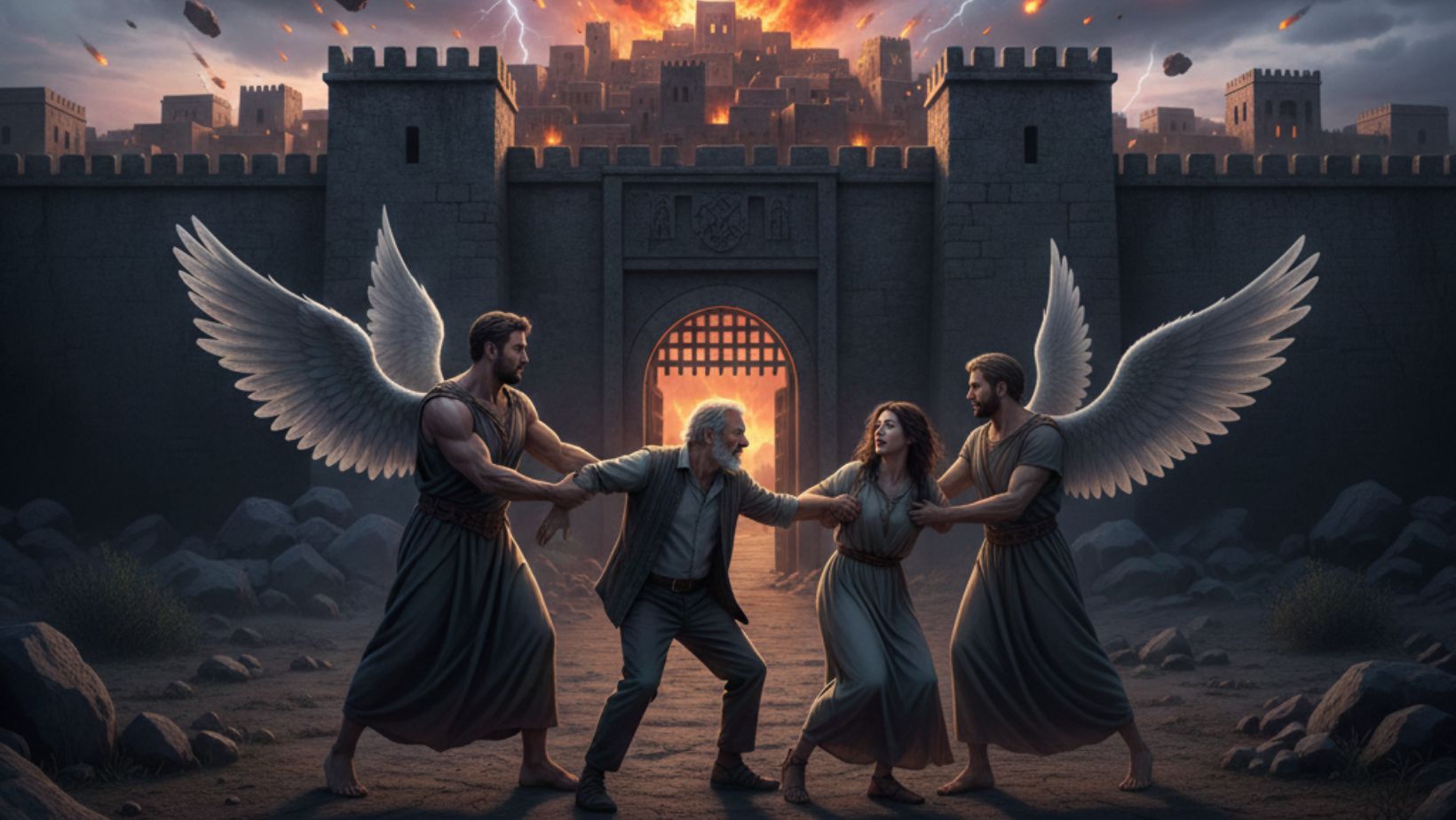
Genesis 19 chronicles the catastrophic judgment of Sodom and Gomorrah and the frantic rescue of Lot and his family. The narrative contrasts sharply with the peaceful hospitality of Abraham in chapter 18. It begins with two angels arriving in Sodom, where they are met by Lot, who offers them shelter. The city’s extreme depravity is revealed when a mob surrounds Lot’s house, demanding to gang-rape the visitors. The angels strike the mob blind and urge Lot to flee before the city is destroyed. Lot hesitates, but the angels drag him, his wife, and his two daughters out. God rains down burning sulfur, destroying the cities. Lot’s wife looks back and becomes a pillar of salt. The chapter concludes in a dark cave where Lot, drunk and fearful, unwittingly commits incest with his daughters, fathering the nations of Moab and Ammon—future enemies of Israel.
1. The Depravity of Sodom (Genesis 19:1–11 NIV)
1 The two angels arrived at Sodom in the evening, and Lot was sitting in the gateway of the city. When he saw them, he got up to meet them and bowed down with his face to the ground. 2 “My lords,” he said, “please turn aside to your servant’s house. You can wash your feet and spend the night and then go on your way early in the morning.” “No,” they answered, “we will spend the night in the square.” 3 But he insisted so strongly that they did go with him and entered his house. He prepared a meal for them, baking bread without yeast, and they ate. 4 Before they had gone to bed, all the men from every part of the city of Sodom—both young and old—surrounded the house. 5 They called to Lot, “Where are the men who came to you tonight? Bring them out to us so that we can have sex with them.” 6 Lot went outside to meet them and shut the door behind him 7 and said, “No, my friends. Don’t do this wicked thing. 8 Look, I have two daughters who have never slept with a man. Let me bring them out to you, and you can do what you like with them. But don’t do anything to these men, for they have come under the protection of my roof.” 9 “Get out of our way,” they replied. “This fellow came here as a foreigner, and now he wants to play the judge! We’ll treat you worse than them.” They kept bringing pressure on Lot and moved forward to break down the door. 10 But the men inside reached out and pulled Lot back into the house and shut the door. 11 Then they struck the men who were at the door of the house, young and old, with blindness so that they could not find the door.
Commentary:
- Lot at the Gate (v. 1):
- Sitting at the “gateway” indicates Lot had achieved a position of status or civic influence in Sodom, as business and legal matters were conducted there. He was deeply embedded in the society he was supposed to be separate from.
- Hospitality: Like Abraham, Lot bows and offers shelter. However, while Abraham ran to meet God in the day, Lot meets angels in the “evening”—a symbol of the encroaching spiritual darkness.
- The Angels’ Test (v. 2-3):
- The angels initially refuse, proposing to stay in the “square.” In a righteous city, the square would be safe; in Sodom, it is a death sentence. Lot “insisted so strongly” because he knew the danger awaiting them outside.
- Total Depravity (v. 4-5):
- Universal Guilt: The text specifies “all the men from every part of the city… young and old.” There were no innocent bystanders; the corruption was total.
- The Demand: The mob demands to “have sex with them” (Hebrew yada, to know, used here in a carnal sense). This is an attempted gang rape of strangers, violating the ancient Near Eastern code of hospitality and natural law.
- Lot’s Compromise (v. 6-8):
- Lot tries to mediate (“my friends”), showing his lack of moral clarity.
- The Horrific Offer: Lot offers his virgin daughters to the mob to protect the guests. This shocking act reveals how warped Lot’s moral compass had become living in Sodom. He attempts to solve one sin (violence against guests) with another (sacrificing his daughters).
- The Mob’s Reaction (v. 9):
- The crowd rejects Lot’s authority, mocking him as a “foreigner” (sojourner) who judges them. This confirms that Lot’s attempt to influence Sodom for good had failed completely.
- Divine Intervention (v. 10-11):
- The angels physically pull Lot to safety.
- Blindness: The mob is struck with blindness (or confusion), yet they persist in trying to “find the door.” This illustrates the obsessive, irrational nature of sin—they are blind but still groping for evil.
Insight: Sodom is not just a city of sexual immorality but of violence and hostility toward outsiders. Lot is portrayed as a “righteous man” (2 Peter 2:7) who is tormented by his environment yet dangerously entangled in it.
2. The Destruction and the Pillar of Salt (Genesis 19:12–29 NIV)
12 The two men said to Lot, “Do you have anyone else here—sons-in-law, sons or daughters, or anyone else in the city who belongs to you? Get them out of here, 13 because we are going to destroy this place. The outcry to the Lord against its people is so great that he has sent us to destroy it.” 14 So Lot went out and spoke to his sons-in-law, who were pledged to marry his daughters. He said, “Hurry and get out of this place, because the Lord is about to destroy the city!” But his sons-in-law thought he was joking. 15 With the coming of dawn, the angels urged Lot, saying, “Hurry! Take your wife and your two daughters who are here, or you will be swept away when the city is punished.” 16 When he hesitated, the men grasped his hand and the hands of his wife and of his two daughters and led them safely out of the city, for the Lord was merciful to them. 17 As soon as they had brought them out, one of them said, “Flee for your lives! Don’t look back, and don’t stop anywhere in the plain! Flee to the mountains or you will be swept away!” 18 But Lot said to them, “No, my lords, please! 19 Your servant has found favor in your eyes… but I can’t flee to the mountains; this disaster will overtake me, and I’ll die. 20 Look, here is a town near enough to run to, and it is small. Let me flee there—it is very small, isn’t it? Then my life will be spared.” 21 He said to him, “Very well, I will grant this request too; I will not overthrow the town you speak of. 22 But flee there quickly, because I cannot do anything until you reach it.” (That is why the town was called Zoar.) 23 By the time Lot reached Zoar, the sun had risen over the land. 24 Then the Lord rained down burning sulfur on Sodom and Gomorrah—from the Lord out of the heavens. 25 Thus he overthrew those cities and the entire plain, destroying all those living in the cities—and also the vegetation in the land. 26 But Lot’s wife looked back, and she became a pillar of salt. 27 Early the next morning Abraham got up and returned to the place where he had stood before the Lord. 28 He looked down toward Sodom and Gomorrah, toward all the land of the plain, and he saw dense smoke rising from the land, like smoke from a furnace. 29 So when God destroyed the cities of the plain, he remembered Abraham, and he brought Lot out of the catastrophe that overthrew the cities where Lot had lived.
Commentary:
- Loss of Witness (v. 14):
- Lot warns his future sons-in-law, but they think he is “joking.” He has no spiritual credibility with his own family.
- The Hesitation (v. 15-16):
- Lot “hesitated” (lingered). He was attached to his life in Sodom.
- The Grip of Grace: The angels literally “grasped his hand” and dragged him out. Salvation here is depicted not as Lot’s initiative but as God’s forceful mercy. “For the Lord was merciful to them.”
- The Command (v. 17):
- “Don’t look back.” This was a test of detachment. To look back was to long for the sinful life they were leaving.
- Lot’s Fear (v. 18-22):
- Even in rescue, Lot bargains. He fears the mountains (where faith would take him) and asks for Zoar (a “little” city). He is a believer with “little” faith, seeking comfort over obedience. Zoar means “small” or “insignificant.”
- The Judgment (v. 24-25):
- “Burning sulfur” (brimstone) rains directly from Yahweh. The destruction is total—people, buildings, and vegetation. Archeological theories suggest a seismic event releasing bituminous gases and fire, but the text presents it as direct divine judgment.
- Lot’s Wife (v. 26):
- She “looked back” (Hebrew nabat – to look intently or gaze). This wasn’t a casual glance but a lingering gaze of longing.
- Pillar of Salt: She is encrusted in the raining judgment. Jesus later warns, “Remember Lot’s wife” (Luke 17:32) as an example of a divided heart that values the world over salvation.
- Abraham’s View (v. 27-29):
Insight: Judgment is real and terrifying. Lot is “saved as one escaping through the flames” (1 Cor 3:15)—he loses everything but his life.
3. Lot’s Cave and Incest (Genesis 19:30–38 NIV)
30 Lot and his two daughters left Zoar and settled in the mountains, for he was afraid to stay in Zoar. He and his two daughters lived in a cave. 31 One day the older daughter said to the younger, “Our father is old, and there is no man around here to give us children—as is the custom all over the earth. 32 Let’s get our father to drink wine and then sleep with him and preserve our family line through our father.” 33 That night they got their father to drink wine, and the older daughter went in and slept with him. He was not aware of it when she lay down or when she got up. 34 The next day the older daughter said to the younger, “Last night I slept with my father. Let’s get him to drink wine again tonight, and you go in and sleep with him so we can preserve our family line through our father.” 35 So they got their father to drink wine that night also, and the younger daughter went in and slept with him. Again he was not aware of it when she lay down or when she got up. 36 So both of Lot’s daughters became pregnant by their father. 37 The older daughter had a son, and she named him Moab; he is the father of the Moabites of today. 38 The younger daughter also had a son, and she named him Ben-Ammi; he is the father of the Ammonites of today.
Commentary:
- Fear and Isolation (v. 30):
- Lot ends up in the very mountains he previously feared, but now he lives in a “cave.” He has regressed from a city leader to a cave-dweller, isolated and afraid. This is the tragic end of a worldly believer.
- The Daughters’ Logic (v. 31-32):
- They assume “there is no man around here.” They believe the whole world has been destroyed (like the Flood) or that no one will marry them because they are refugees from the cursed city.
- Pragmatism over Morality: Their goal (“preserve our family line”) is good, but their method (incest/rape) is evil. They learned the “end justifies the means” philosophy in Sodom.
- The Drunkenness (v. 33-35):
- Lot is intoxicated to the point of stupor (“not aware”). While the daughters initiate the sin, Lot’s lack of sobriety makes him vulnerable and culpable.
- The Origin of Nations (v. 37-38):
Insight: The story of Lot ends in silence and shame. There is no record of his repentance or death, only the birth of nations that would trouble God’s people. It is a stark warning about the long-term consequences of compromising with the world.
Theological Significance of Genesis 19
- The Severity of Judgment: God’s patience (waiting for the outcry) eventually gives way to decisive judgment. Sodom serves as the biblical archetype for divine wrath against unrepentant sin (Jude 1:7).
- Grace in Judgment: Even in wrath, God remembers mercy. Lot is not saved by his own merit (he hesitates and complains) but by God’s “compassion” and Abraham’s intercession.
- The World’s Influence: Lot thought he could live in Sodom without becoming of Sodom. However, Sodom cost him his testimony, his wife, and eventually the morality of his daughters.
- Salvation by Removal: Sometimes God saves his people not by changing their circumstances, but by forcefully removing them from the path of destruction.
Practical Applications
- Don’t Look Back: Following God requires letting go of our past sins and attachments. Looking back at “Sodom” (our old life) with longing can be spiritually fatal.
- The Danger of “Lingering”: Indecision in the face of sin is dangerous. When God says flee, we must move immediately. Delayed obedience is disobedience.
- Environment Matters: Who we surround ourselves with shapes us and our children. Lot’s daughters learned the morals of Sodom, which resurfaced in the cave.
- Intercessory Prayer Works: We should pray for lost friends and family. They may be “dragged out” of destruction because God “remembers” our prayers.
Final Insight
Genesis 19 is a tragedy of a “righteous soul” (Lot) tormented by compromise. While Abraham ascends the heights of faith, Lot descends into the depths of a cave. The chapter teaches that while we can be saved “as through fire,” God desires a faith that produces a legacy of blessing (like Isaac), not a legacy of shame (like Moab and Ammon).
Possible Sermon Titles from the Chapter
- The Man Who Lingered.
- Don’t Look Back.
- Saved, But Scorched.
- The High Cost of Low Living.
- When Angels Drag You Out.
- Remember Lot’s Wife.







Leave a Reply