
Genesis 21 marks a pivotal moment in redemptive history: the long-awaited birth of Isaac. This chapter resolves the tension of the “child of promise” that has spanned decades of Abraham’s life. It contrasts the joy of fulfillment with the sorrow of separation, as the arrival of Isaac necessitates the departure of Ishmael and Hagar. The narrative shifts from the domestic sphere—dealing with family dynamics and inheritance—to the geopolitical sphere, where Abraham establishes a peace treaty with Abimelech, securing his standing in the land. The chapter highlights God’s absolute faithfulness to His word, His compassion for the outcast, and Abraham’s establishment as a recognized prince in Canaan.
1. The Birth of Isaac: Promise Fulfilled (Genesis 21:1–7 NLT)
1 The Lord kept his word and did for Sarah exactly what he had promised. 2 She became pregnant, and she gave birth to a son for Abraham in his old age. This happened at just the time God had said it would. 3 And Abraham named their son Isaac. 4 Eight days after the boy was born, Abraham circumcised him as God had commanded. 5 Abraham was 100 years old when his son Isaac was born. 6 And Sarah declared, “God has brought me laughter. All who hear about this will laugh with me. 7 Who would have said to Abraham that Sarah would nurse a baby? Yet I have given Abraham a son in his old age!”
Commentary:
- Divine Faithfulness (v. 1): The narrative emphasizes God’s fidelity with a three-fold repetition: “kept his word,” “did… exactly what he had promised,” and “at just the time God had said.” The birth is not a biological accident but a theological certainty.
- The Timing (v. 2): God’s timing is precise (“at just the time”). While Abraham waited 25 years (from age 75 to 100), God was not late. This underscores that the fulfillment of the promise depended entirely on divine power, not human vitality.
- Naming Isaac (v. 3): Abraham names the child Yitzhak (Isaac), meaning “He laughs.” Previously, both Abraham (Gen 17:17) and Sarah (Gen 18:12) laughed in skepticism. Now, the name represents the laughter of pure joy and amazement.
- Covenant Obedience (v. 4): Abraham circumcises Isaac on the eighth day, strictly adhering to the command given in Genesis 17:12. This marks Isaac as a participant in the covenant from the very beginning of his life.
- Sarah’s Song (v. 6-7): Sarah’s response is a poetic outburst of joy.
- Shared Joy: She invites the community to laugh with her, transforming her private shame of barrenness into public testimony.
- The Impossible Made Real: Her rhetorical question (“Who would have said…”) highlights the miraculous nature of the event. A post-menopausal woman nursing an infant is the sign that El Shaddai (God Almighty) has intervened.
2. The Expulsion of Hagar and Ishmael (Genesis 21:8–21 NLT)
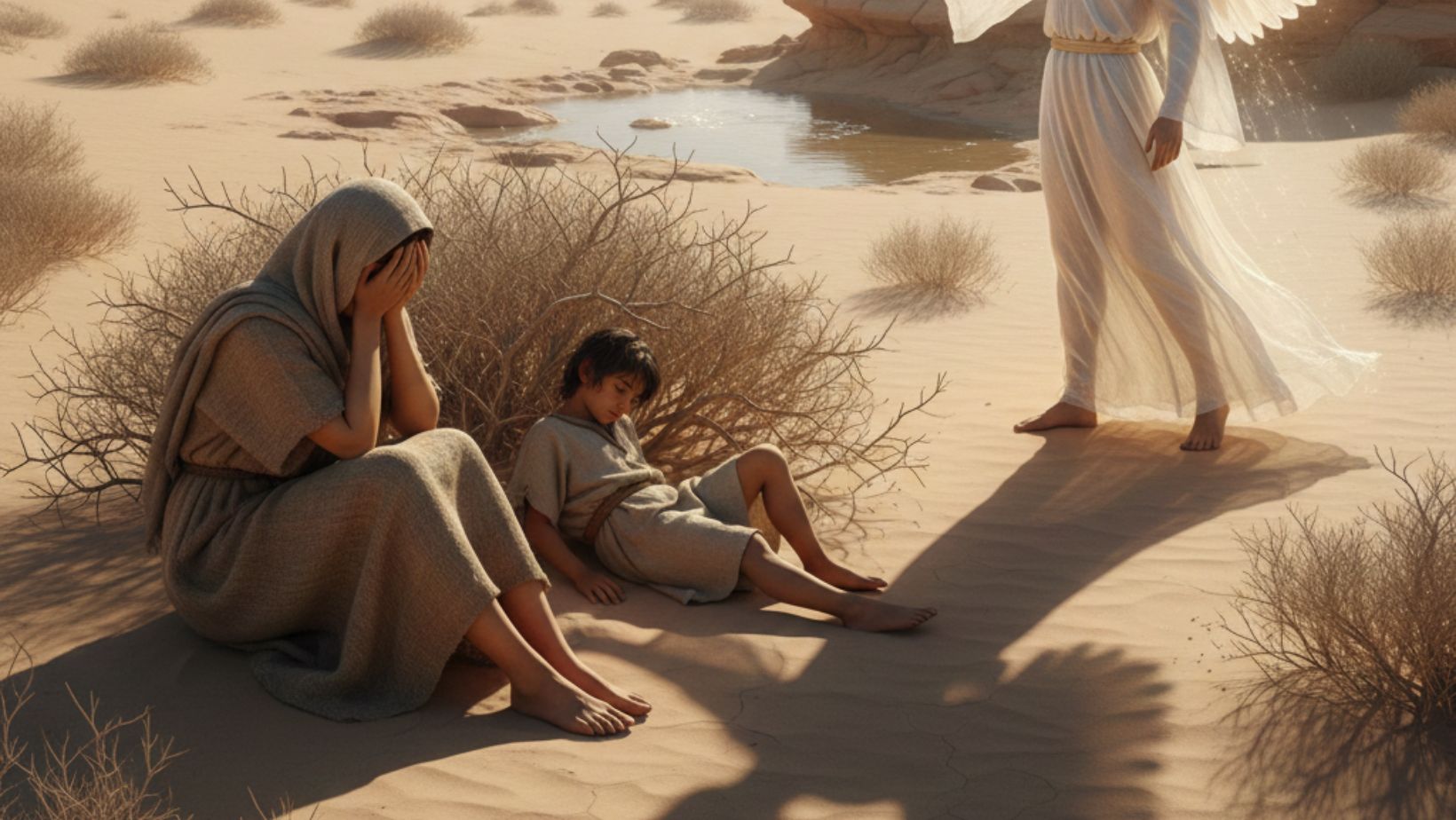
8 When Isaac grew up and was about to be weaned, Abraham prepared a huge feast to celebrate the occasion. 9 But Sarah saw Ishmael—the son of Abraham and her Egyptian servant Hagar—making fun of her son, Isaac. 10 So she turned to Abraham and demanded, “Get rid of that slave woman and her son. He is not going to share the family inheritance with my son, Isaac. I won’t have it!” 11 This upset Abraham very much because Ishmael was his son. 12 But God told Abraham, “Do not be upset over the boy and your servant. Do whatever Sarah tells you, for Isaac is the son through whom your descendants will be counted. 13 But I will also make a nation of the descendants of Hagar’s son because he is your son, too.” 14 So Abraham got up early the next morning, prepared food and a container of water, and strapped them on Hagar’s shoulders. Then he sent her away with the boy, and she wandered aimlessly in the wilderness of Beersheba. 15 When the water was gone, she put the boy in the shade of a bush. 16 Then she went and sat down by herself about a hundred yards away. “I don’t want to watch the boy die,” she said, as she burst into tears. 17 But God heard the boy crying, and the angel of God called to Hagar from heaven, “Hagar, what’s wrong? Do not be afraid! God has heard the boy crying as he lies there. 18 Go to him and comfort him, for I will make a great nation from his descendants.” 19 Then God opened Hagar’s eyes, and she saw a well full of water. She quickly filled her water container and gave the boy a drink. 20 And God was with the boy as he grew up in the wilderness. He became a skillful archer, 21 and he settled in the Wilderness of Paran. His mother arranged for him to marry a woman from the land of Egypt.
Commentary:
- The Weaning Feast (v. 8): In ancient culture, weaning occurred later than today (often around age 3). Surviving past the infant stage was a major milestone, warranting a “huge feast.” This marked Isaac’s transition from precarious infancy to established heir.
- The Conflict (v. 9): Sarah observes Ishmael “making fun” of Isaac. The Hebrew word is a form of tzaḥaq (laughing/playing), a play on Isaac’s name.
- Interpretation: While it can mean innocent playing, the context suggests mocking or asserting superiority. Paul interprets this in Galatians 4:29 as persecution. As the older son (approx. 17 years old), Ishmael posed a threat to Isaac’s status.
- Sarah’s Demand (v. 10): Sarah uses harsh legal language: “Get rid of that slave woman.” She refuses to use their names, creating distance. Her concern is explicitly about inheritance—she wants to ensure no rivalry exists for the covenant blessing.
- Abraham’s Distress (v. 11): Abraham is deeply conflicted. Ishmael is his firstborn, whom he loves. This reveals Abraham’s heart; he is not callous, but torn between his love for his son and the peace of his household.
- Divine Sanction (v. 12-13): God intervenes with a difficult command: listen to Sarah.
- The Chosen Line: “Isaac is the son through whom your descendants will be counted.” This establishes the principle of election—covenant status is by God’s choice, not just biological descent.
- Comfort for Abraham: God promises to care for Ishmael because of his connection to Abraham (“he is your son, too”).
- The Expulsion (v. 14): Abraham obeys promptly (“early the next morning”). He provides them with supplies, but they are limited. Sending them into the “wilderness of Beersheba” was a death sentence without divine aid.
- The Crisis in the Desert (v. 15-16): The supplies run out. Hagar, in despair, separates herself from Ishmael because she cannot bear to watch him die. This is a picture of utter hopelessness.
- God Who Hears (v. 17): “God heard the boy crying.” This connects back to Ishmael’s name (Ishmael = God Hears). God responds not to Hagar’s tears explicitly, but to the boy’s voice.
- Divine Provision (v. 19): “God opened Hagar’s eyes.” The well was likely there, but grief and panic had blinded her. God provides the physical resource needed for survival.
- Ishmael’s Future (v. 20-21): God remains with Ishmael. He becomes a man of the desert (Wilderness of Paran) and a skilled archer. His marriage to an Egyptian (arranged by Hagar, an Egyptian) reconnects him to his mother’s heritage.
3. The Treaty at Beersheba (Genesis 21:22–34 NLT)
22 About this time, Abimelech came with Phicol, his army commander, to visit Abraham. “God is obviously with you in everything you do,” Abimelech said. 23 “Swear to me in God’s name that you will never deceive me, my children, or any of my descendants. I have been loyal to you, so now swear that you will be loyal to me and to this country where you are living as a foreigner.” 24 Abraham replied, “I swear it.” 25 Then Abraham complained to Abimelech about a well that Abimelech’s servants had taken by force from Abraham’s servants. 26 “This is the first I’ve heard of it,” Abimelech answered. “I have no idea who is responsible. You have never complained about this before.” 27 Abraham then gave some of his sheep and goats and cattle to Abimelech, and they made a treaty. 28 But Abraham also took seven ewe lambs from the flock and placed them by themselves. 29 “Why are you doing that?” Abimelech asked. “What is the meaning of these seven ewe lambs?” 30 Abraham replied, “Please accept these seven lambs to show your agreement that I dug this well.” 31 Then he named the place Beersheba (which means “Well of the Seven”), because they swore an oath there. 32 After making their covenant at Beersheba, Abimelech and Phicol, the army commander, returned home to the land of the Philistines. 33 Then Abraham planted a tamarisk tree at Beersheba, and there he worshiped the Lord, the Eternal God. 34 And Abraham lived in the Philistine country for a long time.
Commentary:
- Gentile Recognition (v. 22): Abimelech, a Philistine king, recognizes the supernatural favor on Abraham: “God is obviously with you.” This fulfills the promise in Genesis 12:2 that Abraham would have a great name.
- The Request for Covenant (v. 23): The locals are intimidated by Abraham’s growing power. They seek a non-aggression pact to secure their future.
- The Water Dispute (v. 25): Water rights were critical in the Negev desert. Abraham confronts Abimelech about a stolen well. This shows Abraham’s boldness; he is no longer the fearful man who lied about his wife in Genesis 20.
- The Treaty Ritual (v. 27-30):
- Beersheba (v. 31): The name is a pun. Beer means “well,” and Sheba can mean “seven” or “oath.” Thus, it is the “Well of the Seven” or “Well of the Oath.” This location becomes a significant religious center in Israel’s history.
- El Olam (v. 33): Abraham plants a Tamarisk tree (a symbol of permanence and shade in the desert) and calls on El Olam (The Eternal God / The Everlasting God).
Theological Significance of Genesis 21
- Fulfillment of Prophecy: The birth of Isaac is the “anchor” event of the Abrahamic narrative. It proves that God is capable of overcoming biological impossibilities to keep His word.
- Election and Grace: Paul uses this chapter in Galatians 4 to illustrate the difference between being born of the flesh (Ishmael/works) and being born of the Spirit (Isaac/promise). The inheritance is by grace, not human effort.
- The God of the Outcast: While God chooses Isaac for the covenant line, He does not abandon Ishmael. He hears the cries of the marginalized and provides for them in the wilderness. This balances the doctrine of election with the doctrine of God’s universal compassion.
- God as Eternal (El Olam): Amidst shifting political landscapes and family strife, God is revealed as the Everlasting One, the stable rock upon which faith rests.
Practical Applications
- Trusting God’s Timing: Like Sarah, we often struggle with the “when” of God’s promises. This chapter reminds us that God’s delays are not denials; He acts at the appointed time.
- Dealing with Family Conflict: The friction between Sarah and Hagar warns against the consequences of trying to “help” God through fleshly means. However, it also shows that God can work through our messy family dynamics to accomplish His will.
- God Sees Our Tears: Hagar’s experience in the desert is a comfort to single mothers, the abandoned, and the desperate. When human resources run dry, God opens our eyes to provisions we missed.
- Living Peaceably: Abraham’s treaty with Abimelech serves as a model for how believers should interact with the secular world—with integrity, courage in claiming rights, and a willingness to make peace (Romans 12:18).







Leave a Reply