
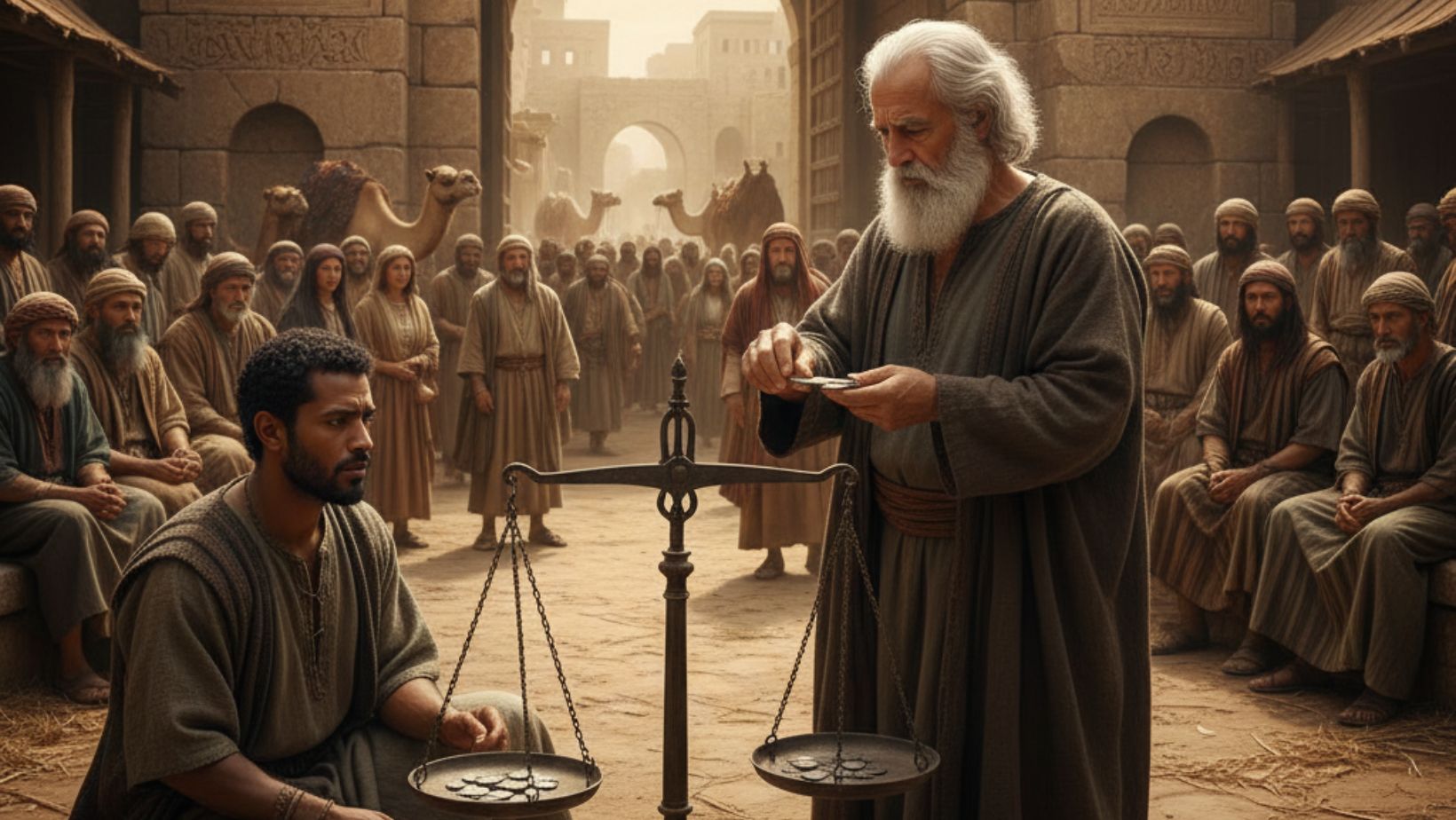
Genesis 23 records the death of Sarah and Abraham’s subsequent purchase of a burial site. While it may seem like a mundane record of a real estate transaction, this chapter is momentous in the history of Israel. It represents the first time Abraham legally owns a piece of the Promised Land. After decades of living as a nomad in tents, Abraham drives a “stake” into the ground, purchasing the Cave of Machpelah in Hebron. This act testifies to his unwavering faith that, although he is a foreigner now, his descendants will one day inherit this land as God promised.
1. The Death of Sarah (Genesis 23:1–4 NLT)
1 Sarah lived to be 127 years old. 2 She died at Kiriath-arba (now called Hebron) in the land of Canaan. There Abraham mourned and wept for her. 3 Then, leaving her body, he said to the Hittite elders, 4 “Here I am, a stranger and a foreigner among you. Please sell me a piece of land so I can give my dead a proper burial.”
Commentary:
- Sarah’s Age (v. 1): Sarah is the only woman in the Bible whose age at death is recorded. This honors her status as the matriarch of the covenant. She lived 127 years—meaning she lived 37 years after the birth of Isaac.
- The Location (v. 2): She dies in Kiriath-arba (City of Four), later known as Hebron. This is in the heart of the Promised Land, distinct from Beersheba where they were living in chapter 22.
- Abraham’s Grief (v. 2): Abraham “mourned and wept.” The Hebrew implies a formal period of mourning rituals coupled with genuine emotional weeping. Even the father of faith feels the sting of death.
- Stranger and Foreigner (v. 4): Abraham addresses the “Hittite elders” (literally “sons of Heth”). He introduces himself paradoxically: he is a “resident alien.” He lives there but has no legal rights to land.
- The Request (v. 4): In the ancient Near East, owning a family tomb was a sign of permanent roots. By asking to buy land rather than just use it, Abraham is declaring that his family is here to stay.
2. The Negotiation for the Cave (Genesis 23:5–16 NLT)
5 The Hittites replied to Abraham, 6 “Listen to us, my lord. You are an honored prince among us. Choose the finest of our tombs and bury her there. No one here will refuse to help you in this way.” 7 Then Abraham bowed low before the Hittites and said, 8 “Since you are willing to help me in this way, be so kind as to ask Ephron son of Zohar 9 to let me have the cave of Machpelah, which is at the end of his field. I will pay the full price in the presence of witnesses, so I will have a permanent burial place for my family.” 10 Ephron was sitting there among the others, and he answered Abraham as the others listened, speaking across the town gate. 11 “No, my lord,” he said to Abraham, “please listen to me. I will give you the field and the cave. Here in the presence of my people, I give it to you. Go and bury your dead.” 12 Abraham bowed low before the people of the land 13 and said to Ephron as everyone listened, “No, listen to me. I will buy it from you. Let me pay the full price for the field so I can bury my dead there.” 14 Ephron answered Abraham, 15 “My lord, please listen to me. The land is worth 400 pieces of silver, but what is that between friends? Go ahead and bury your dead.” 16 So Abraham agreed to Ephron’s price and paid the amount he had suggested—400 pieces of silver, weighed according to the market standard. The Hittite elders witnessed the transaction.
Commentary:
- The Hittite Offer (v. 6): The locals call Abraham a “prince of God” (or honored prince). They offer him the use of their best tombs. This sounds generous, but it would mean Sarah is buried in a Hittite grave, eventually blending their families. Abraham refuses; he wants a distinct, owned possession.
- Middle Eastern Bargaining (v. 10-15): This section is a classic example of ancient oriental bargaining protocol.
- “I give it to you” (v. 11): Ephron offers to “give” the land. This is likely not a literal free gift but a polite social gesture expected to be refused. Accepting it would place Abraham under a lifelong social debt (patronage) to Ephron.
- The Package Deal (v. 11): Abraham asked only for the cave (v. 9). Ephron insists on giving the field and the cave. By selling the field, the feudal tax obligations likely transfer to Abraham.
- The Price Drop (v. 15): Ephron casually mentions, “The land is worth 400 pieces of silver, but what is that between friends?” This is the asking price.
- The Price Tag (v. 16): 400 shekels of silver was an exorbitant price. For comparison, later in history, Omri buys an entire hill to build the city of Samaria for 6,000 shekels (1 Kings 16:24), and Jeremiah buys a field for 17 shekels (Jeremiah 32:9). David buys the temple site for 50 shekels (2 Samuel 24:24).
- Abraham’s Response (v. 16): Abraham does not haggle. He pays the inflated price immediately (“weighed according to market standard”). Why? He wants undisputed, clear title to the land. He wants no Hittite to ever say, “We gave that to Abraham.”
3. The Transfer of Title (Genesis 23:17–20 NLT)
17 So Abraham bought the plot of land belonging to Ephron at Machpelah, near Mamre. This included the field itself, the cave that was in it, and all the surrounding trees. 18 It was transferred to Abraham as his permanent possession in the presence of the Hittite elders at the city gate. 19 Then Abraham buried his wife, Sarah, there in Canaan, in the cave of Machpelah, near Mamre (also called Hebron). 20 So the field and the cave were transferred from the Hittites to Abraham for use as a permanent burial place.
Commentary:
- Legal Precision (v. 17): The text reads like a legal deed. It lists exactly what was purchased: the plot, the cave, and “all the surrounding trees.” This specificity ensures the boundaries are recorded for future generations.
- The City Gate (v. 18): Transactions at the “city gate” were public, legal proceedings. The elders served as the notary public. This purchase was ironclad.
- First Foothold (v. 20): This is the first fulfilling of the promise of land. Abraham owns nothing else in Canaan—only a grave. Yet, this grave acts as an anchor. By burying Sarah here, and later himself, Isaac, Rebekah, Jacob, and Leah, the Patriarchs testify that their hope is in this land.
- Insight: The Cave of Machpelah (meaning “double” or “folded” cave) remains one of the few biblical sites identified with almost absolute certainty today. It stands in modern Hebron as a testament to this transaction.
Theological Significance of Genesis 23
- Faith in the Resurrection: Abraham did not take Sarah’s body back to Ur (his homeland). He buried her in Canaan. This signifies his belief that the Promised Land was their true home and implies a hope that they would be raised here to enjoy the promise eventually (Hebrews 11:13-16).
- Legitimate Ownership: The narrative stresses that the land was not stolen or conquered, but legally purchased at a premium price. This establishes Israel’s moral and legal right to this specific plot.
- The “Down Payment” of the Promise: The purchase of the tomb is the “earnest money” or down payment on the future conquest of Canaan. It is a small piece of the reality that God promised would eventually be theirs in full.
Practical Applications
- Planning for the End: Abraham faced death with practical responsibility. He ensured his family was cared for and that the legacy was preserved. Faith does not ignore the practicalities of death and wills.
- Integrity in Business: Abraham refused to take shortcuts or use social manipulation. He paid the full price to maintain his independence and integrity. Our business dealings should be so transparent that even “those at the gate” (the world) can testify to our honesty.
- Grieving with Hope: Abraham weeps, yet he acts. The Christian response to death is not stoicism (no tears) nor despair (no hope), but sorrow anchored in the promises of God (1 Thessalonians 4:13).
- Investing in the Future: Abraham paid a high cost for a piece of land he would never farm or build on, solely for the benefit of future generations. We are called to make sacrifices today that secure spiritual ground for our children.
Possible Sermon Titles
- A Grave in the Promised Land.
- The First Possession: Faith at a Funeral.
- Weeping and Working: How Faith Handles Death.
- The 400 Shekel Investment.
- Strangers, Pilgrims, and Landowners.
- Machpelah: The Anchor of Hope.







Leave a Reply