
Genesis 24 is the longest chapter in the book of Genesis, underscoring its importance. It details the transition of the covenant promise from the first generation (Abraham) to the second (Isaac) through the critical task of finding a suitable bride. The narrative is a masterclass in divine guidance, human faithfulness, and providence. It follows Abraham’s unnamed senior servant (likely Eliezer) on a journey to Mesopotamia to find a wife for Isaac who is not a Canaanite. The chapter highlights the providence of God in micromanaging the details to ensure the purity of the covenant line.
1. The Commission: No Canaanites (Genesis 24:1–9 NLT)
1 Abraham was now a very old man, and the Lord had blessed him in every way. 2 One day Abraham said to his oldest servant, the man in charge of his household, “Take an oath by putting your hand under my thigh. 3 Swear by the Lord, the God of heaven and earth, that you will not allow my son to marry one of these local Canaanite women. 4 Go instead to my homeland, to my relatives, and find a wife there for my son Isaac.” 5 The servant asked, “But what if I can’t find a young woman who is willing to travel so far from home? Should I then take Isaac there to the land you came from?” 6 “No!” Abraham warned. “Be careful never to take my son there. 7 For the Lord, the God of heaven, who took me from my father’s house and my native land, solemnly promised to give this land to my descendants. He will send his angel ahead of you, and he will see to it that you find a wife there for my son. 8 If she is unwilling to come back with you, then you are free from this oath. But under no circumstances are you to take my son there.” 9 So the servant took an oath by putting his hand under the thigh of his master, Abraham. He swore to follow those instructions.
Commentary:
- Age and Blessing (v. 1): Abraham is “very old” (approx. 140 years). The text notes God has blessed him “in every way,” setting the stage for the final blessing needed: a future for his lineage.
- The Oath Ritual (v. 2): “Put your hand under my thigh.” This ancient custom likely invoked the reproductive organs, symbolizing that the oath was binding on Abraham’s descendants (the “seed” that would come from his loins). It was a solemn vow regarding the family line.
- No Canaanites (v. 3): This is the central conflict. Marrying a Canaanite would eventually lead to religious syncretism (worshipping their gods) and assimilation. The holy line must remain distinct.
- No Return (v. 6): Abraham is adamant that Isaac must not go back to Mesopotamia.
- Angel of Guidance (v. 7): Abraham expresses absolute confidence (“He will send his angel”). His past experiences with God (Gen 22) have solidified his trust that God will provide the means to fulfill the promise.
2. The Prayer at the Well (Genesis 24:10–14 NLT)
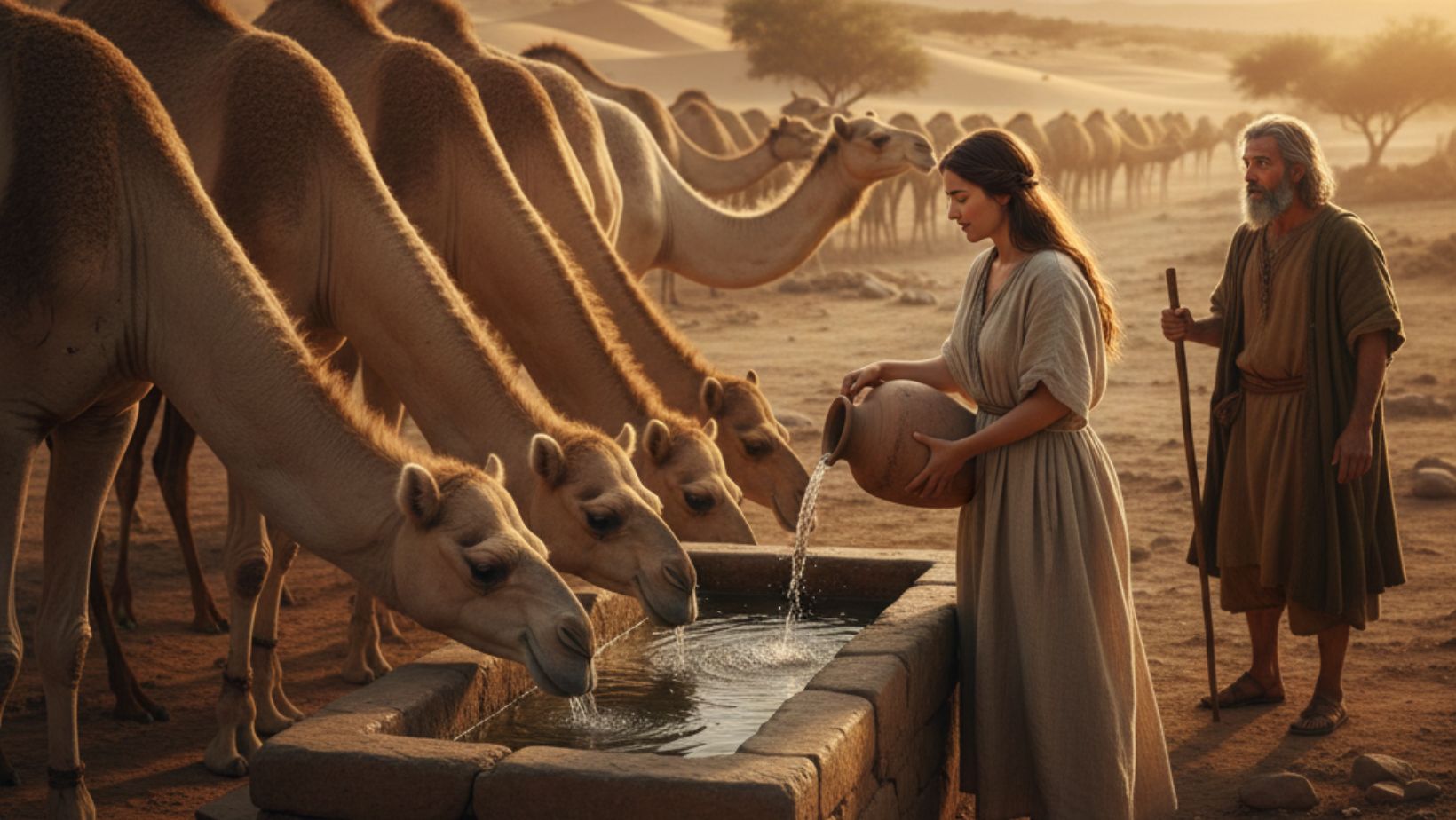
10 Then the servant loaded ten of Abraham’s camels with all kinds of expensive gifts from his master, and he traveled to distant Aram-naharaim. There he went to the town where Abraham’s brother Nahor had settled. 11 He made the camels kneel beside a well just outside the town. It was evening, and the women were coming out to draw water. 12 “O Lord, God of my master, Abraham,” he prayed. “Please give me success today, and show unfailing love to my master, Abraham. 13 See, I am standing here beside this spring, and the young women of the town are coming out to draw water. 14 This is my request. I will ask one of them, ‘Please give me a drink from your jug.’ If she says, ‘Yes, drink, and I will water your camels, too!’—let her be the one you have selected as Isaac’s wife. This is how I will know that you have shown unfailing love to my master.”
Commentary:
- The Caravan (v. 10): Ten camels and “expensive gifts” served two purposes: survival for the long journey (approx. 500+ miles) and proof of the bride-price wealth to negotiate the marriage.
- The Prayer for Hesed (v. 12): The servant prays for “success” (Hebrew: qarah, meaning to happen/encounter) and “unfailing love” (Hebrew: hesed—covenant loyalty). He bases his prayer not on his own merit, but on God’s relationship with Abraham (“God of my master”).
- The Specific Test (v. 14): The servant sets a character test, not a random sign.
- The Difficulty: A thirsty camel can drink 20-30 gallons of water. Watering ten camels meant drawing hundreds of gallons.
- The Virtue: He is looking for a woman who is not just polite (“drink”), but extraordinarily generous, hardworking, and hospitable (“I will water your camels too”). This requires a servant heart—essential for the matriarch of God’s people.
3. The Meeting: Rebekah’s Character (Genesis 24:15–27 NLT)
15 Before he had finished praying, he saw a young woman named Rebekah coming out with her water jug on her shoulder. She was the daughter of Bethuel, who was the son of Abraham’s brother Nahor and his wife, Milcah. 16 Rebekah was very beautiful and old enough to be married, but she was still a virgin. She went down to the spring, filled her jug, and came up again. 17 Running to meet her, the servant said, “Please give me a little drink of water from your jug.” 18 “Yes, my lord, drink!” she said. She quickly lowered her jug from her shoulder and gave him a drink. 19 When she had given him a drink, she said, “I’ll draw water for your camels, too, until they have had enough to drink.” 20 So she quickly emptied her jug into the watering trough and ran back to the well to draw water for all his camels. 21 The servant watched her in silence, wondering whether or not the Lord had given him success. 22 When the camels had finished drinking, he took out a gold ring for her nose and two large gold bracelets for her wrists… 26 The man bowed low and worshiped the Lord. 27 “Praise the Lord, the God of my master, Abraham,” he said. “The Lord has shown unfailing love and faithfulness to my master, for he has led me straight to my master’s relatives.”
Commentary:
- Immediate Answer (v. 15): “Before he had finished praying.” This echoes Isaiah 65:24 (“Before they call I will answer”).
- Rebekah’s Identity (v. 15): She is Abraham’s grand-niece (daughter of Bethuel, son of Nahor). She fits the genealogy requirement perfectly.
- Rebekah’s Action (v. 18-20): Note the verbs: “quickly lowered,” “ran back,” “quickly emptied.” She displays immense energy and eagerness to serve a stranger. She passes the character test with flying colors.
- The Servant’s Reaction (v. 21): He watches in silence. He is likely stunned that the specific, difficult sign he asked for is unfolding before his eyes.
- Worship (v. 26): Before introductions or business, the servant stops to worship. He acknowledges that God led him (“The Lord… has led me”).
4. The Negotiation with Laban and Bethuel (Genesis 24:28–60 NLT)
(Summary of v. 28-49: The servant enters the home, refuses to eat until he tells his story, recounts the journey and the sign, and asks for a decision.)
50 Then Laban and Bethuel replied, “The Lord has obviously brought this about. There is nothing we can say one way or the other. 51 Here is Rebekah; take her and go. Let her become the wife of your master’s son, as the Lord has directed.”… 58 So they called Rebekah. “Are you willing to go with this man?” they asked her. And she replied, “Yes, I will go.” 59 So they said good-bye to Rebekah and sent her away with Abraham’s servant and his men. The woman who had been Rebekah’s nurse went with her. 60 They gave her this blessing as she parted: “Our sister, may you become the mother of many millions! May your descendants conquer the cities of their enemies.”
Commentary:
- Laban’s Introduction (v. 29-30): We are introduced to Rebekah’s brother, Laban. The text notes he ran out after seeing the nose-ring and bracelets. This foreshadows his greedy character, which will plague Jacob in later chapters.
- Retelling the Story (v. 34-49): The servant repeats the entire narrative to the family. This repetition in the text emphasizes that this marriage is God’s doing, not human arrangement.
- Divine Overrule (v. 50): Even Laban and Bethuel admit, “The Lord has obviously brought this about.” They cannot argue with the evidence of the sign.
- Rebekah’s Choice (v. 58): In a rare move for ancient culture, the family asks the woman’s consent regarding the timing of departure. Her simple “I will go” reflects her faith. She is leaving everything she knows for a bridegroom she has never seen—a parallel to Abraham’s initial call.
- The Blessing (v. 60): The family blesses her with “mother of millions” and “conquer the cities of their enemies.” Unknowingly, they are repeating the exact wording of the Abrahamic Covenant (Gen 22:17).
5. Isaac Meets Rebekah (Genesis 24:61–67 NLT)
61 Then Rebekah and her servant girls mounted the camels and followed the man. So the servant took Rebekah and set out on his journey. 62 Meanwhile, Isaac, whose home was in the Negev, had returned from Beer-lahai-roi. 63 One evening as he was walking and meditating in the fields, he looked up and saw the camels coming. 64 When Rebekah looked up and saw Isaac, she quickly dismounted from her camel. 65 “Who is that man walking through the fields to meet us?” she asked the servant. And he replied, “It is my master.” So Rebekah covered her face with her veil. 66 Then the servant told Isaac everything he had done. 67 And Isaac brought Rebekah into his mother Sarah’s tent, and she became his wife. He loved her deeply, and she was a special comfort to him after the death of his mother.
Commentary:
- Isaac’s Meditation (v. 63): This is the first time we see Isaac acting independently as an adult. He is “meditating” (Hebrew suach—the meaning is obscure, could mean praying or grieving) in the field.
- Beer-lahai-roi (v. 62): Isaac is coming from the “Well of the Living One Who Sees Me” (where Hagar met God). He is living near the place of divine vision.
- The Veil (v. 65): Veiling was a sign of betrothal and modesty. By veiling herself, she signals she is the bride.
- Love and Comfort (v. 67): The chapter ends on a tender note. “He loved her deeply.” This is significant in a culture of arranged marriages. The marriage also brings closure to Isaac’s grief over Sarah. Rebekah literally steps into Sarah’s tent, taking her place as the matriarch.
Theological Significance of Genesis 24
- Divine Providence: The chapter is a treatise on how God guides His people. There are no burning bushes or booming voices here—just a servant praying and events lining up perfectly (the “right place at the right time”). It shows God works through natural means.
- Covenant Fidelity: Abraham’s refusal to compromise with the culture (Canaanites) secures the spiritual future of his family. Purity of faith often requires separation from the world’s values.
- Typology of Christ and the Church: Many theologians view this chapter allegorically:
Practical Applications
- Finding a Spouse: The “Isaac and Rebekah” model suggests three keys:
- Shared Faith: Do not be “unequally yoked” (no Canaanites).
- Character: Look for a servant heart (watering camels).
- Prayer: Invite God into the search process.
- Success in Work: The servant prays for success in his specific assignment. We should pray for “success” in our daily tasks, not for our glory, but to honor our “Master” (God).
- Faith is Active: Rebekah had to move to meet her destiny. She had to water the camels; she had to get on the camel to leave home. Faith involves risk and action.
- The Value of Servanthood: Rebekah was chosen because she went the extra mile in service. In God’s kingdom, the way up is down. Leaders are servants.
Possible Sermon Titles
- The Right Person at the Right Time.
- How to Find a Wife: The Genesis Model.
- Divine Appointments: When Preparation Meets Providence.
- I Will Go: The Faith of Rebekah.
- Watering the Camels: The Test of Character.
- A Bride for the Son.







Leave a Reply