
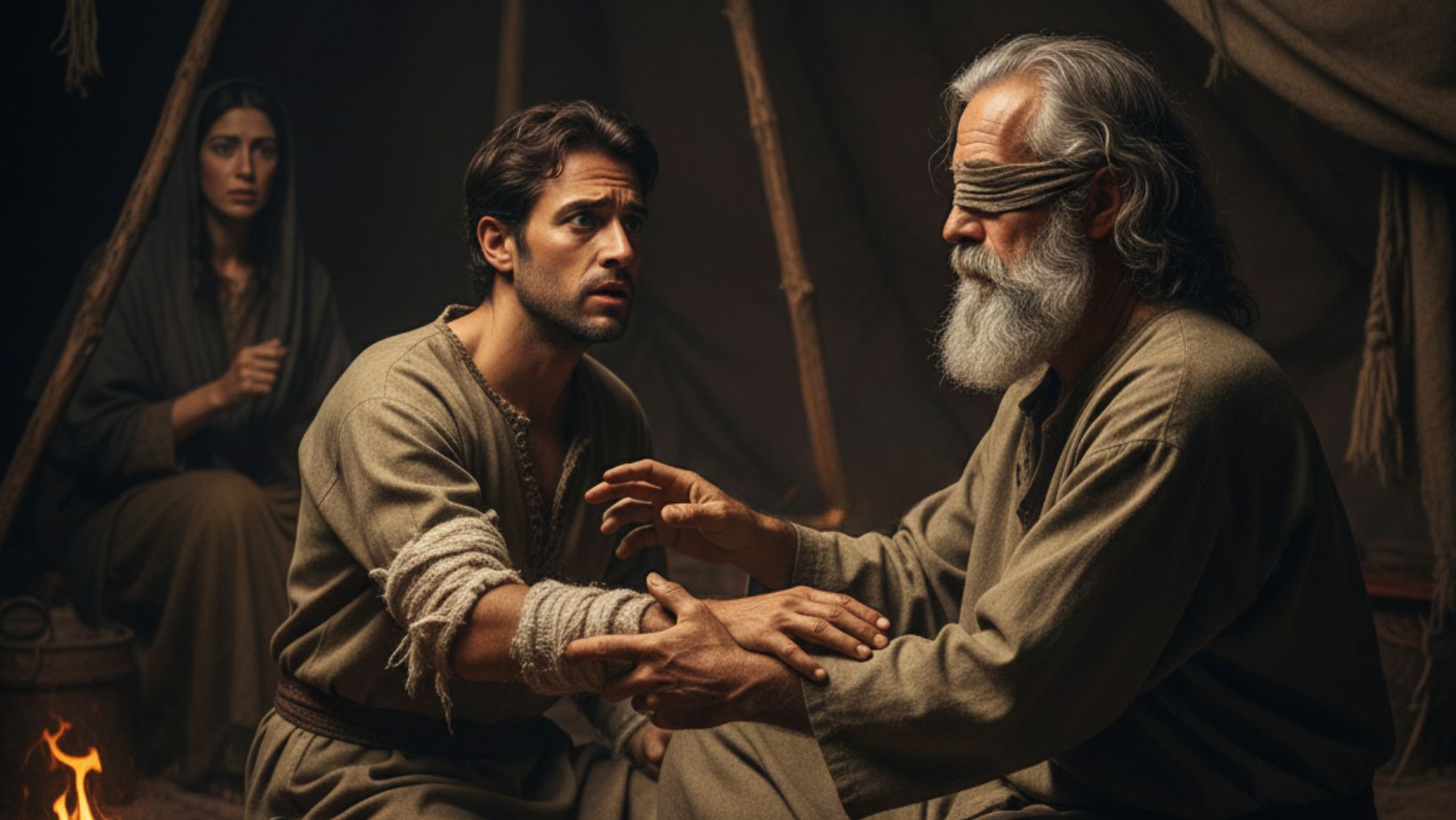
Summary of Genesis 27 Genesis 27 is a dramatic narrative of deception, family dysfunction, and the sovereign purposes of God working through flawed human actions. It details how Jacob, instigated by his mother Rebekah, steals the patriarchal blessing intended for his older twin, Esau. This event cements the split between the two brothers, fulfilling the prophecy given at their birth (“the older will serve the younger”), but it does so through painful betrayal that fractures the family forever. The chapter serves as a warning against favoritism and deceit while affirming that God’s election stands regardless of human scheming.
1. Isaac’s Plan (Genesis 27:1–4 NLT)
1 One day when Isaac was old and turning blind, he called for Esau, his older son, and said, “My son.” “Yes, Father?” Esau replied. 2 “I am an old man now,” Isaac said, “and I don’t know when I may die. 3 Take your bow and a quiver full of arrows, and go out into the open country to hunt some wild game for me. 4 Prepare my favorite dish, and bring it here for me to eat. Then I will pronounce the blessing that belongs to you, the firstborn, before I die.”
Commentary:
- Isaac’s Physical State (v. 1): Isaac is old (approx. 137 years) and blind. Blindness here is both physical and spiritual—he is blind to God’s oracle that the older should serve the younger.
- The Secret Plan (v. 4): Blessings were typically public events. Isaac attempts to bless Esau privately, likely knowing that Rebekah and God preferred Jacob. He is driven by his appetite (“my favorite dish”) rather than spiritual discernment.
- The Blessing: This was more than a well-wish; it was a prophetic, irrevocable transfer of authority and the Abrahamic Covenant.
2. The Deception (Genesis 27:5–29 NLT)
5 But Rebekah overheard what Isaac had said to his son Esau. So when Esau left to hunt for the wild game, 6 she said to her son Jacob, “Listen. I overheard your father say to Esau, 7 ‘Bring me some wild game and prepare me a delicious meal. Then I will eat it and bless you in the presence of the Lord before I die.’ 8 Now, my son, listen to me. Do exactly as I tell you. 9 Go out to the flocks, and bring me two fine young goats. I’ll use them to prepare your father’s favorite dish. 10 Then take the food to your father so he can eat it and bless you before he dies.” 11 “But look,” Jacob replied to Rebekah, “my brother, Esau, is a hairy man, and my skin is smooth. 12 What if my father touches me? He’ll see that I’m trying to trick him, and then he’ll curse me instead of blessing me.” 13 But his mother replied, “Then let the curse fall on me, my son! Just do what I tell you. Go and get the goats for me!” 14 So Jacob went out and got the young goats for his mother. Rebekah took them and prepared a delicious meal, just the way Isaac liked it. 15 Then she took Esau’s favorite clothes, which were there in the house, and asked her younger son, Jacob, to put them on. 16 She covered his arms and the smooth part of his neck with the skin of the young goats. 17 Then she gave Jacob the delicious meal, including freshly baked bread. 18 So Jacob went to his father. “Father?” he said. “Yes, my son,” Isaac answered. “Who are you—Esau or Jacob?” 19 Jacob replied, “It’s Esau, your firstborn son. I’ve done as you told me. Here is the wild game. Now sit up and eat it so you can give me your blessing.” 20 Isaac asked, “How did you find it so quickly, my son?” “The Lord your God put it in my path!” Jacob replied. 21 Then Isaac said to Jacob, “Come closer so I can touch you. Are you really Esau or not?” 22 So Jacob went over to his father, Isaac, who felt him and said, “The voice is Jacob’s voice, but the hands are Esau’s hands.” 23 He did not recognize Jacob, because Jacob’s hands felt hairy just like Esau’s. So Isaac prepared to bless him. 24 “But are you really my son Esau?” he asked. “Yes, I am,” Jacob replied. 25 Then Isaac said, “Now, my son, bring me the wild game. Let me eat it, and then I will give you my blessing.” So Jacob took the food over to his father, and Isaac ate it. He also drank the wine that Jacob served him. 26 Then his father, Isaac, said to him, “Come here, my son, and kiss me.” 27 So Jacob went over and kissed him. And when Isaac caught the smell of his clothes, he was finally convinced, and he blessed his son. He said, “Ah! The smell of my son is like the smell of the outdoors, which the Lord has blessed! 28 “From the dew of heaven and the richness of the earth, may God always give you abundant harvests of grain and bountiful new wine. 29 May many nations become your servants, and may they bow down to you. May you be the master over your brothers, and may your mother’s sons bow down to you. All who curse you will be cursed, and all who bless you will be blessed.”
Commentary:
- Rebekah’s Scheme (v. 6-10): Rebekah acts as the mastermind. She believes the end (Jacob receiving the blessing God promised) justifies the means (lying to her husband).
- Jacob’s Hesitation (v. 11-12): Jacob objects, but not on moral grounds. He is afraid of getting caught (“What if my father touches me?”). He is a pragmatist, not a saint.
- The Costly Vow (v. 13): Rebekah says, “Let the curse fall on me.” This is tragic irony; she will never see Jacob again after this chapter. She pays a high price for her manipulation.
- The Disguise (v. 15-16): Wearing Esau’s clothes provided the smell; goat skins provided the texture. It was a sensory deception relying on Isaac’s failing sight but utilizing his touch and smell.
- The Blasphemous Lie (v. 20): When asked how he hunted so fast, Jacob claims, “The Lord your God put it in my path.” Using God’s name to cover a lie is the depth of his depravity here.
- The Blessing Given (v. 28-29):
- Prosperity: “Dew of heaven… grain and wine.”
- Dominion: “Master over your brothers.” This confirms the prophecy of Gen 25:23 (“older shall serve younger”).
- Covenant Protection: “All who curse you will be cursed…” (Echoing Gen 12:3).
3. Esau’s Return and Grief (Genesis 27:30–40 NLT)
30 As soon as Isaac had finished blessing Jacob, and almost before Jacob had left his father, Esau returned from his hunt. 31 Esau prepared a delicious meal and brought it to his father. Then he said, “Sit up, my father, and eat my wild game so you can give me your blessing.” 32 But Isaac asked him, “Who are you?” “It’s Esau, your firstborn son,” he replied. 33 Isaac began to tremble uncontrollably and said, “Then who just served me wild game? I have already eaten it, and I blessed him just before you came. And yes, that blessing must stand!” 34 When Esau heard his father’s words, he let out a loud and bitter cry. “Oh my father, what about me? Bless me, too!” he begged. 35 But Isaac said, “Your brother was here, and he tricked me. He has taken away your blessing.” 36 Esau exclaimed, “No wonder his name is Jacob, for now he has cheated me twice. First he took my rights as the firstborn, and now he has stolen my blessing. Oh, haven’t you saved even one blessing for me?” 37 Isaac said to Esau, “I have made Jacob your master and have declared that all his brothers will be his servants. I have guaranteed him an abundance of grain and wine—what is left for me to give you, my son?” 38 Esau pleaded, “But do you have only one blessing? Oh my father, bless me, too!” Then Esau broke down and wept. 39 Finally, his father, Isaac, said to him, “You will live away from the richness of the earth, and away from the dew of the heaven above. 40 You will live by your sword, and you will serve your brother. But when you decide to break free, you will shake his yoke from your neck.”
Commentary:
- Isaac’s Trembling (v. 33): Isaac trembles “uncontrollably.” This is the moment of realization. He understands that despite his best efforts to thwart God’s will and bless Esau, God has overruled him. He affirms, “Yes, that blessing must stand!” He submits to God’s sovereignty.
- Esau’s Sorrow (v. 34): Esau’s “loud and bitter cry” is one of the most tragic sounds in Scripture. Hebrews 12:17 notes that he sought the blessing with tears but could not reverse the situation. He regrets the consequence, not the sin of selling his birthright earlier.
- Jacob’s Name (v. 36): Esau connects the dots: Jacob (Heel-grabber/Deceiver) has lived up to his name twice.
- The Anti-Blessing (v. 39-40): Isaac has no spiritual capital left to give. He pronounces a future that sounds like a curse:
4. The Aftermath: Hatred and Flight (Genesis 27:41–46 NLT)
41 From that time on, Esau hated Jacob because their father had given him the blessing. And Esau began to scheme: “I will soon be mourning my father’s death. Then I will kill my brother, Jacob.” 42 But Rebekah heard about Esau’s plans. So she sent for Jacob and told him, “Listen, Esau is consoling himself by plotting to kill you. 43 So listen to me, my son. Get away at once to my brother, Laban, in Haran. 44 Stay there with him for a while until your brother’s fury cools down. 45 When he forgets what you have done to him, I will send for you and bring you back. Why should I lose both of you in one day?” 46 Then Rebekah said to Isaac, “I’m sick and tired of these local Hittite women! I would rather die than see Jacob marry one of them.”
Commentary:
- Fratricidal Intent (v. 41): The family conflict escalates to potential murder. Esau plans to wait until Isaac dies to kill Jacob (Cain and Abel redux).
- Rebekah’s Solution (v. 43): Once again, Rebekah takes charge. She plans a “short” exile (“a while”) to Haran.
- Tragedy: She thinks it will be a few weeks or months. It turns into 20 years. She likely dies before Jacob returns.
- The Pretext (v. 46): Rebekah manipulates Isaac again, framing Jacob’s departure as a quest for a godly wife (avoiding Hittite women) rather than a flight from murder. This ensures Isaac blesses the journey.
Theological Significance of Genesis 27
- Sovereignty vs. Human Will: Isaac tried to bless Esau; Esau tried to get the blessing; Rebekah and Jacob used lies. Yet, in the end, God’s specific will (prophesied in Gen 25:23) was accomplished. God can draw straight lines with crooked sticks.
- The Failure of Flesh: Every character acts in the flesh. Isaac (appetite), Esau (bitterness), Rebekah (manipulation), Jacob (deceit). No one is the “hero” here; only God’s purpose prevails.
- The Irrevocability of Blessing: In the ancient world, the spoken word, once released, had objective power. This points to the power of God’s Word—once spoken, it achieves its purpose (Isaiah 55:11).
Practical Applications
- The Destructiveness of Favoritism: This chapter is a case study on how parental favoritism can destroy sibling relationships and family unity for generations.
- Letting God Do His Work: Rebekah and Jacob didn’t trust God to fulfill His promise in His own way. We often resort to manipulation when we think God is moving too slowly, creating messes we have to live with.
- Sin Has Consequences: Jacob got the blessing, but the cost was high: he had to flee his home, never saw his mother again, and spent the next 20 years being deceived by his uncle Laban. You reap what you sow.
- Repentance vs. Regret: Esau wept because he lost the blessing, not because he valued the spiritual birthright. We must distinguish between being sorry for getting caught/losing out and being truly repentant before God.
Possible Sermon Titles
- The Stolen Blessing.
- When God’s Will Meets Human Scheming.
- The Dysfunctional Family of Faith.
- Appetite vs. Anointing.
- The Great Deception.
- Jacob: The Man Who Fought for the Wrong Things.







Leave a Reply