
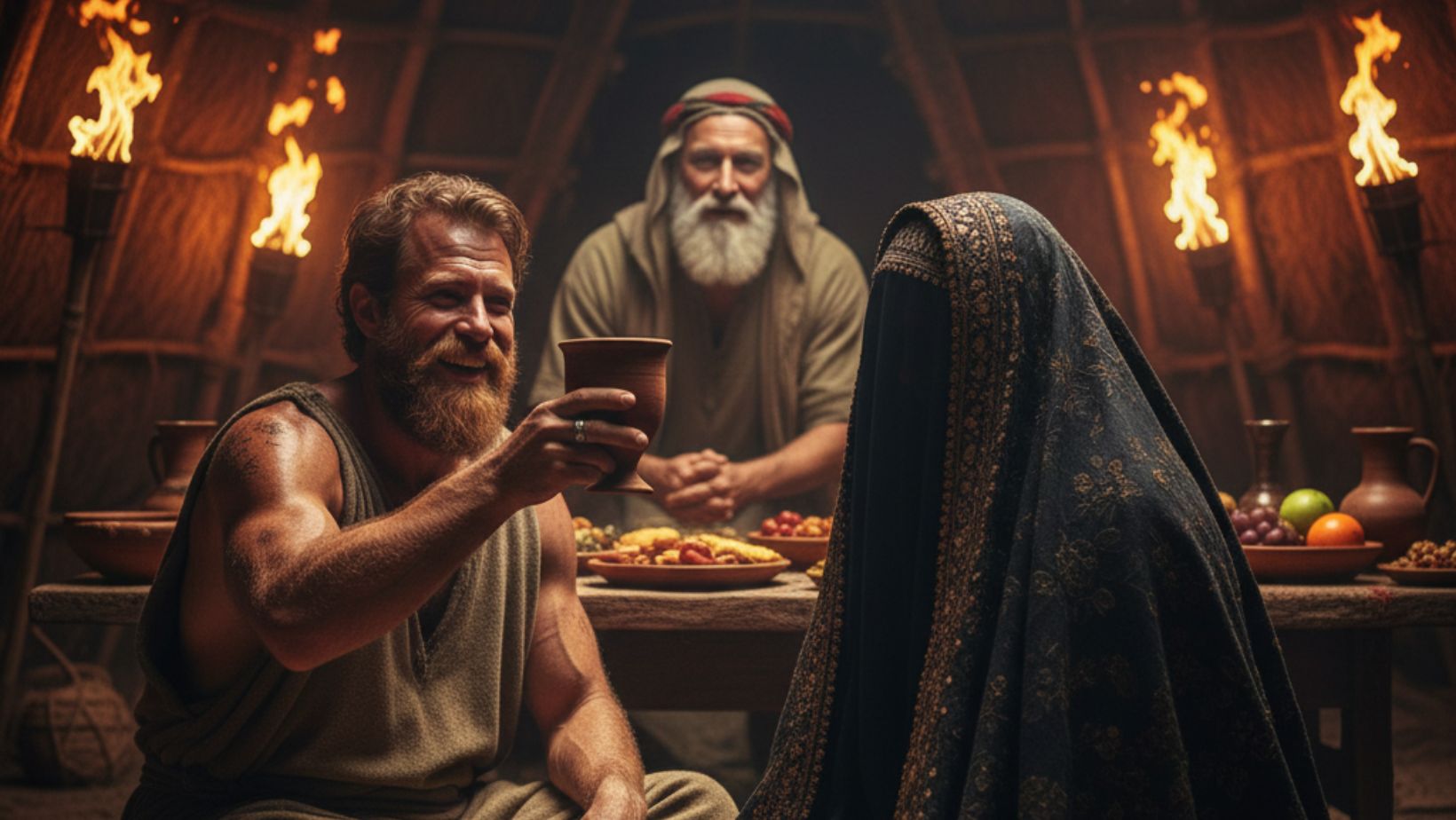
Genesis 29 records the next phase of Jacob’s exile, where the deceiver becomes the deceived. Arriving in Paddan-aram (Haran), Jacob meets his extended family and falls in love with Rachel. However, he meets his match in his uncle Laban, a master manipulator. After working seven years for Rachel, Jacob is tricked into marrying her older sister, Leah. This chapter establishes the messy, polygamous family structure that will birth the twelve tribes of Israel. It highlights the theme of divine discipline—Jacob reaps what he sowed—while also showcasing God’s grace in building the nation of Israel through the unloved wife, Leah.
1. Jacob Arrives and Meets Rachel (Genesis 29:1–14 NLT)
1 Then Jacob hurried on, finally arriving in the land of the East. 2 He saw a well in the distance and three flocks of sheep and goats lying in an open field beside it, waiting to be watered. But a heavy stone covered the mouth of the well. 3 It was the custom there to wait for all the flocks to arrive before removing the stone and watering the animals. Afterward the stone would be replaced. 4 Jacob went over to the shepherds and asked, “Where are you from, my friends?” “We are from Haran,” they answered. 5 “Do you know a man there named Laban, the grandson of Nahor?” he asked. “Yes, we do,” they replied. 6 “Is he doing well?” Jacob asked. “Yes, he’s well,” they answered. “Look, here comes his daughter Rachel with the flock now.” 7 Jacob said, “Look, it’s still broad daylight—too early to round up the animals. Why don’t you water the sheep and goats so they can get back to grazing?” 8 “We can’t,” they replied. “We have to wait until all the flocks make it here. Then we can roll the stone from the mouth of the well and water the sheep.” 9 While he was still talking with them, Rachel arrived with her father’s flock, for she was a shepherd. 10 And because Rachel was his cousin—the daughter of Laban, his mother’s brother—and because the sheep and goats belonged to his uncle Laban, Jacob went over to the well and rolled the stone from its mouth and watered his uncle’s flock. 11 Then Jacob kissed Rachel, and he wept aloud. 12 He explained to Rachel that he was her cousin on her father’s side—the son of her aunt Rebekah. So Rachel ran and told her father. 13 As soon as Laban heard that his nephew Jacob had arrived, he ran out to meet him. He embraced and kissed him and brought him home. When Jacob had told him his story, 14 Laban exclaimed, “You really are my own flesh and blood!” And Jacob stayed there for the next month.
Commentary:
- Providence at the Well (v. 1-6): Just as Abraham’s servant found Rebekah at a well (Gen 24), Jacob finds Rachel at a well. It is a “type-scene” for betrothal in the Bible. God guides Jacob to the exact location and time to meet his future bride.
- The Stone (v. 2-3): The “heavy stone” required multiple men to move. This detail sets up Jacob’s feat of strength.
- Jacob’s Strength (v. 10): Upon seeing Rachel, Jacob rolls the stone away by himself. This “superhuman” feat is driven by adrenaline and the desire to impress. It mirrors Moses helping Zipporah at a well (Exodus 2).
- The Kiss and Tears (v. 11): Jacob kisses Rachel (a greeting of kinship) and weeps aloud. The tears likely stem from the relief of a long, lonely journey ending and the realization that God has fulfilled the promise to bring him to his mother’s people.
- Laban’s Welcome (v. 13-14): Laban runs to meet Jacob, just as he ran to meet the servant with gold bracelets in Genesis 24. However, Jacob arrives empty-handed (unlike the servant). Laban’s hospitality (“my own flesh and blood”) may be genuine initially, but his exploiting nature soon surfaces.
2. The Deceiver Deceived: Leah for Rachel (Genesis 29:15–30 NLT)
15 Later Laban said to him, “You shouldn’t work for me without pay just because we are relatives. Tell me how much your wages should be.” 16 Now Laban had two daughters. The older one was named Leah, and the younger one was Rachel. 17 There was no sparkle in Leah’s eyes, but Rachel had a beautiful figure and a lovely face. 18 Since Jacob was in love with Rachel, he told her father, “I’ll work for you for seven years if you’ll give me Rachel, your younger daughter, as my wife.” 19 “Agreed!” Laban replied. “I’d rather give her to you than to anyone else. Stay and work with me.” 20 So Jacob worked seven years to pay for Rachel. But his love for her was so strong that it seemed to him but a few days. 21 Finally, the time came for him to marry her. “I have fulfilled my agreement,” Jacob said to Laban. “Now give me my wife so I can sleep with her.” 22 So Laban invited everyone in the neighborhood and prepared a wedding feast. 23 But that night, when it was dark, Laban took Leah to Jacob, and he slept with her. 24 (Laban had given Leah a servant, Zilpah, to be her maid.) 25 But when Jacob woke up in the morning—it was Leah! “What have you done to me?” Jacob raged at Laban. “I worked seven years for Rachel! Why have you tricked me?” 26 “It’s not our custom here to marry off a younger daughter ahead of the firstborn,” Laban replied. 27 “But wait until the bridal week is over, then we’ll give you Rachel, too—provided you promise to work another seven years for me.” 28 So Jacob agreed to work seven more years. A week after Jacob married Leah, Laban gave him Rachel, too. 29 (Laban gave Rachel a servant, Bilhah, to be her maid.) 30 So Jacob slept with Rachel, too, and he loved her much more than Leah. He then stayed and worked for Laban the additional seven years.
Commentary:
- The Wage Negotiation (v. 15): Jacob has no bride price (dowry) to offer. He offers labor instead—seven years of his life. This is an exorbitant price (the Code of Hammurabi suggests far less for a laborer), showing his desperation and love.
- Leah vs. Rachel (v. 17):
- Seven Years as a Few Days (v. 20): One of the most romantic verses in Scripture. The toil was heavy, but love made it light.
- The Great Switch (v. 23): “When it was dark.” Laban brings the veiled bride. Jacob, likely feasting and drinking (v. 22), consummates the marriage, making it legally binding.
- Morning Revelation (v. 25): “When Jacob woke up in the morning—it was Leah!”
- Divine Irony: Jacob, the younger brother who pretended to be the older (Esau) to deceive his blind father, is now deceived by a father-figure into taking the older sister instead of the younger. The deceiver gets a taste of his own medicine.
- “Why have you tricked me?”: Jacob uses the same word for “treachery” or “deceit” that Isaac used about him (Gen 27:35).
- Laban’s Excuse (v. 26): “Not our custom… to marry younger ahead of firstborn.” Laban uses custom to justify manipulation. He traps Jacob into another seven years of labor.
- Polygamy (v. 28): Jacob marries two sisters within a week. This violates later Mosaic Law (Leviticus 18:18), but was permitted here. It sets the stage for intense rivalry.
3. God Sees the Unloved: The Birth of Sons (Genesis 29:31–35 NLT)
31 When the Lord saw that Leah was unloved, he enabled her to have children, but Rachel could not conceive. 32 So Leah became pregnant and gave birth to a son. She named him Reuben, for she said, “The Lord has noticed my misery, and now my husband will love me.” 33 She soon became pregnant again and gave birth to another son. She named him Simeon, for she said, “The Lord heard that I was unloved and has given me another son.” 34 Then she became pregnant a third time and gave birth to another son. He was named Levi, for she said, “Surely this time my husband will feel affection for me, since I have given him three sons!” 35 Once again she became pregnant and gave birth to another son. She named him Judah, for she said, “This time I will praise the Lord!” And then she stopped having children.
Commentary:
- God’s Intervention (v. 31): “The Lord saw that Leah was unloved.” The Hebrew word is senuah (hated). Jacob didn’t just love her less; he resented her role in the deception. God balances the scales: Rachel has beauty and love; Leah has fruitfulness.
- The Naming of the Sons: Leah’s names for her sons are heartbreaking prayers for her husband’s affection.
- The Shift in Judah (v. 35): With the fourth son, Leah’s focus shifts. She stops mentioning her husband and focuses entirely on God. “This time I will praise the Lord.”
Theological Significance of Genesis 29
- Retributive Justice (Lex Talionis): Jacob deceived his father using goat skins and clothing; he is deceived by Laban using a veil and darkness. God uses Laban to discipline Jacob, refining his character through the very tactics he used on others.
- God’s Sovereignty in Rejection: Humanly, Leah was the “wrong” wife. She was unwanted and unloved. Yet, God chose Leah to be the mother of the Priesthood (Levi) and the Kingship (Judah). God often builds His kingdom through those the world rejects (1 Corinthians 1:27).
- The School of Patience: Jacob, who grabbed the heel and the birthright impatiently, is forced to wait 14 years. God uses delays to mature us.
Practical Applications
- Reaping What We Sow: We cannot escape the consequences of our character flaws. If we are deceptive, we often attract deception.
- Work as Worship: Jacob’s love made hard labor feel light. When we are motivated by love (for family or for God), the burden of service becomes bearable.
- Finding Worth in God: Leah’s journey from “Maybe my husband will love me” to “I will praise the Lord” is a model for anyone seeking validation. Human relationships often fail to satisfy the deepest ache of the soul; only God can fill that void.
- God’s Eye on the Outcast: If you feel “unloved” or second-best (like Leah), know that God sees you specifically and has a purpose for you that might exceed the “favored” ones.
Possible Sermon Titles
- The Deceiver Deceived.
- The Morning After: When You Don’t Get What You Expected.
- Leah’s Song: From Rejection to Praise.
- Seven Years for Love.
- God of the Unloved Wife.
- The Discipline of Grace.







Leave a Reply