
Genesis 30 is a chaotic chapter dominated by intense rivalry and biological warfare. It details the expansion of Jacob’s family from four children to twelve (eleven sons and one daughter) through a bitter contest between his wives, Leah and Rachel, and their servants. The narrative is driven by jealousy, bargaining, and the desperate desire for validation through offspring. The second half of the chapter shifts to economics, describing the “battle of wits” between Jacob and Laban. Through a mix of ancient husbandry techniques and divine blessing, Jacob outmaneuvers his exploitative father-in-law, transferring the wealth of Laban to himself.
1. The Battle of the Brides: Bilhah and Zilpah (Genesis 30:1–13 NLT)
1 When Rachel saw that she wasn’t having any children for Jacob, she became jealous of her sister. She pleaded with Jacob, “Give me children, or I’ll die!” 2 Then Jacob became furious with Rachel. “Am I God?” he asked. “He is the one who has kept you from having children!” 3 Then Rachel told him, “Take my maid, Bilhah, and sleep with her. She will bear children for me, and through her I can have a family, too.” 4 So Rachel gave her servant, Bilhah, to Jacob as a wife, and he slept with her. 5 Bilhah became pregnant and presented him with a son. 6 Rachel named him Dan, for she said, “God has vindicated me! He has heard my request and given me a son.” 7 Then Bilhah became pregnant a second time and gave Jacob another son. 8 Rachel named him Naphtali, for she said, “I have struggled hard with my sister, and I’m winning!” 9 Meanwhile, Leah realized that she had stopped having children, so she took her servant, Zilpah, and gave her to Jacob as a wife. 10 Soon Zilpah presented him with a son. 11 Leah named him Gad, for she said, “How fortunate I am!” 12 Then Zilpah gave Jacob a second son. 13 And Leah named him Asher, for she said, “What joy is mine! Now the other women will celebrate with me.”
Commentary:
- Rachel’s Desperation (v. 1): “Give me children, or I’ll die!” In the ancient Near East, a woman’s worth was often tied exclusively to fertility. Rachel prefers death to barrenness.
- Jacob’s Anger (v. 2): Jacob snaps. Unlike his father Isaac, who prayed for his barren wife (Gen 25:21), Jacob responds with frustration. He correctly identifies that life is God’s prerogative (“Am I God?”), but lacks compassion.
- Surrogacy Strategy (v. 3): Rachel uses the same legal loophole Sarah used with Hagar (Gen 16). By having the servant give birth “on her knees” (a literal or idiomatic expression of adoption), the child legally belongs to the mistress.
- The Names of Conflict:
- Leah’s Retaliation (v. 9): Leah already had four sons, but seeing Rachel “catch up” (even through a proxy), she re-enters the race using her own servant, Zilpah.
2. The Mandrakes and Leah’s Victory (Genesis 30:14–24 NLT)
14 One day during the wheat harvest, Reuben found some mandrakes growing in a field and brought them to his mother, Leah. Rachel begged Leah, “Please give me some of your son’s mandrakes.” 15 But Leah replied, “Wasn’t it enough that you stole my husband? Now will you steal my son’s mandrakes, too?” Rachel answered, “I will let Jacob sleep with you tonight if you give me some of the mandrakes.” 16 That evening as Jacob was coming home from the fields, Leah went out to meet him. “You must come and sleep with me tonight!” she said. “I have paid for you with some mandrakes that my son found.” So he slept with her that night. 17 And God answered Leah’s prayers. She became pregnant and gave birth to a fifth son for Jacob. 18 She named him Issachar, for she said, “God has rewarded me for giving my servant to my husband.” 19 Then Leah became pregnant again and gave birth to a sixth son for Jacob. 20 She named him Zebulun, for she said, “God has given me a good reward. Now my husband will treat me with respect, for I have given him six sons.” 21 Later she gave birth to a daughter and named her Dinah. 22 Then God remembered Rachel’s plight and answered her prayers by enabling her to have children. 23 She became pregnant and gave birth to a son. “God has removed my disgrace,” she said. 24 And she named him Joseph, for she said, “May the Lord add yet another son to my family.”
Commentary:
- The Mandrakes (v. 14): Mandrakes (duda’im, related to the word for “love”) were believed to be powerful fertility drugs and aphrodisiacs. They look somewhat like a human torso.
- The Transaction (v. 15): The sisters bargain over Jacob as if he were a commodity. Rachel wants the “magic potion” (mandrakes) to cure her barrenness; Leah wants sexual intimacy (which Rachel apparently controlled/monopolized).
- Issachar and Zebulun (v. 18-20):
- Dinah (v. 21): The only daughter named in the genealogy, likely because of her critical role in the narrative of Genesis 34.
- God Remembers Rachel (v. 22): After years of “struggle” and reliance on schemes (servants, mandrakes), God acts.
- Joseph (v. 24): His name is a double play on words: Asaph (to take away disgrace) and Yasaph (to add). Rachel is not satisfied; her prayer is immediately “May the Lord add another.”
3. The New Contract: Speckled and Spotted (Genesis 30:25–36 NLT)
25 Soon after Rachel had given birth to Joseph, Jacob said to Laban, “Please release me so I can go home to my own country. 26 Let me take my wives and children, for whom I have served you, and let me be on my way. You surely know how hard I have worked for you.” 27 “Please listen to me,” Laban replied. “I have become wealthy, for the Lord has blessed me because of you. 28 Tell me how much I owe you. Whatever it is, I’ll pay it.”… 31 “What wages do you want?” Laban asked again. Jacob replied, “Don’t give me anything. Just do this one thing, and I’ll continue to tend and watch over your flocks. 32 Let me inspect your flocks today and remove all the sheep and goats that are speckled or spotted, along with all the black sheep. Give these to me as my wages. 33 In the future, when you check on the animals you have given me as my wages, you’ll see that I have been honest. If you find in my flock any goats without speckles or spots, or any sheep that are not black, you will know that I have stolen them from you.” 34 “All right,” Laban replied. “It will be as you say.” 35 But that very day Laban went out and removed the male goats that were streaked and spotted, all the female goats that were speckled and spotted or had white patches, and all the black sheep. He placed them in the care of his own sons, 36 who took them a three-days’ journey from where Jacob was. Meanwhile, Jacob stayed and cared for the rest of Laban’s flock.
Commentary:
- Jacob’s Value (v. 27): Laban admits he learned by “divination” (omens) that Jacob is a lucky charm. He doesn’t want to lose his cash cow.
- The Deal (v. 32): In the Middle East, sheep are typically white and goats are typically black/brown. Spotted or speckled animals are rare recessive genetic anomalies.
- Laban’s Treachery (v. 35): Laban immediately removes all the existing speckled/spotted animals and hides them three days away. He ensures Jacob starts with zero breeding stock of the requested color. Jacob has to breed speckled sheep from pure white ones.
4. Jacob’s Breeding Strategy (Genesis 30:37–43 NLT)
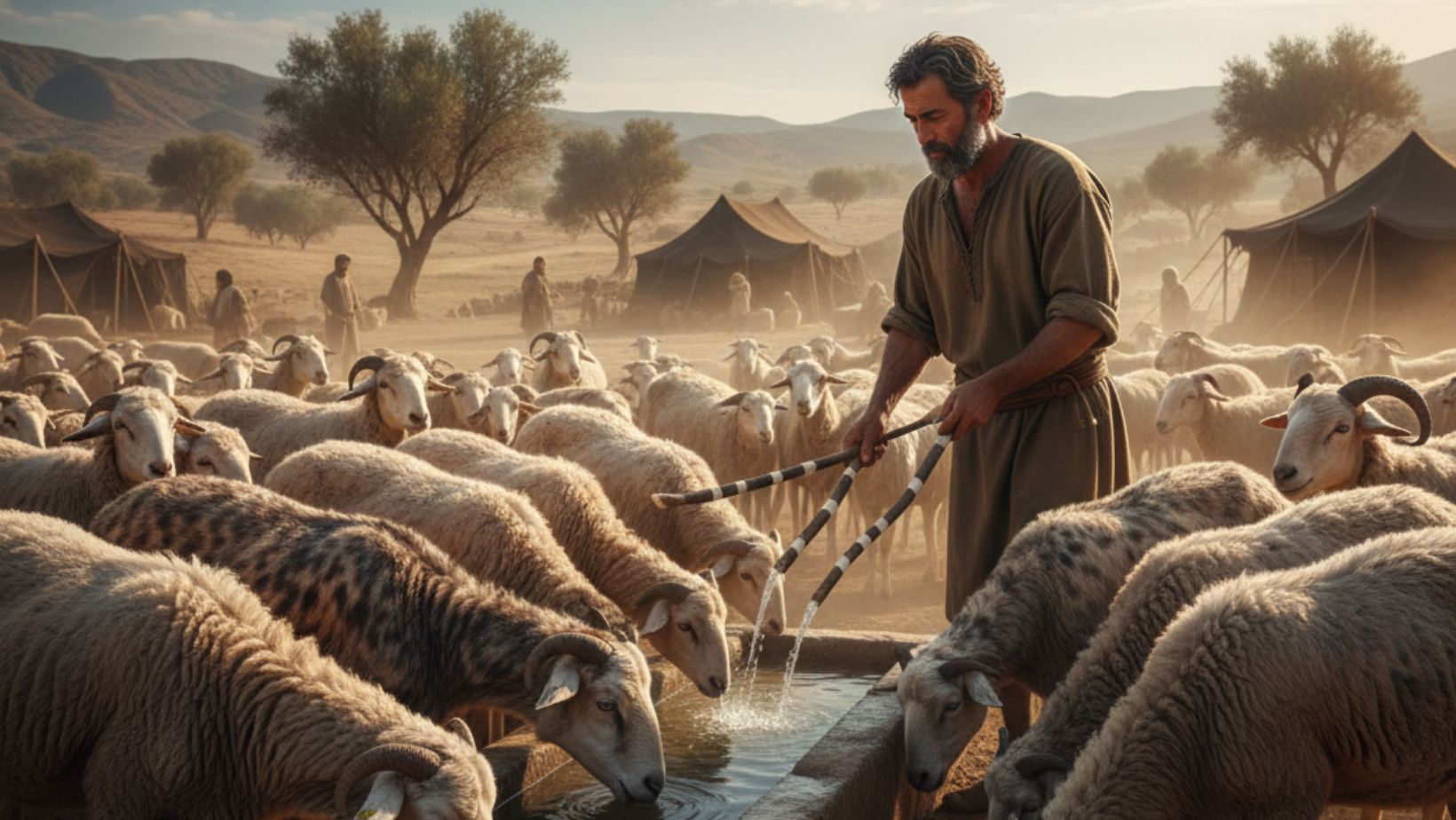
37 Then Jacob took some fresh branches from poplar, almond, and plane trees and peeled off strips of bark, making white streaks on them. 38 Then he placed these peeled branches in the watering troughs where the flocks came to drink, for that was where they mated. 39 And when they mated in front of the white-streaked branches, they gave birth to young that were streaked, speckled, and spotted. 40 Jacob separated those lambs from Laban’s flock. And at mating time he turned the flock to face Laban’s animals that were streaked or black. This is how he built his own flock instead of increasing Laban’s. 41 Whenever the stronger females were ready to mate, Jacob would place the peeled branches in the watering troughs in front of them. Then they would mate in front of the branches. 42 But he didn’t do this for the weaker ones. So the weaker lambs belonged to Laban, and the stronger ones were Jacob’s. 43 As a result, Jacob became very wealthy, with large flocks of sheep and goats, female and male servants, and many camels and donkeys.
Commentary:
- The Peeled Rods (v. 37): Jacob peels bark to expose the white wood, creating a striped pattern.
- Prenatal Influence (v. 38-39): This reflects an ancient belief (maternal impression) that what a mother sees during conception influences the offspring’s appearance. Jacob believed the visual pattern of the sticks would cause the sheep to bear striped lambs.
- Selective Breeding (v. 41-42): While the sticks were likely superstition (or a visual aid for faith), Jacob also used sound science: he bred the strong animals for himself and left the weak ones for Laban.
- Divine Intervention: While the text here describes Jacob’s actions, Genesis 31:10-12 later reveals that God spoke to Jacob in a dream, showing him that the genetic reality (the male goats leaping) was controlled by God, not the sticks. God overruled Laban’s cheating.
- The Transfer of Wealth (v. 43): The chapter ends with Jacob possessing the substance of the Covenant blessing: massive wealth. He has effectively plundered Laban, setting the stage for his flight in the next chapter.
Theological Significance of Genesis 30
- God Works Through Messy Families: The twelve tribes of Israel—the foundation of God’s people—were born out of jealousy, competition, and mandrake-trading. This proves that God’s election is not based on the moral superiority of the parents but on His sovereign grace.
- Prayer vs. Magic: Rachel relied on mandrakes (magic) and got nothing. Leah and Rachel eventually prayed (v. 17, v. 22), and God answered. The text subtly critiques superstition (mandrakes/peeled rods) while affirming God as the true source of life and wealth.
- The Underdog Wins: In both the baby war (unloved Leah has the most sons) and the sheep war (cheated Jacob gets the most flocks), God sides with the disadvantaged party against the arrogant (Rachel/Laban).
Practical Applications
- Comparison Kills Contentment: Rachel had beauty and Jacob’s love, but she was miserable because she lacked children. Leah had children, but was miserable because she lacked Jacob’s love. Comparison blinded both to their own blessings.
- God Sees the Afflicted: Just as God saw Leah’s misery, He sees when we are mistreated in business (like Jacob with Laban). We can trust Him to balance the scales in His time.
- Integrity in Business: Jacob honored his contract (v. 33) even when Laban changed the wages ten times (Gen 31:7). Christians are called to work with excellence even for difficult bosses, trusting God for promotion.
- Desperate Prayer: Rachel’s cry “Give me children or I die” was raw and desperate. While her attitude was flawed, her intensity reminds us to bring our deepest unfulfilled longings to God—though we should say, “Lord, give me this, but Your will be done.”
Possible Sermon Titles
- The War of the Wombs.
- Mandrakes, Jealousy, and the Grace of God.
- When You Get What You Want but Are Still Empty.
- Spotted Sheep and Peeled Sticks: God’s Economy.
- The Dysfunction that Built a Nation.
- Outsmarting the Manipulator.







Leave a Reply