
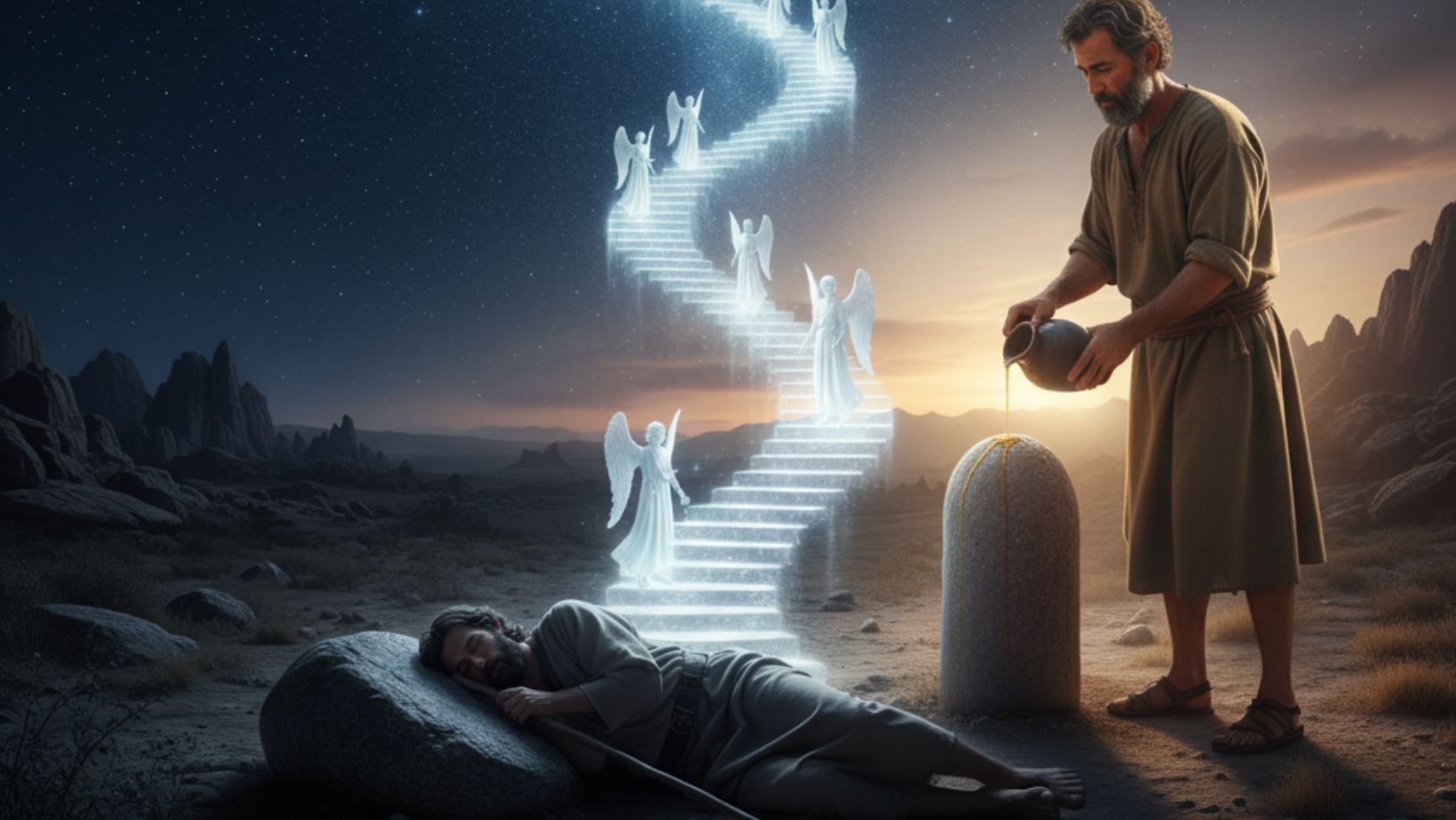
Genesis 28 captures one of the most famous turning points in the Bible. Jacob is a man on the run, fleeing from the consequences of his own deception. Exhausted and alone in the wilderness, he uses a stone for a pillow, only to encounter the living God in a dream. This story shows how God meets us in our lowest moments, transforming a place of isolation into a portal of divine revelation.
Main Scripture: Genesis 28
“Early the next morning Jacob took the stone he had placed under his head and set it up as a pillar and poured oil on top of it.” — Genesis 28:18 (NIV)
Introduction
Jacob’s journey from a “pillow” to a “pillar” represents the transition from a life of survival to a life of worship. When Jacob lay down, he was a fugitive with nothing but a rock for comfort. When he stood up, he was a man with a vision and a covenant. This passage teaches us that the hard places in our lives—the “stones” that cause us pain—are often the exact locations where God intends to build something permanent.
1. God Meets Us at Our Lowest Point
“When he reached a certain place, he stopped for the night because the sun had set. Taking one of the stones there, he put it under his head and lay down to sleep.” — Genesis 28:11
- The Unexpected Encounter: Jacob wasn’t in a temple or a church; he was in a “certain place” in the middle of nowhere when God showed up.
- The Hard Pillow: The stone represents the discomfort and hardship of our current trials; God often uses our seasons of lack to get our undivided attention.
- Sovereign Timing: God didn’t wait for Jacob to fix his life or apologize to Esau before appearing to him; He met him right in the middle of his mess.
2. The Open Heaven Over a Closed Door
“He had a dream in which he saw a stairway resting on the earth, with its top reaching to heaven, and the angels of God were ascending and descending on it.” — Genesis 28:12
- Divine Connection: The ladder (or stairway) proves that Heaven is never out of reach, even when we feel abandoned by everyone on earth.
- Angelic Activity: The movement of angels shows that God is constantly working on our behalf, even while we are “sleeping” or unaware of His presence.
- A Bridge of Grace: This vision reveals that there is a path from our earthly struggles to God’s heavenly resources, a bridge later identified as Jesus Christ.
3. The Presence of God in Ordinary Places
“When Jacob awake from his sleep, he thought, ‘Surely the Lord is in this place, and I was not aware of it.’” — Genesis 28:16
- Spiritual Blindness: We often mistake our “wilderness” for a place of God’s absence, when it is actually the gate of His house.
- Awakening to Reality: Jacob’s fear and awe come from the realization that God had been standing over him the whole time he was complaining about his hard pillow.
- The Ordinary becomes Holy: Any place where you encounter God becomes “Bethel” (the House of God), regardless of how uncomfortable the surroundings are.
4. Turning the Hard Place Into a Holy Monument
“Early the next morning Jacob took the stone he had placed under his head and set it up as a pillar and poured oil on top of it.” — Genesis 28:18
- Consecrating the Pain: Jacob took the very stone that caused him discomfort and transformed it into a symbol of God’s faithfulness.
- The Act of Anointing: By pouring oil on the stone, Jacob shifted his focus from his own survival to God’s sanctification.
- From Temporary to Permanent: A pillow is for a night, but a pillar is for a lifetime; God wants to turn your temporary trial into a permanent testimony.
5. A Vow of Total Dependence
“Then Jacob made a vow, saying, ‘If God will be with me and will watch over me… then the Lord will be my God.’” — Genesis 28:20-21
- Responding to Revelation: Seeing the ladder was not enough; Jacob had to respond by committing his future to the God of the vision.
- The Promise of Provision: Jacob acknowledged that his food, clothing, and safety were all in God’s hands, not his own cleverness.
- The Foundation of Tithing: Jacob ended by promising to give back a tenth, signifying that the “pillar” was not just a memory, but a commitment to support God’s work.
Quick Insights
- The stone you are currently resting on may be the foundation for the greatest revelation of your life.
- God does not need a perfect environment to speak to you; He only needs a heart that has run out of its own options.
- A “Bethel” experience is when you realize that God is with you even when you didn’t feel Him or expect Him.
- Your worship should always be a response to what God has revealed, turning your history into a holy monument.







Leave a Reply