
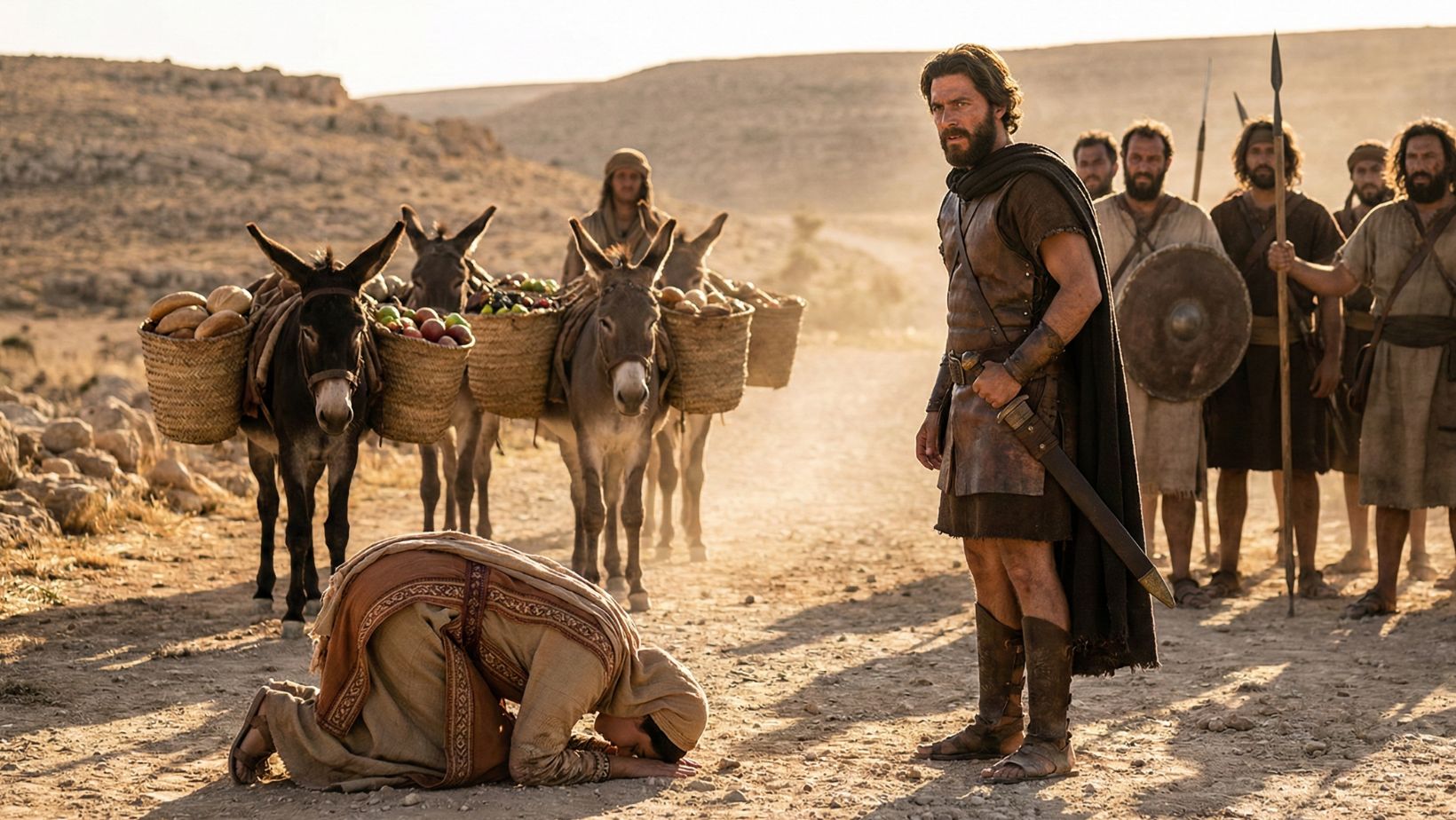
Abigail is one of the most intelligent and politically astute women in the Hebrew Bible. Known for her beauty, quick wit, and prophetic foresight, she stepped into a volatile situation to prevent a massacre and secure her future. Her story, primarily found in 1 Samuel 25, highlights her as a peacemaker and a woman of deep faith who recognized God’s hand upon David long before he took the throne. Through her courage and diplomacy, she saved her household from destruction and eventually became a queen of Israel.
QUICK FACTS
- Name: Abigail (Hebrew: Avigayil, meaning “My Father’s Joy” or “Source of Joy”)
- Tribe/Nation: Israelite (Judah)
- Era: United Monarchy / Transition from Saul to David (~11th century BCE)
- Husband: Nabal (first), later King David
- Home: Maon and Carmel (in the hill country of Judah)
- Book: 1 Samuel (Chapter 25)
- Key Virtues: Discernment, courage, diplomacy, wisdom
- Legacy: One of the seven female prophets in Jewish tradition; mother of David’s second son
- Symbol: A gift of bread and wine — symbolizing hospitality and the prevention of bloodshed
Name Meaning
Abigail is derived from the Hebrew words “Ab” (father) and “Giyal” (to rejoice). Her name suggests a person who brings joy or reflects the joy of her father. In the biblical narrative, her name stands in stark contrast to her first husband, Nabal, whose name means “fool” or “senseless.”
Lineage / Family Background
Origin: She lived in the region of Maon, located in the rugged territory of the tribe of Judah.
First Husband: Nabal the Calebite, a very wealthy but “harsh and badly behaved” man who lived in Maon and had property in Carmel.
Second Husband: David, the future King of Israel, who married her after Nabal’s death.
Child: Kileab (also known as Daniel), who was David’s second son, born in Hebron.
Biblical Era / Context
Time: The period when David was a fugitive fleeing from King Saul, leading a band of roughly 600 men in the wilderness.
Setting: The Judean wilderness during the sheep-shearing season—a traditional time of celebration, hospitality, and sharing of wealth.
Cultural Context: Hospitality was a sacred duty. Nabal’s refusal to provide for David’s men after they had protected his shepherds was a grave social and moral insult that justified military retaliation in the eyes of the culture.
Major Roles / Identity
Wise Matriarch: The manager of a wealthy household who acted decisively when its head failed.
Peacemaker: An intermediary who stepped between an angry warrior and a foolish man to prevent sin.
Prophetess: She spoke with divine insight regarding David’s future kingship and the “house” God would build for him.
Queen of Israel: One of David’s earliest wives who supported him during his years as a fugitive and his early reign in Hebron.
Key Character Traits
Discernment: She immediately understood the gravity of Nabal’s folly and the danger it posed.
Eloquence: Her speech to David is one of the longest and most sophisticated rhetorical pieces by a woman in the Old Testament.
Courage: She went to meet David’s 400 armed men without her husband’s permission or protection.
Humility: She approached David by prostrating herself, taking the blame for Nabal’s actions to de-escalate the tension.
Faith: She trusted that God would deal with her enemies and fulfill His promises to David.
Main Life Events
The Insult: Nabal insulted David’s messengers and refused to provide food, prompting David to swear to kill every male in Nabal’s household.
The Intervention: Informed by a servant, Abigail quickly prepared a massive feast and intercepted David on the mountain trail.
The Speech: She appealed to David’s conscience, urging him not to have the “staggering burden of needless bloodshed” on his hands when he became king.
The Death of Nabal: Upon hearing what Abigail had done, Nabal’s “heart failed him” and he died ten days later.
Marriage to David: Recognizing her wisdom and God’s hand in her intervention, David sent for Abigail and took her as his wife.
Captivity and Rescue: She was later captured by Amalekites at Ziklag but was rescued by David and his men.
Major Relationships
Nabal: Her first husband; their marriage represented a union of “beauty and the beast,” or wisdom and folly.
David: Her second husband; she recognized his divine anointing and became a source of counsel and stability for him.
The Servants: They trusted Abigail’s judgment over Nabal’s, going to her first when they realized the household was in danger.
God: Abigail’s speech reveals a woman who studied the moves of God and aligned her life with His providence.
Notable Passages
1 Samuel 25:3: The initial description — “She was an intelligent and beautiful woman, but her husband was surly and mean in his dealings.”
1 Samuel 25:29: Her prophetic blessing — “The life of my lord will be bound securely in the bundle of the living by the Lord your God, but the lives of your enemies he will hurl away as from the pocket of a sling.”
1 Samuel 25:32–33: David’s response — “Praise be to the Lord… who has sent you today to meet me. May you be blessed for your good judgment.”
Legacy & Impact
Abigail serves as the biblical archetype of the “Wise Woman” who uses diplomacy to solve problems that violence cannot.
She is one of the few characters in the Bible who successfully rebuked David and changed his mind, protecting his integrity as a future king.
Her life demonstrates that one can remain faithful and discerning even in an unequal or difficult domestic situation.
In Jewish tradition (the Talmud), she is ranked as one of the seven female prophets of Israel due to her insight into David’s eternal dynasty.
Symbolism / Typology
The Feast: Symbolizes the provision of Christ, who offers peace and life to those under the threat of judgment.
Intercessor: Abigail is often seen as a type of Christ or the Church, standing in the gap to turn away wrath and intercede for the “foolish.”
The Donkey: Riding to meet David, she symbolizes a humble approach that disarms the pride of the warrior.
Extra-Biblical References
Jewish Midrash: Suggests Abigail was so beautiful that she nearly caused David to stumble, but her wisdom and piety ultimately drew him to God.
Artistic History: Abigail has been a popular subject in European art (such as by Rubens and Tintoretto), often depicted as a symbol of grace and the power of the “soft answer” to turn away wrath.







Leave a Reply