
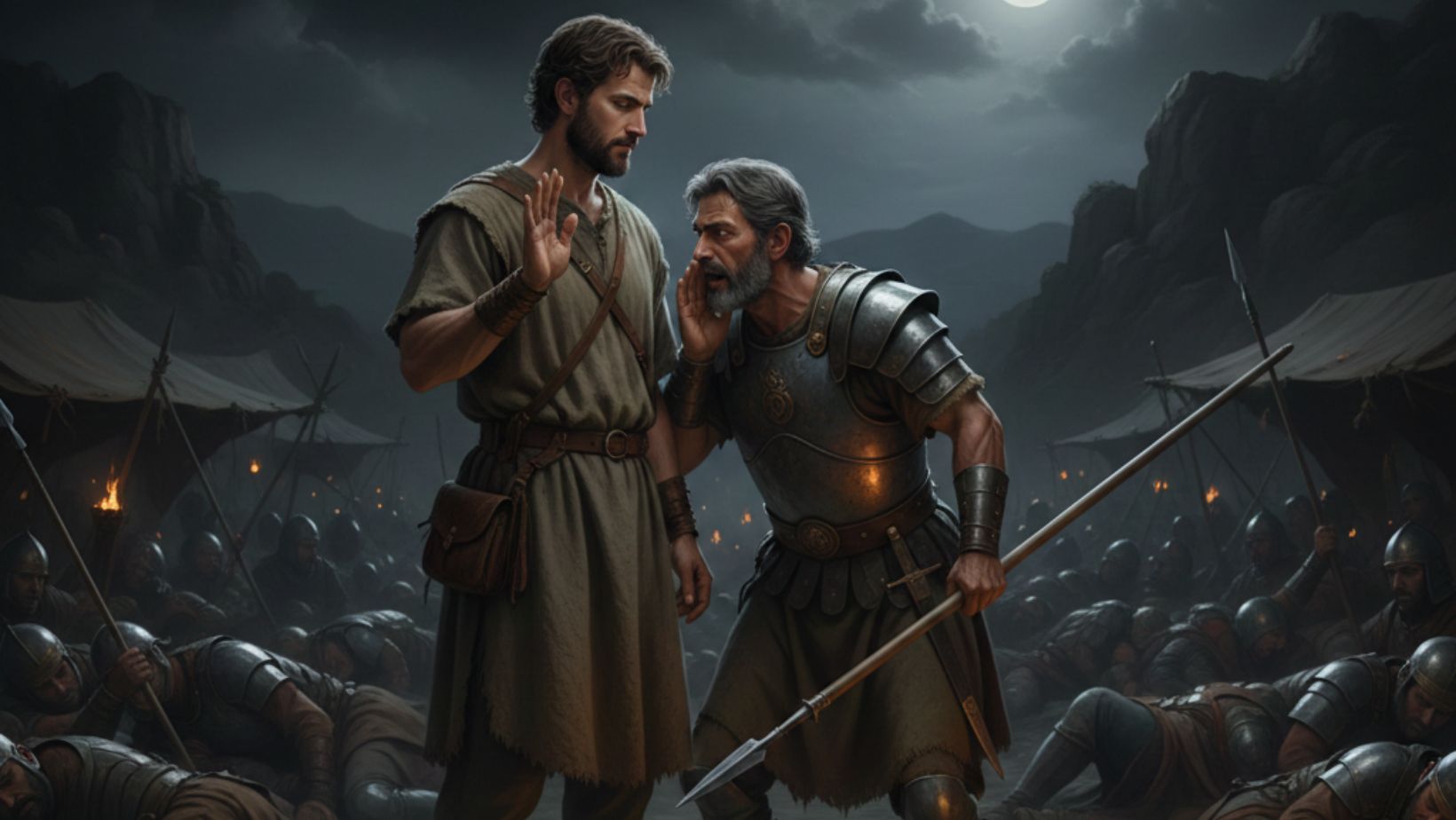
2 Samuel 26 provides a gripping encounter in the wilderness of Ziph. King Saul is hunting David, and David finds himself standing over his sleeping enemy. Beside him is Abishai, his loyal soldier, who offers a “quick fix” to David’s long-term problem. This passage serves as a warning: the greatest temptation to compromise often comes from those closest to us, framed as a “godly” opportunity.
Main Scripture: 2 Samuel 26
“Abishai said to David, ‘Today God has delivered your enemy into your hands. Now let me pin him to the ground with one thrust of the spear; I won’t need to strike him twice.’” — 2 Samuel 26:8 (NIV)
Introduction
In 2 Samuel 26, we see David facing a massive internal struggle. He is tired of running, tired of living in caves, and tired of being hunted by Saul. Suddenly, an “easy way out” appears. His trusted companion, Abishai, points out that Saul is vulnerable and even uses “religious” language to justify a shortcut. Compromise is rarely a loud, ugly decision; it usually looks like a reasonable shortcut suggested by a friend. This chapter teaches us that we must be more committed to God’s timing than to our own comfort.
1. Compromise Often Wears the Mask of Opportunity
“Today God has delivered your enemy into your hands.” — 2 Samuel 26:8
- The Spiritual Excuse: Abishai claimed that God was the one who put Saul in that position. We must be careful not to mistake a “coincidence” for a “command” from God.
- The False Door: Just because a door is open doesn’t mean God opened it. Sometimes an open door is a test of our integrity, not an invitation to act.
- Misinterpreting Circumstances: When we are desperate for a solution, we tend to see every chance to escape as a divine blessing, even if it requires us to break God’s principles.
2. The Abishai Voice Urges the Quick Fix
“Now let me pin him to the ground with one thrust of the spear; I won’t need to strike him twice.” — 2 Samuel 26:8
- Efficiency Over Obedience: Abishai promised it would be quick and painless. Compromise always promises to solve the problem “once and for all” without any mess.
- The Proxy Sin: Abishai offered to do the dirty work for David. We often feel that compromise is okay if we aren’t the ones “directly” doing the wrong thing, or if we let others influence us.
- The Lure of the Short-Cut: Why wait for God’s timing when we can take matters into our own hands right now? Abishai represents the voice of human logic that ignores divine character.
3. True Authority Respects God’s Order
“But David said to Abishai, ‘Don’t destroy him! Who can lay a hand on the Lord’s anointed and be guiltless?’” — 2 Samuel 26:9
- The Fear of the Lord: David’s refusal to kill Saul wasn’t about Saul’s goodness, but about God’s appointment. Compromise dies when we realize we are accountable to God, not men.
- Protecting Your Conscience: David knew that a kingdom won through murder would be a kingdom ruled by guilt. How we get what we want matters as much as what we get.
- Trusting the Divine Clock: David realized that God had anointed Saul, and only God had the right to remove him. Integrity means letting God handle the “ending” of our trials.
4. Compromise Destroys the Future Harvest
“As surely as the Lord lives… the Lord himself will strike him, or his time will come and he will die.” — 2 Samuel 26:10
- Faith in Future Justice: David chose to believe that God was a better judge than he was. When we compromise, we stop believing that God is capable of handling our enemies.
- The Long Game: If David had killed Saul, he would have set a precedent that it’s okay to kill a king to take the throne. By resisting, he ensured his own future throne would be built on righteousness.
- Preserving Your Testimony: Resisting the “Abishais” in our lives keeps our hands clean so we can receive God’s blessings without the stain of regret.
Quick Insights
- The voice of Abishai is often the voice of our own impatience disguised as a friend’s advice.
- A shortcut is usually the longest distance between you and the will of God.
- Compromise feels like a relief in the moment but acts like a debt that must be paid with interest later.
- Your character is defined by what you refuse to do when you have the power to do it.







Leave a Reply