
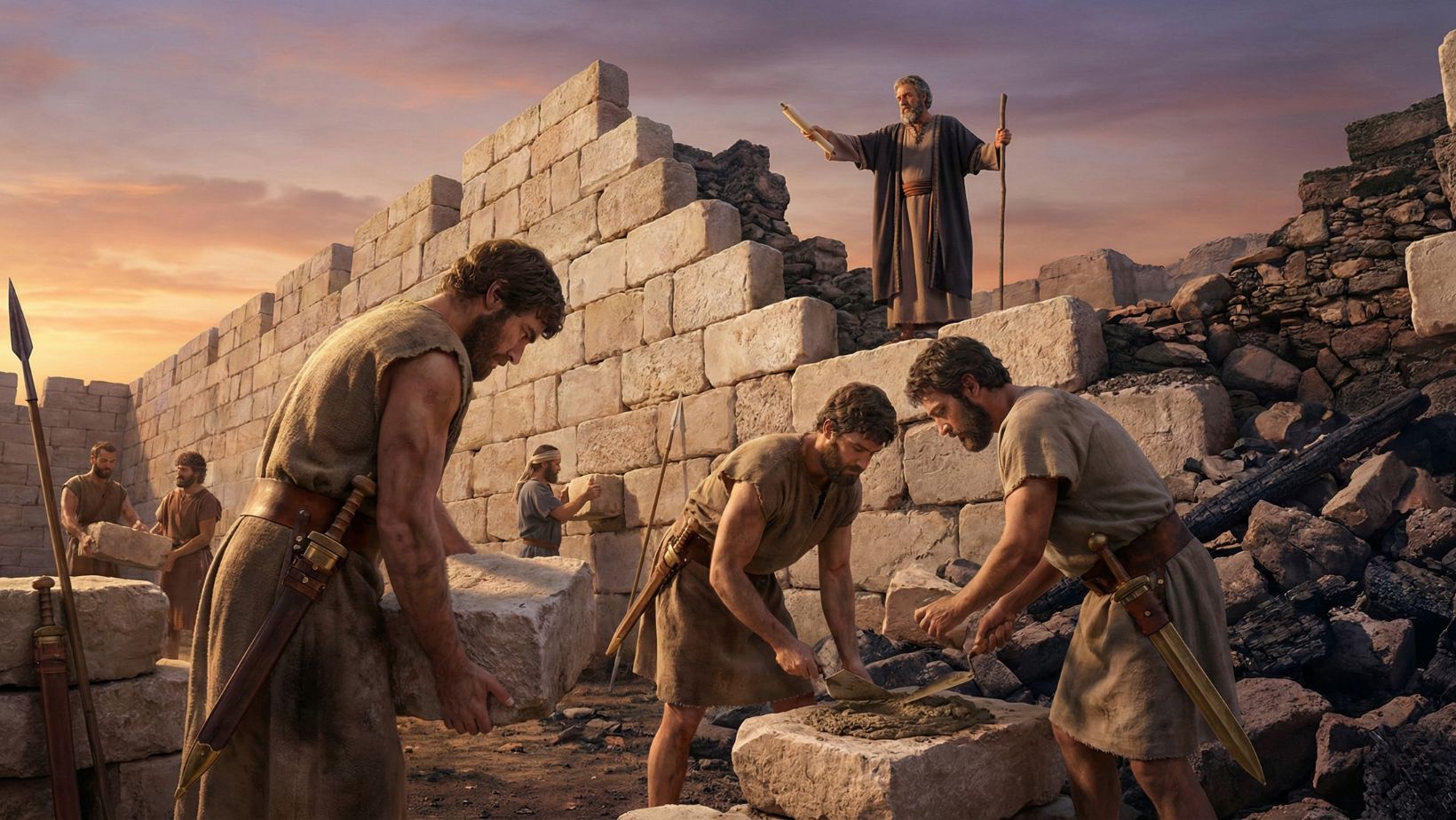
The Book of Nehemiah provides a vivid, first-person account of the rebuilding of Jerusalem’s broken walls. While Ezra restored the spiritual community and the Temple, Nehemiah—a high-ranking official in the Persian court—returned to restore the city’s physical security and civil order. It is a masterpiece on leadership, demonstrating how prayer and pragmatism work hand-in-hand. The narrative covers the swift reconstruction of the walls in just fifty-two days despite fierce opposition, followed by the consolidation of the people through social reforms and the public reading of the Law. Nehemiah stands as one of the Bible’s most dynamic figures: a man who wept over the ruins, prayed for favor, and then went to work with a trowel in one hand and a sword in the other.
Quick Facts
- Name: Nehemiah (Hebrew: Nechemyah, meaning “Yahweh Comforts”)
- Author: Nehemiah (memoirs), likely compiled by Ezra
- Main Character: Nehemiah
- Key Figures: Ezra, King Artaxerxes I, Sanballat, Tobiah, Geshem
- Era: The Persian Period (~445–430 BCE)
- Core Themes: Leadership, prayer, perseverance, social justice, covenant renewal
- Setting: Susa (Persia) and Jerusalem
- Literary Style: Personal memoir / Administrative journal
- Key Symbol: The Wall — representing separation from the world and protection for God’s people
Name Meaning
“Yahweh Comforts” reflects the dual nature of Nehemiah’s mission. He brought comfort to a disheartened people not merely through kind words, but through decisive action that removed their shame and vulnerability.
Historical Context
Time: The narrative begins in the 20th year of Artaxerxes I (445 BCE), roughly 13 years after Ezra arrived. The Problem: Although the Temple was rebuilt, Jerusalem remained a heap of rubble without walls or gates. This left the inhabitants vulnerable to raids and mockery (“a city without walls is like a man without self-control”). The Position: Nehemiah served as the “Cupbearer to the King” in Susa, a position of immense trust, intimacy, and influence within the Persian Empire.
Major Roles / Identity
The Cupbearer: A trusted confidant to the most powerful man on earth, willing to risk his life to request leave for Jerusalem. The Governor (Tirshatha): Nehemiah was appointed governor of Judah, giving him the political authority to marshal resources and enforce laws. The Engineer/Foreman: He strategically divided the wall construction among families, ensuring everyone had a stake in the work (“building across from their own house”). The Reformer: He confronted wealthy Jews who were exploiting their poor brothers (usury) and enforced strict Sabbath observance.
Key Character Traits
Prayerfulness: The book opens and closes with prayer. Nehemiah famously offers “arrow prayers”—instant, silent appeals to God in the middle of conversations (Nehemiah 2:4). Courage: He refused to hide in the Temple when assassins threatened him, stating, “Should a man like me run away?” Focus: He ignored the distractions of his enemies, famously telling them, “I am doing a great work and I cannot come down.” Empathy: He sat down and wept, mourned, and fasted when he heard of the distress of his people.
Main Events
The Report: Hanani brings news that Jerusalem’s wall is broken down and its gates burned with fire. The Request: Nehemiah risks the King’s anger by showing sadness, but receives royal letters of safe conduct and timber. The Midnight Ride: Nehemiah secretly inspects the damage by night to form a plan before announcing it. The Building Project: Families are assigned specific sections of the wall; the work is completed in a miraculous 52 days. The Opposition: Sanballat (Horonite), Tobiah (Ammonite), and Geshem (Arab) use mockery, conspiracy, and threats of war to stop the work. The Reading of the Law: Ezra reads the Torah from a wooden platform while Nehemiah organizes the people, leading to a massive revival (Nehemiah 8). The Dedication: Two large choirs march in opposite directions on top of the finished walls, meeting at the Temple to praise God.
Major Relationships
Nehemiah and Artaxerxes: A relationship of mutual respect that allowed God’s purpose to move forward through a pagan administration. Nehemiah and Ezra: A powerful partnership; Ezra was the spiritual authority (High Priest/Scribe) while Nehemiah was the civil authority (Governor). Nehemiah and the Workers: He did not demand his governor’s food allowance but worked alongside the people, earning their loyalty. Nehemiah and the Enemies: A relationship defined by firm boundaries; Nehemiah refused to compromise or “parley” with those who sought Israel’s harm.
Notable Passages
Nehemiah 2:17: The call to action: “You see the trouble we are in… Come, let us rebuild the wall of Jerusalem, and we will no longer be in disgrace.” Nehemiah 4:17: The posture of readiness: “Those who carried materials did their work with one hand and held a weapon in the other.” Nehemiah 6:3: The refusal to be distracted: “I am sending this message to them: ‘I am doing a great work and I cannot come down.’” Nehemiah 8:10: The exhortation: “Do not grieve, for the joy of the Lord is your strength.”
Legacy & Impact
Nehemiah provides the ultimate biblical case study in visionary leadership. He demonstrates that spirituality involves practical planning, administration, and hard work. By securing the physical safety of Jerusalem, he created the environment necessary for the religious reforms of Ezra to take root, preserving the Jewish identity until the time of Christ.
Symbolism / Typology
The Walls: Symbolize the necessary boundaries of the Christian life—distinctness from the world and protection of the truth. The Sword and Trowel: Represents the dual duty of the believer: to build (constructive work/evangelism) and to battle (defending the faith/spiritual warfare). The Broken Gates: Represent the entry points of influence; when they are burned, the city (or the soul) is open to invasion.







Leave a Reply