
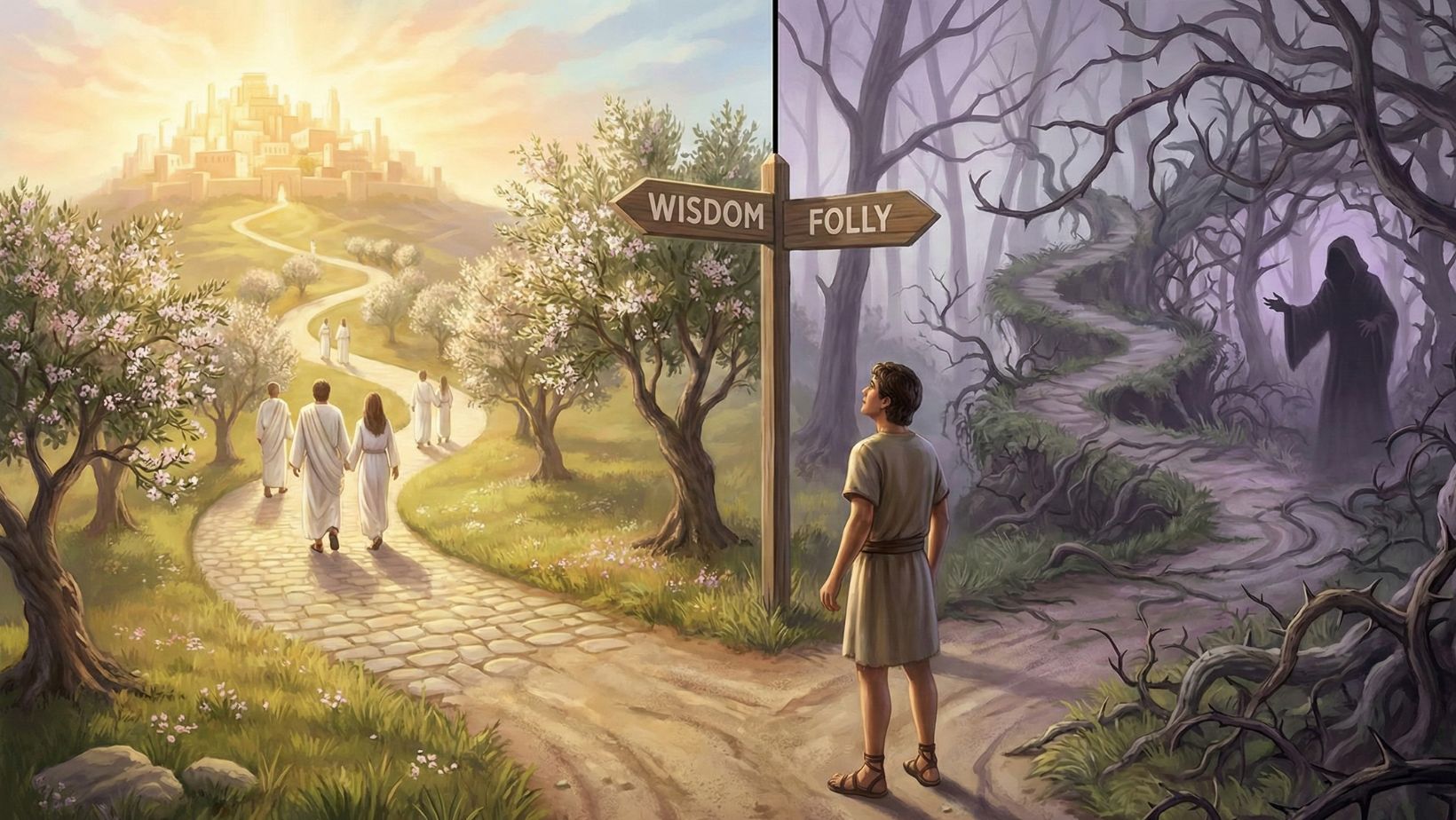
The Book of Proverbs is the Bible’s primary collection of “Wisdom Literature,” offering practical skill for living in God’s world. Unlike the Psalms, which focus on the vertical relationship with God, Proverbs focuses largely on the horizontal—how to interact with neighbors, handle money, work diligently, and speak wisely. The book is not a collection of legal guarantees or absolute promises (e.g., “do this and you will always get rich”), but rather principles of probability: “this is how life generally works when you align yourself with God’s order.” It presents life as a choice between two paths: the path of Wisdom, which leads to life, and the path of Folly, which leads to ruin.
Quick Facts
- Name: Proverbs (Hebrew: Mishlei, meaning “Parables” or “Comparisons”)
- Authors: Primary author is King Solomon; others include Agur and King Lemuel
- Date Written: Mostly 10th Century BCE (Solomon’s reign), compiled later under King Hezekiah (~700 BCE)
- Target Audience: Young people (specifically young men in the royal court) learning how to lead
- Core Themes: The Fear of the Lord, wisdom vs. folly, the power of words, work ethic, family
- Literary Style: Didactic poetry, short pithy sayings (aphorisms)
- Key Symbol: Lady Wisdom — the personification of God’s wisdom calling out in the streets
Name Meaning
The Hebrew word Mashal (Proverb) refers to a comparison or a similitude. It is a short, memorable saying that expresses a general truth about life, often using metaphors or contrasts to make the point stick.
Historical Context
Time: The core of the book comes from the “Golden Age” of Israel under Solomon, who was renowned globally for his intellect and encyclopedic knowledge of nature and human behavior. Cultural Context: In the ancient Near East, “wisdom” wasn’t just abstract philosophy; it was the practical skill of navigating life successfully—like a carpenter having the skill to build a house. The Setting: The book is framed as a father’s instruction to his son, preparing him for the dangers of adulthood (money, sex, power).
Major Roles / Identity
Solomon: The principal contributor, who “spoke three thousand proverbs” (1 Kings 4:32). He represents the ideal sage-king. Lady Wisdom: A poetic personification of God’s wisdom. She is portrayed as a noble woman inviting people to a banquet of life. Lady Folly: The antagonist; a seductress who lures the simple into a trap of death with promises of “stolen water” (illicit pleasure). The Simple: The naive person who isn’t necessarily evil but is open to influence—easily led astray if not instructed. The Scoffer: The hardened fool who mocks truth and refuses correction.
Key Character Traits
The Fear of the Lord: This is the motto of the book. It is not terror, but a reverent awe of God that serves as the starting point for all true knowledge. Diligence: The “ant” is held up as a model of hard work and foresight, while the “sluggard” is mocked for his laziness. Self-Control: A major mark of wisdom is the ability to control one’s temper (“he who rules his spirit is better than he who takes a city”). Prudence: The ability to foresee danger and hide oneself, rather than rushing blindly into trouble.
Structure
Chapters 1–9: The Prologue. A series of ten fatherly lectures urging the son to choose Wisdom over Folly. It establishes the theological foundation. Chapters 10–29: The Proverbs of Solomon. The main collection of short, two-line sayings covering random topics (wealth, speech, justice). Chapter 30: The Sayings of Agur. A skeptical, humble reflection on the limits of human understanding. Chapter 31: The Sayings of King Lemuel. Includes the famous poem of the “Proverbs 31 Woman” (The Woman of Noble Character).
Major Topics
The Tongue: Proverbs has more to say about speech than almost any other topic. Words have the power of “life and death.” Money: It warns against debt (“the borrower is slave to the lender”), get-rich-quick schemes, and stinginess, while praising generosity and honest labor. Friendship: “A friend loves at all times.” The book distinguishes between fair-weather friends and those who “stick closer than a brother.” Sex and Marriage: It contains graphic warnings against adultery (the “forbidden woman”) and celebrates the joys of faithful marriage (“rejoice in the wife of your youth”).
Notable Passages
Proverbs 1:7: The thesis statement: “The fear of the Lord is the beginning of knowledge, but fools despise wisdom and instruction.” Proverbs 3:5–6: The life verse: “Trust in the Lord with all your heart and lean not on your own understanding.” Proverbs 27:17: Iron sharpens iron: “As iron sharpens iron, so one person sharpens another.” Proverbs 31:30: The value of character: “Charm is deceptive, and beauty is fleeting; but a woman who fears the Lord is to be praised.”
Legacy & Impact
Proverbs shaped the Jewish ethical worldview, emphasizing that faith is lived out in the marketplace, not just the temple. In the New Testament, Jesus is presented as someone “greater than Solomon” (Luke 11:31) and the embodiment of Wisdom itself (1 Corinthians 1:24). The book remains the go-to guide for parents teaching their children about character.
Symbolism / Typology
The Tree of Life: Wisdom is described as a “tree of life” to those who embrace her—a callback to Eden, suggesting that wisdom restores a piece of paradise. The Two Banquets: Chapter 9 contrasts the meal served by Wisdom (meat and wine) with the meal served by Folly (stolen water and bread eaten in secret). The Path: Life is constantly depicted as a “road” or “way.” Every decision is a step on a path that leads either to the City of God or the pit of destruction.







Leave a Reply