
The Book of Isaiah is often described as the “Mount Everest” of biblical prophecy and the “Fifth Gospel” because of its unparalleled literary beauty and detailed predictions about the Messiah. Standing at the head of the Major Prophets, Isaiah spans a turbulent period in Israel’s history—the rise of the brutal Assyrian Empire and the spiritual decline of Judah. The book is a masterpiece of contrast: the first half (Chapters 1–39) thunders with judgment against sin and idolatry, while the second half (Chapters 40–66) soars with messages of comfort, redemption, and the coming of the “Suffering Servant.” It presents a majestic view of God as the “Holy One of Israel,” whose plan includes not just the punishment of a rebellious nation, but the salvation of the entire world.
Quick Facts
- Name: Isaiah (Hebrew: Yeshayahu, meaning “Yahweh is Salvation”)
- Author: Isaiah, son of Amoz
- Date Written: ~740–680 BCE
- Kings Served: Uzziah, Jotham, Ahaz, Hezekiah, Manasseh
- Core Themes: The Holiness of God, the Messiah, Judgment and Restoration, The Remnant
- Setting: Jerusalem, during the Assyrian crisis
- Literary Style: High poetic prophecy, historical narrative, apocalyptic imagery
- Key Symbol: The Suffering Servant — the figure who bears the sins of many
Name Meaning
The name Isaiah is a summary of the book’s entire message: “The Lord is Salvation.” While the people looked to political alliances (like Egypt) for safety, Isaiah consistently preached that salvation comes only from Yahweh.
Historical Context
Time: Isaiah ministered for at least 40 years. He saw the Northern Kingdom (Israel) destroyed by Assyria in 722 BCE and warned the Southern Kingdom (Judah) that they were next if they didn’t repent. The Crisis: The book is set against the terrifying backdrop of the Assyrian war machine, which conquered most of the known world, and the rising threat of Babylon on the horizon. The Division:
- 1st Isaiah (Ch 1–39): Focuses on the Assyrian threat and God’s judgment.
- 2nd Isaiah (Ch 40–66): Looks forward to the Babylonian exile and the future restoration (some scholars attribute this to a school of disciples, but tradition ascribes the whole to Isaiah).
Major Roles / Identity
The Court Prophet: Unlike Micah (a country prophet), Isaiah was likely an aristocrat with access to the royal court and the ear of the king. The Poet: His command of the Hebrew language is considered the finest in the Old Testament, utilizing rich metaphors, sarcasm, and soaring hymns. The Messianic Herald: More than any other prophet, Isaiah paints the picture of who Jesus will be—both the Conquering King and the Suffering Servant. The Theologian of Holiness: His favorite title for God is “The Holy One of Israel,” emphasizing the vast gap between God’s perfection and human sin.
Key Character Traits
Humility: In his vision of God, his immediate reaction is to confess his own sin (“Woe is me! I am ruined!”). Unwavering Faith: He stood firm when King Ahaz panicked, and he strengthened King Hezekiah to withstand the Assyrian siege when all hope seemed lost. Drama: He was willing to be a “living sign,” walking naked and barefoot for three years to illustrate the coming shame of Egypt and Ethiopia (Isaiah 20).
Main Events
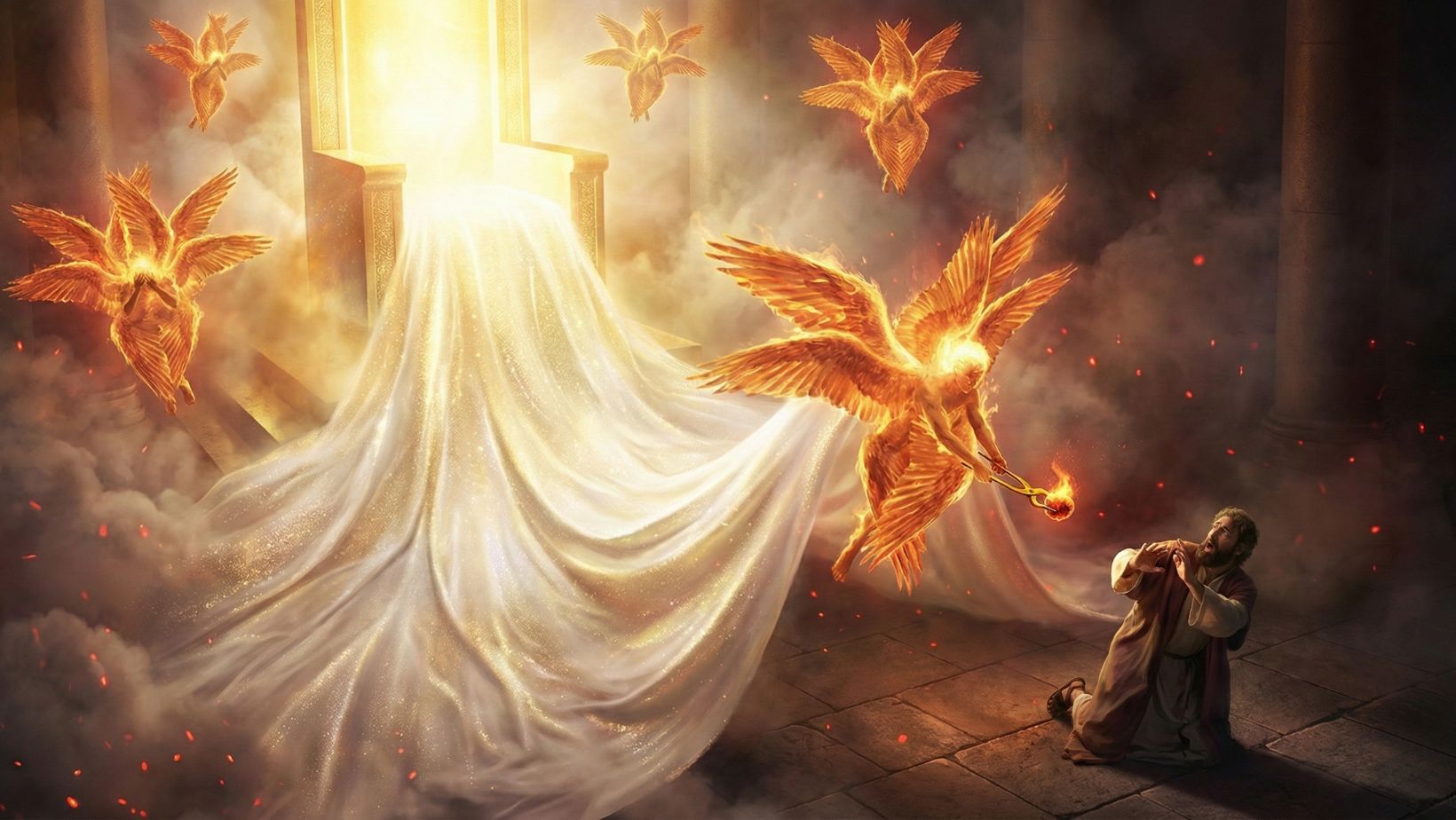
The Vision of the Throne Room: Isaiah sees the Lord high and lifted up, with seraphim calling “Holy, Holy, Holy,” and his lips are cleansed by a burning coal (Isaiah 6). The Syro-Ephraimite War: Isaiah warns King Ahaz not to fear the alliance of Israel and Syria, giving the sign of “Immanuel” (Isaiah 7). The Siege of Jerusalem: The Assyrian army surrounds Jerusalem. Isaiah prophesies they will not enter; the Angel of the Lord kills 185,000 troops in one night (Isaiah 36–37). Hezekiah’s Healing: The king falls ill, prays, and is granted 15 more years of life. The Babylonian Prophecy: After Hezekiah shows off his treasures to Babylonian envoys, Isaiah predicts that Babylon will one day carry it all away (Isaiah 39).
Major Relationships
Isaiah and Hezekiah: A model partnership between prophet and king, leading to national revival and deliverance. Isaiah and Ahaz: A relationship of conflict; Ahaz refused to listen to Isaiah and plunged Judah into idolatry. The Servant and the Sinner: The prophetic relationship between the innocent “Suffering Servant” (Messiah) and the sheep who have gone astray.
Notable Passages
Isaiah 6:8: The Commission: “Then I heard the voice of the Lord saying, ‘Whom shall I send?’ …And I said, ‘Here am I. Send me!’” Isaiah 7:14: The Virgin Birth: “Therefore the Lord himself will give you a sign: The virgin will conceive and give birth to a son, and will call him Immanuel.” Isaiah 9:6: The Names of Christ: “For to us a child is born… And he will be called Wonderful Counselor, Mighty God, Everlasting Father, Prince of Peace.” Isaiah 40:31: The Strength: “But those who hope in the Lord will renew their strength. They will soar on wings like eagles.” Isaiah 53: The Gospel in the OT: “But he was pierced for our transgressions, he was crushed for our iniquities… and by his wounds we are healed.”
Legacy & Impact
Isaiah is the bridge between the Testaments. He provides the theological vocabulary for the New Testament writers to explain the cross (the sacrificial lamb). The Dead Sea Scrolls, discovered in 1947, contained a complete scroll of Isaiah from ~125 BCE, virtually identical to modern texts, proving the incredible accuracy of biblical transmission.
Symbolism / Typology
The Vineyard: Represents Israel. God cleared the stones and planted good vines, but it produced only “sour grapes” (injustice), leading to its destruction. The Stump of Jesse: A tree cut down (the royal line of David judged/exiled) that sprouts a new “Branch” (the Messiah) from the dead stump. The Wolf and the Lamb: A picture of the Millennial Kingdom or the New Creation, where natural enemies live in peace. The Potter and the Clay: Represents God’s sovereign right to mold history and nations as He sees fit.







Leave a Reply