
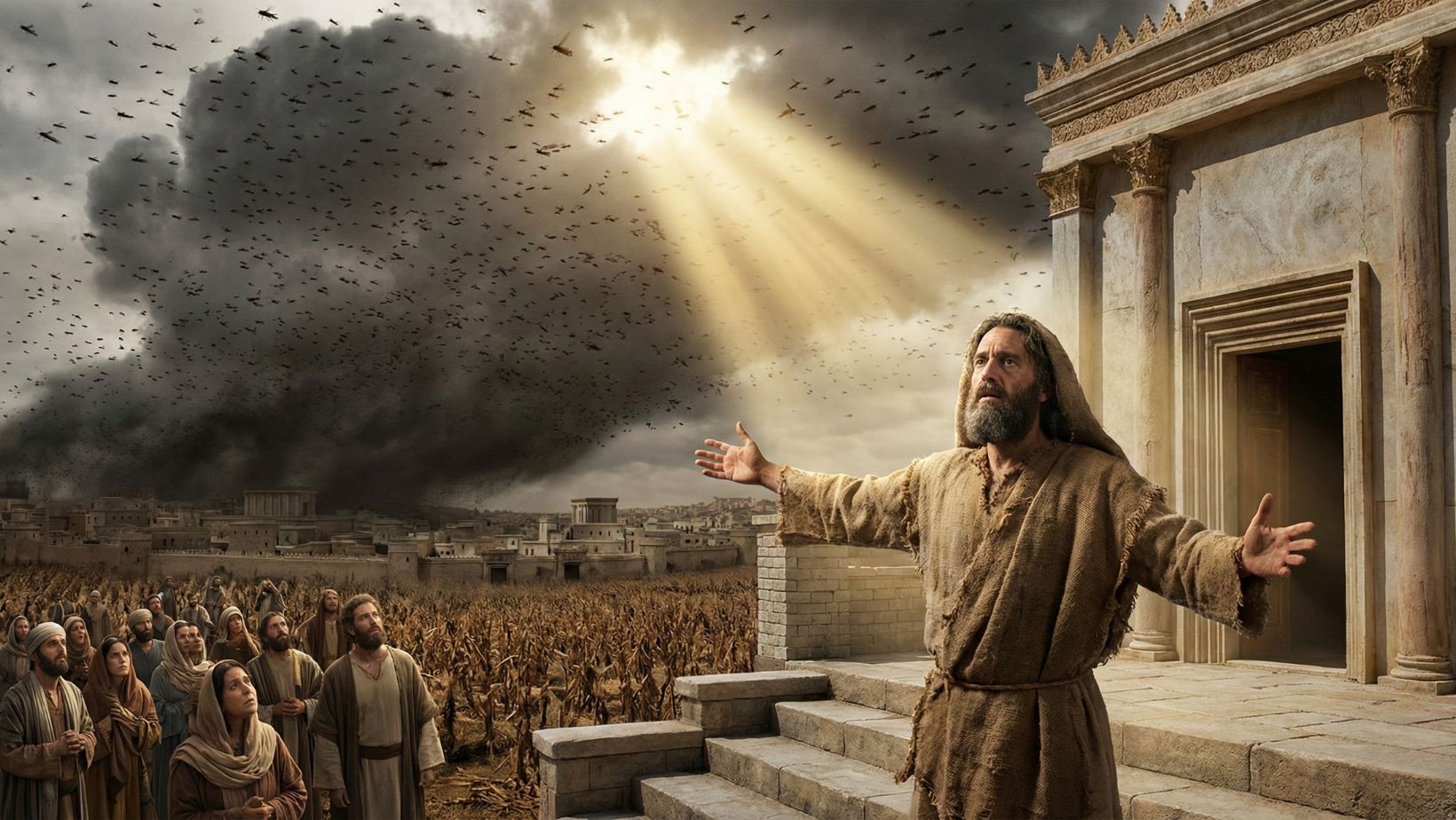
Joel is known as the “Prophet of Pentecost” and the herald of the “Day of the LORD.” Little is known about his personal life, but his message is one of the most urgent and graphically descriptive in the Old Testament. Using a catastrophic locust plague as a terrifying backdrop, Joel called the nation of Judah to deep, heartfelt repentance. He is best known for his stunning prophecy regarding the outpouring of the Holy Spirit—a prediction explicitly cited by the Apostle Peter in Acts 2 to explain the birth of the Church. His book transitions from a local natural disaster to a cosmic vision of end-times judgment and restoration.
Quick Facts
- Name: Joel (Hebrew: Yoel)
- Tribe/Nation: Judah (Southern Kingdom)
- Era: Uncertain/Debated (ranges from 9th Century BCE to post-exilic 5th Century BCE)
- Father: Pethuel
- Home: Jerusalem (inferred from his focus on the Temple and priesthood)
- Book: The Book of Joel (3 chapters)
- Key Virtues: Spiritual urgency, insight, hope
- Legacy: Predicted the outpouring of the Holy Spirit on all flesh
- Symbol: The Locust Swarm — representing divine judgment and devastation
Name Meaning
“Joel” means “Yahweh is God.” It is a combination of two names for God (YHWH and El). His name is essentially the inversion of the name Elijah (“God is Yahweh”), serving as a confession of faith in the character and sovereignty of the God of Israel.
Lineage / Family Background
Father: Pethuel. This is the only biographical detail given in the text (Joel 1:1).
Background: He is widely believed to have been a resident of Jerusalem and possibly a priest or closely associated with the Temple, as he shows intimate familiarity with the liturgy, priests, and sacrificial system (grain and drink offerings).
Biblical Era / Context
Time: The dating of Joel is one of the most debated issues in Old Testament scholarship.
- Early Date (c. 835 BCE): During the reign of King Joash (boy king) and the priesthood of Jehoiada. This explains the focus on priests rather than a king.
- Late Date (c. 400s BCE): Post-exilic period. This explains the lack of references to a specific king, the mention of Greeks (3:6), and the focus on the Temple liturgy.
Setting: The book opens in the aftermath of a devastating locust plague and drought that stripped the land bare, which Joel interprets as a harbinger of the greater “Day of the LORD.”
Major Roles / Identity
The Alarmist: Joel sounded the trumpet in Zion (Joel 2:1), warning that the natural disaster was merely a shadow of a coming military and spiritual judgment.
The Revivalist: He called for a solemn assembly and a national fast, urging the people to tear their hearts, not just their garments.
The Visionary: He looked beyond his immediate time to the “Last Days,” seeing a time when God’s Spirit would no longer be restricted to prophets and kings but poured out on everyone.
Key Character Traits
Urgency: “Blow the trumpet in Zion! Sound the alarm…” (Joel 2:1). He wrote with high intensity and speed.
Descriptive Power: His description of the locust army is one of the most vivid in ancient literature, comparing insects to warhorses and chariots.
Theocentric: He focused entirely on God’s sovereignty. He did not blame politics or economics for the disaster, but spiritual apathy.
Hopeful: Despite the gloom, he offered a promise of restoration (“I will restore the years…”) that was contingent on repentance.
Main Life Events
The Great Locust Plague: Joel witnesses a four-stage invasion of locusts that decimates the agriculture of Judah, cutting off the grain and drink offerings for the Temple (Joel 1).
The Call to Repentance: He commands the priests to mourn and the people to fast, interpreting the ecological disaster as divine discipline (Joel 1:13–14).
The Vision of the Army: He prophesies a future invasion (possibly Assyrian or Babylonian, or an eschatological army) that will act like the locusts, devouring everything in its path (Joel 2).
The Promise of Restoration: Following the people’s hypothetical repentance, Joel delivers God’s promise to drive away the northern army and restore the land’s fertility (Joel 2:18–27).
The Outpouring of the Spirit: He predicts a future era where God will pour His Spirit on “all flesh”—sons, daughters, old men, and young men (Joel 2:28–29).
Major Relationships
The Priesthood: Joel speaks directly to the priests, “ministers of the altar,” urging them to lead the nation in repentance.
Apostle Peter: Centuries later, Peter acts as the primary interpreter of Joel, using Joel 2:28–32 as the text for his first sermon on the day of Pentecost (Acts 2:16–21).
Notable Passages
Joel 2:12–13: “Rend your heart and not your garments. Return to the LORD your God, for he is gracious and compassionate…”
Joel 2:25: “I will repay you for the years the locusts have eaten—the great locust and the young locust, the other locusts and the locust swarm…”
Joel 2:28: “And afterward, I will pour out my Spirit on all people. Your sons and daughters will prophesy, your old men will dream dreams, your young men will see visions.”
Joel 3:14: “Multitudes, multitudes in the valley of decision! For the day of the LORD is near in the valley of decision.”
Legacy & Impact
The Pentecost Prophecy: Joel is the primary Old Testament link to the New Testament doctrine of the Holy Spirit indwelling all believers.
The Day of the LORD: He solidified this concept as a time of terrifying judgment for the wicked but salvation for those who “call on the name of the LORD.”
Ash Wednesday: His call to “return to me with all your heart, with fasting and weeping and mourning” is the traditional scripture reading for Ash Wednesday in Christian liturgy.
Symbolism / Typology
The Locusts: A type of divine judgment. They represent both the literal insect plague and the invading human armies (Babylon/Rome) that would eventually sack Jerusalem.
The Early and Latter Rain: Represents not only agricultural restoration but spiritual refreshing and the outpouring of the Holy Spirit.
Valley of Jehoshaphat: Meaning “Yahweh Judges.” It symbolizes the final place of judgment for the nations, often associated with the Kidron Valley or an eschatological gathering place.
Extra-Biblical References
Historical Context: Plagues of locusts were common in the ancient Near East, but the severity described by Joel (cutting off the temple sacrifices) suggests an event of historical magnitude, though specific secular records of this specific plague are difficult to pinpoint due to the uncertain dating of the book.







Leave a Reply