
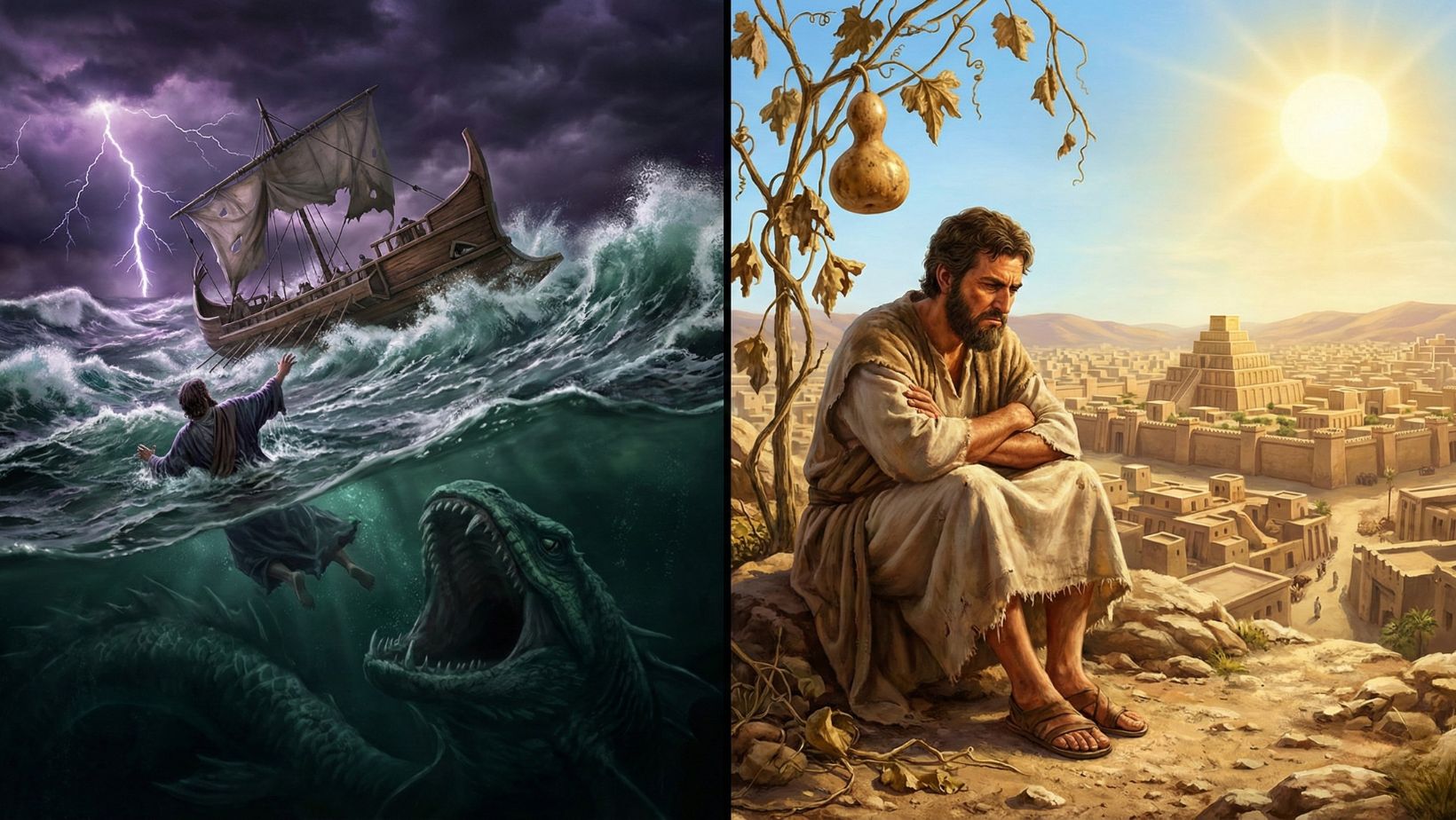
Jonah is perhaps the most famous yet most misunderstood figure in the prophetic canon. He is the only prophet whose book is primarily a narrative about his reluctance to prophesy rather than a collection of his oracles. Called to preach judgment to Nineveh—the capital of the brutal Assyrian Empire and Israel’s arch-enemy—Jonah famously fled in the opposite direction. His story is not just about a great fish; it is a profound theological treatise on the scandal of God’s grace, which extends even to the most wicked of nations, much to the frustration of the prophet himself.
Quick Facts
- Name: Jonah (Hebrew: Yonah)
- Tribe/Nation: Northern Kingdom of Israel
- Era: Pre-Exilic (Early 8th Century BCE)
- Kings Served: Jeroboam II (Israel)
- Father: Amittai
- Home: Gath Hepher (in the territory of Zebulun, near Nazareth)
- Target Audience: Nineveh (Assyria)
- Book: The Book of Jonah (4 chapters)
- Key Virtues: Honest with God (brutally so), eventual obedience
- Key Vice: Nationalism, lack of compassion, anger at God’s mercy
- Legacy: The “Reluctant Prophet” who foreshadowed Christ’s burial and resurrection
- Symbol: The Great Fish — representing divine intervention and rescue from the depths
Name Meaning
“Jonah” means “Dove.” The dove is often a symbol of peace or the Holy Spirit, but in the Old Testament, “silly dove” was also used as a metaphor for being easily deceived or flighty (Hosea 7:11). The name is ironic, as Jonah was anything but peaceful; he was a hawk who desired war and judgment upon his enemies.
Lineage / Family Background
Father: Amittai.
Hometown: Gath Hepher. This is significant because it is located in Galilee, just a few miles from Nazareth. (This challenges the Pharisees’ later claim in John 7:52 that “no prophet arises from Galilee”).
Political Status: Unlike the “fringe” prophets, Jonah was likely a highly respected, patriotic prophet established in the royal court. In 2 Kings 14:25, he is credited with prophesying the expansion of Israel’s borders under Jeroboam II. He was a champion of Israel’s success.
Biblical Era / Context
Time: Approx. 793–753 BCE (Reign of Jeroboam II).
Geopolitical Context:
- Assyria: A rising superpower known for horrific cruelty (flaying captives alive, piling skulls). They were the existential threat to Israel.
- Tarshish: Likely Tartessos in modern-day Spain. By fleeing there, Jonah was attempting to go to the “end of the world” in the opposite direction of Nineveh (modern-day Mosul, Iraq).
Major Roles / Identity
The Anti-Prophet: In almost every scene, Jonah does the opposite of what a “man of God” should do. Pagan sailors pray while he sleeps; a pagan king repents while he sulks.
The Nationalist: Jonah did not flee because he was afraid the Ninevites would kill him; he fled because he was afraid God would save them (Jonah 4:2). He put his national identity (Israel) above God’s global compassion.
The Sign: Jesus called Jonah a “sign” to his generation, pointing to the resurrection.
Key Character Traits
Stubbornness: He would rather drown in the sea than go to Nineveh, and later, he would rather die of heat/anger than see Nineveh forgiven.
Theological Orthodoxy: Ironically, Jonah had perfect theology. He knew God was “gracious and compassionate, slow to anger and abounding in love” (Jonah 4:2). He just hated that this theology applied to his enemies.
Drama: His emotional state swings wildly—from deep depression in the boat, to poetic gratitude in the fish, to suicidal anger outside the city.
Main Life Events
The Call and Flight: God commands Jonah to go East (Nineveh); Jonah boards a ship to go West (Tarshish).
The Storm: God hurls a storm at the ship. The pagan sailors cast lots, identifying Jonah as the culprit. Jonah admits he is running from Yahweh.
The Great Fish: Jonah is thrown overboard to save the ship. God “appoints” a great fish to swallow him. He spends three days and three nights in the belly of the fish, where he composes a prayer of thanksgiving (Jonah 2).
The Second Chance: Vomited onto dry land, Jonah obeys the second command. He walks into the massive city of Nineveh and preaches a five-word sermon (in Hebrew): “Forty more days and Nineveh will be overthrown.”
The Great Revival: Astonishingly, the entire city repents, from the King down to the cattle, wearing sackcloth.
The Anger of Jonah: God relents from the disaster. Jonah is furious. He sits outside the city waiting for fire to fall. God uses a leafy plant to teach him a lesson: Jonah cared more about a plant than about 120,000 human beings.
Major Relationships
The Sailors: Pagan mariners who end up fearing Yahweh more than His own prophet does.
The Worm: A small creature appointed by God to eat the plant that provided shade for Jonah, exposing his misplaced priorities.
God: The book is a dialogue between a relentless God and a recalcitrant prophet. God never gives up on Jonah, constantly asking him questions (“Is it right for you to be angry?”) to deconstruct his prejudice.
Notable Passages
Jonah 2:9: “But I, with shouts of grateful praise, will sacrifice to you. What I have vowed I will make good. I will say, ‘Salvation comes from the LORD.’”
Jonah 3:4: “Forty more days and Nineveh will be overthrown.” (The shortest and most successful sermon in history).
Jonah 4:2: “I knew that you are a gracious and compassionate God, slow to anger and abounding in love, a God who relents from sending calamity.” (Jonah explaining why he fled—he didn’t want God to be good to them).
Jonah 4:11: “And should I not have concern for the great city of Nineveh, in which there are more than a hundred and twenty thousand people who cannot tell their right hand from their left—and also many animals?”
Legacy & Impact
The Sign of Jonah: Jesus explicitly links his death and resurrection to Jonah: “For as Jonah was three days and three nights in the belly of a huge fish, so the Son of Man will be three days and three nights in the heart of the earth” (Matthew 12:40).
Universal Grace: The Book of Jonah is the great Old Testament counter-balance to Jewish exclusivism. It shows that God is the God of the Gentiles (even the enemies) as much as the Jews.
Yom Kippur: The entire Book of Jonah is read in synagogues during the afternoon service of Yom Kippur (Day of Atonement) to teach that no one is beyond the reach of repentance.
Symbolism / Typology
The Fish: Represents death and Sheol (the grave). Jonah’s emergence is a type of resurrection.
Sleeping in the Boat: Parallels Jesus sleeping in the boat during a storm (Mark 4). However, Jonah slept out of apathy; Jesus slept out of peace.
The Plant (Gourd): Represents temporal comforts and our tendency to value material things over human souls.
Extra-Biblical References
Historical Nineveh: Archaeological excavations at Nineveh (Kuyunjik) confirm the massive size of the city (“a visit required three days,” Jonah 3:3). The reference to “120,000 people” likely refers to the population of the metropolitan district.
Fish Accounts: While skeptics doubt the fish story, there are historical anecdotes (such as the James Bartley case, though disputed) of men surviving inside whales, though the biblical text presents it as a miraculous divine appointment, not a natural anomaly.







Leave a Reply