
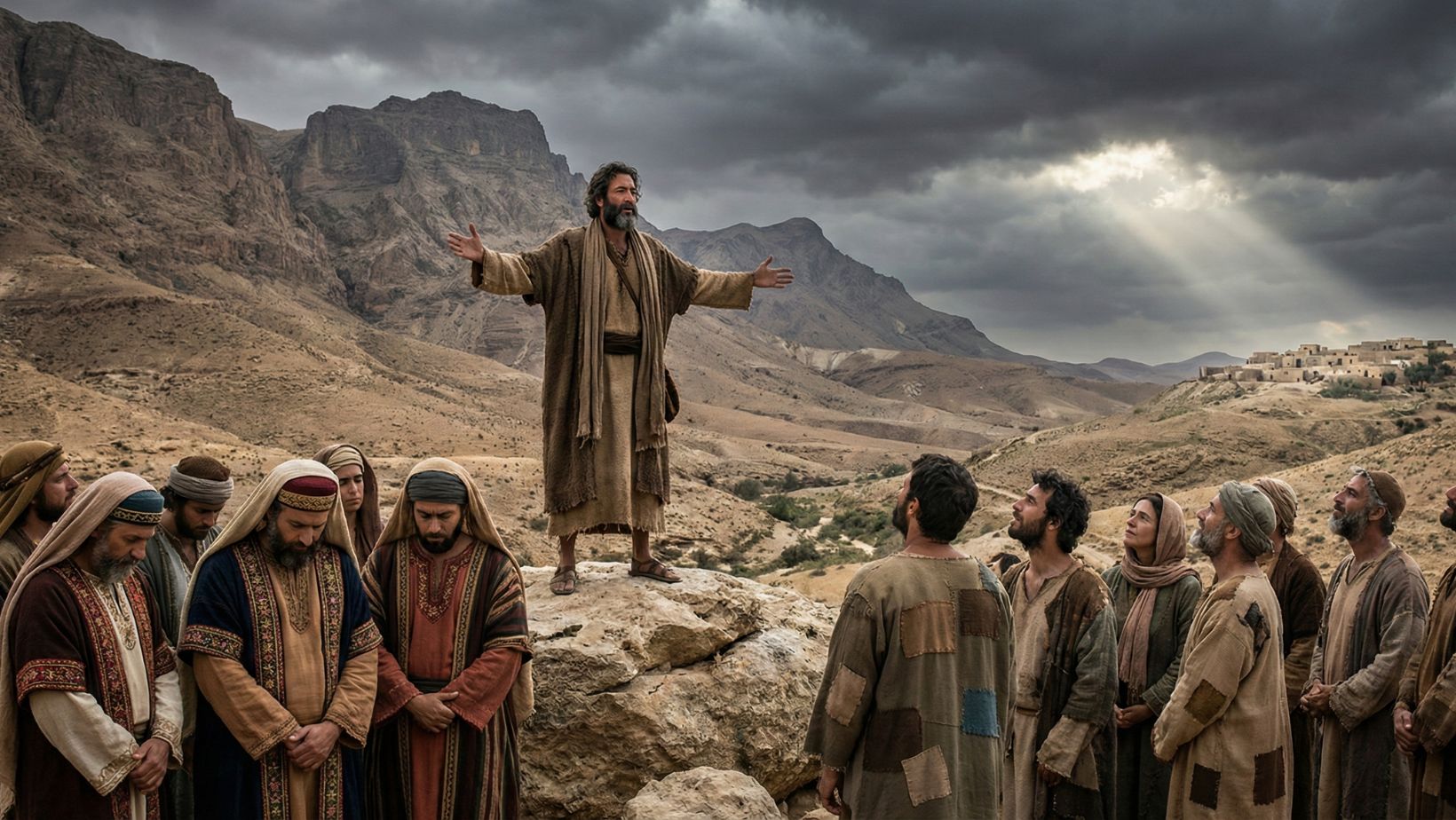
Micah is often called the “Prophet of the Poor.” A contemporary of Isaiah and Hosea, he was a rural villager who looked with horror upon the corruption of the big cities, Jerusalem and Samaria. While Isaiah walked the halls of the royal palace, Micah walked the dusty roads of the countryside, speaking for the farmers and peasants who were being exploited by wealthy land-grabbers and corrupt judges. His message alternates between devastating judgment and soaring hope. He is best known for summarizing the essence of true religion in a single verse (Micah 6:8) and for accurately pinpointing the humble village of Bethlehem as the birthplace of the future Messiah.
Quick Facts
- Name: Micah (Hebrew: Mikhah)
- Tribe/Nation: Judah (Southern Kingdom)
- Era: Pre-Exilic (Late 8th Century BCE)
- Kings Served: Jotham, Ahaz, Hezekiah
- Home: Moresheth-Gath (a small town in the Shephelah/foothills, southwest of Jerusalem)
- Book: The Book of Micah (7 chapters)
- Key Virtues: Justice, humility, advocacy for the oppressed
- Legacy: Saved Jeremiah’s life (Jeremiah 26:18); predicted Christ’s birthplace
- Symbol: The Courtroom — representing God bringing a “lawsuit” against His people
Name Meaning
“Micah” is a shortened form of “Mikhayahu,” meaning “Who is like Yahweh?” The prophet plays on his own name at the very end of his book, asking, “Who is a God like you, who pardons sin and forgives the transgression…?” (Micah 7:18). His name is a theological challenge to the idols of his day.
Lineage / Family Background
Origin: Moresheth-Gath.
Status: Unlike Isaiah (who was likely of noble birth) or Jeremiah (a priest), Micah appears to be a “common man” from the agrarian foothills. This outsider perspective fueled his fierce criticism of the urban elite in Jerusalem, whom he saw as cannibals “who tear the skin from my people and the flesh from their bones” (Micah 3:2).
Biblical Era / Context
Time: Approx. 735–700 BCE.
Geopolitical Context:
- The Assyrian Threat: Micah lived during the terrifying expansion of the Assyrian Empire. He witnessed the fall of the Northern Kingdom (Samaria) in 722 BCE and warned that the same fate awaited Judah if they did not repent.
- Social Crisis: It was a time of economic polarization. Wealthy merchants and nobles were using legal loopholes and bribery to seize the ancestral lands of poor farmers, destroying the social fabric of the covenant.
Major Roles / Identity
The Country Preacher: He brought the raw, unfiltered word of God from the village to the capital, unconcerned with offending the aristocracy.
The Social Critic: He specifically targeted three groups:
- Unjust Rulers: Who hate good and love evil.
- False Prophets: Who preach “peace” only when paid (Micah 3:5).
- Dishonest Merchants: Who use false weights and scales (Micah 6:11).
The Messianic Visionary: He looked beyond the failure of the current davidic kings (like Ahaz) to a future King who would come from the ancient, humble stock of Bethlehem.
Key Character Traits
Boldness: “But as for me, I am filled with power, with the Spirit of the LORD, and with justice and might, to declare to Jacob his transgression…” (Micah 3:8).
Plain-Spoken: He used simple, vivid imagery drawn from rural life—shepherds, flocks, vineyards, and harvest—to convey complex theological truths.
Compassionate: Like God, he mourned over the coming destruction. He describes himself “wailing like a jackal and moaning like an owl” (Micah 1:8) out of grief for his people.
Main Life Events
Predicting the Fall of Samaria: Micah accurately forecasted that Samaria (the Northern Capital) would become “a heap of rubble” (Micah 1:6).
The Vision of Zion’s Fall: He was the first prophet to explicitly state that Jerusalem and the Temple would be destroyed: “Zion will be plowed like a field, Jerusalem will become a heap of rubble” (Micah 3:12).
The Lawsuit: In a dramatic literary device, Micah presents a “Covenant Lawsuit” (Rib) where God summons the mountains and hills as a jury to hear His case against Israel (Micah 6).
The Shepherd King Prophecy: He predicted that the “One to be Ruler in Israel” would not be born in the royal capital of Jerusalem, but in Bethlehem Ephrathah, establishing the connection between David’s humble beginnings and the Messiah’s humble arrival.
Major Relationships
Isaiah: Micah was a contemporary of Isaiah. They likely knew of each other. In fact, Micah 4:1–3 and Isaiah 2:2–4 are almost identical passages (the vision of the Mountain of the Lord). Scholars debate who quoted whom, but it shows a shared vision of future peace.
Hezekiah: King Hezekiah actually listened to Micah. In Jeremiah 26:18–19, the elders recall that when Micah preached destruction, Hezekiah did not kill him but “feared the LORD and sought his favor,” which delayed the judgment.
Notable Passages
Micah 6:8: “He has shown you, O mortal, what is good. And what does the LORD require of you? To act justly and to love mercy and to walk humbly with your God.” (The “Golden Rule” of the Old Testament).
Micah 5:2: “But you, Bethlehem Ephrathah, though you are small among the clans of Judah, out of you will come for me one who will be ruler over Israel, whose origins are from of old, from ancient times.”
Micah 7:18: “Who is a God like you, who pardons sin and forgives the transgression of the remnant of his inheritance?”
Micah 7:8: “Do not gloat over me, my enemy! Though I have fallen, I will rise. Though I sit in darkness, the LORD will be my light.”
Legacy & Impact
Saving Jeremiah: Over a century later, when the prophet Jeremiah was on trial for his life, the elders quoted Micah’s prophecy to save Jeremiah from execution (Jeremiah 26). Micah’s words had a lasting legal precedent.
The Magi: When the Wise Men arrived in Jerusalem asking where the King of the Jews was to be born, the scribes quoted Micah 5:2 to point them to Bethlehem (Matthew 2:5–6).
Social Justice: Micah provides the biblical foundation for the idea that true worship is inseparable from ethical behavior toward the poor.
Symbolism / Typology
Bethlehem: Represents the principle that God chooses the weak and insignificant things of the world to shame the strong.
Swords into Plowshares: Micah (and Isaiah) use this image to symbolize the ultimate peace of God’s Kingdom, where tools of death are transformed into tools of life and cultivation.







Leave a Reply