
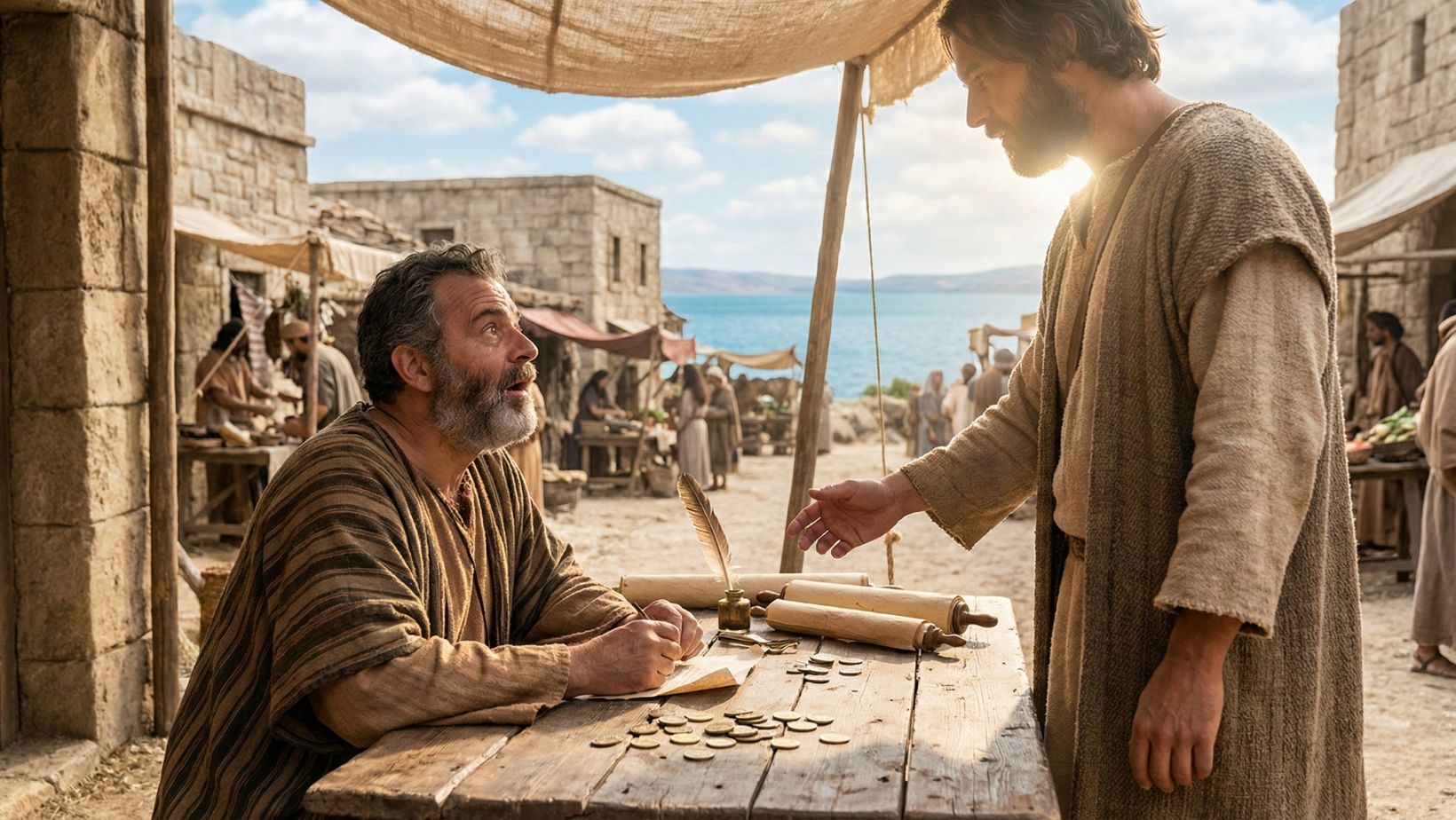
Matthew, also known as Levi, is a central figure in the New Testament as one of the twelve apostles of Jesus and the traditional author of the first Gospel. Before following Christ, he was a tax collector in Capernaum—a profession despised by the Jewish people for its association with the Roman occupation and reputation for corruption. His immediate response to Jesus’ call demonstrates a profound transformation, moving from a life of material greed to one of spiritual wealth. His Gospel is uniquely bridged to the Old Testament, meticulously presenting Jesus as the promised Messiah and the King of the Jews.
Quick Facts
- Name: Matthew (Greek: Matthaios; Hebrew: Mattityahu), also called Levi
- Father: Alphaeus (Mark 2:14)
- Tribe/Nation: Jewish (Galilean)
- Era: First Century AD (Roman Occupation)
- Occupation: Tax Collector (Publican) → Apostle/Evangelist
- Home: Capernaum, Galilee
- Book: The Gospel According to Matthew
- Key Virtues: Humility, obedience, hospitality, meticulousness
- Legacy: One of the Twelve Apostles; Author of the first book of the New Testament
- Symbol: Winged Man or Angel — symbolizing the humanity and royal lineage of Christ
Name Meaning
Matthew: Means “Gift of Yahweh” or “Gift of God.” This name may have been given to him by Jesus after his conversion, similar to Simon becoming Peter.
Levi: His original Hebrew name, meaning “Attached” or “Joined,” possibly linking him to the priestly tribe of Levi, though his profession as a tax collector alienated him from religious status.
Lineage / Family Background
Father: Alphaeus. This may make him the brother of James the Less (son of Alphaeus), though the Bible does not explicitly confirm they were siblings.
Social Standing: As a tax collector (publican), he was considered a social outcast and a “sinner” by the Pharisees, excluded from the synagogue and religious life.
Financial Status: Likely wealthy due to his profession, as evidenced by the “great banquet” he threw for Jesus in his own home.
Biblical Era / Context
Time: Ministry of Jesus (c. 30–33 AD) and the early Church era.
Setting: Capernaum, a bustling lakeside town on the trade route (Via Maris), ideal for a customs post.
Cultural Context: Tax collectors worked for Rome and were viewed as traitors to Israel. Matthew’s inclusion in the Twelve was a shocking statement of grace and the disruptive nature of Jesus’ Kingdom.
Major Roles / Identity
The Outcast Turned Insider: Represented the “sinners” Jesus came to save.
Apostle: One of the twelve chosen to be closest to Jesus.
Evangelist: The author of the Gospel written primarily for a Jewish audience to prove Jesus is the Messiah.
Witness: An eyewitness to the resurrection and ascension.
Key Character Traits
Obedience: When Jesus said “Follow me,” Matthew stood up and followed him immediately, leaving his lucrative booth behind (Matthew 9:9).
Humility: In his own Gospel, he refers to himself as “Matthew the tax collector,” ensuring his sinful past highlights God’s grace. He is often silent in the narrative, pointing attention solely to Jesus.
Generosity: He used his resources to host a large banquet to introduce his friends (other sinners) to Jesus.
Detail-Oriented: His Gospel is structured, organized, and filled with Old Testament references, reflecting a mind trained in record-keeping.
Main Life Events
The Call: While sitting at his tax booth in Capernaum, Jesus calls him. He leaves everything instantly to follow Christ (Matthew 9:9).
** The Great Banquet:** Matthew hosts a feast in his house for Jesus and his disciples, inviting many tax collectors and sinners, drawing criticism from the Pharisees (Luke 5:29).
Selection as an Apostle: Formally chosen as one of the Twelve (Matthew 10:3).
The Great Commission: Present on the mountain in Galilee when Jesus commanded them to make disciples of all nations (Matthew 28:16–20).
Pentecost: Present in the Upper Room in Jerusalem receiving the Holy Spirit (Acts 1:13).
Major Relationships
Jesus: The Rabbi who redeemed him from social isolation and gave him a new purpose.
The Twelve: His new brothers, including Simon the Zealot (a political opposite to a tax collector), showing the unity found in Christ.
The “Sinners”: His former circle of friends whom he sought to bring to Jesus during his banquet.
Notable Passages
Matthew 9:9: “As Jesus went on from there, he saw a man named Matthew sitting at the tax collector’s booth. ‘Follow me,’ he told him, and Matthew got up and followed him.”
Matthew 9:12–13: Jesus defends dining with Matthew: “It is not the healthy who need a doctor, but the sick… I have not come to call the righteous, but sinners.”
Matthew 28:19–20: The Great Commission recorded in his Gospel.
Legacy & Impact
The First Gospel: His account is placed first in the New Testament canon, serving as the perfect bridge between the Old and New Testaments.
Focus on Fulfillment: He quotes the Old Testament more than any other evangelist (over 60 times) to prove Jesus is the fulfillment of prophecy.
Kingdom Theology: His Gospel emphasizes the “Kingdom of Heaven,” shaping Christian understanding of discipleship and ethics (e.g., The Sermon on the Mount).
Symbolism / Typology
The Tax Booth: Represents the worldly entanglements and greed that one must leave behind to follow Christ.
The Pen/Quill: Represents his role as the recorder of the King’s words and deeds.
Winged Man: In Christian art, Matthew is symbolized by a winged man (or angel) because his Gospel opens with the human genealogy of Jesus, emphasizing His incarnation and human nature.
Extra-Biblical References
Missionary Travels: Tradition states Matthew preached in Judea for several years and then traveled to nations such as Ethiopia, Persia, or Parthia.
Martyrdom: Accounts vary; some traditions say he died a natural death, while others claim he was martyred in Ethiopia (stabbed with a sword or halberd) for criticizing the morals of a local king.
Patronage: He is the patron saint of accountants, bankers, tax collectors, and civil servants.







Leave a Reply