
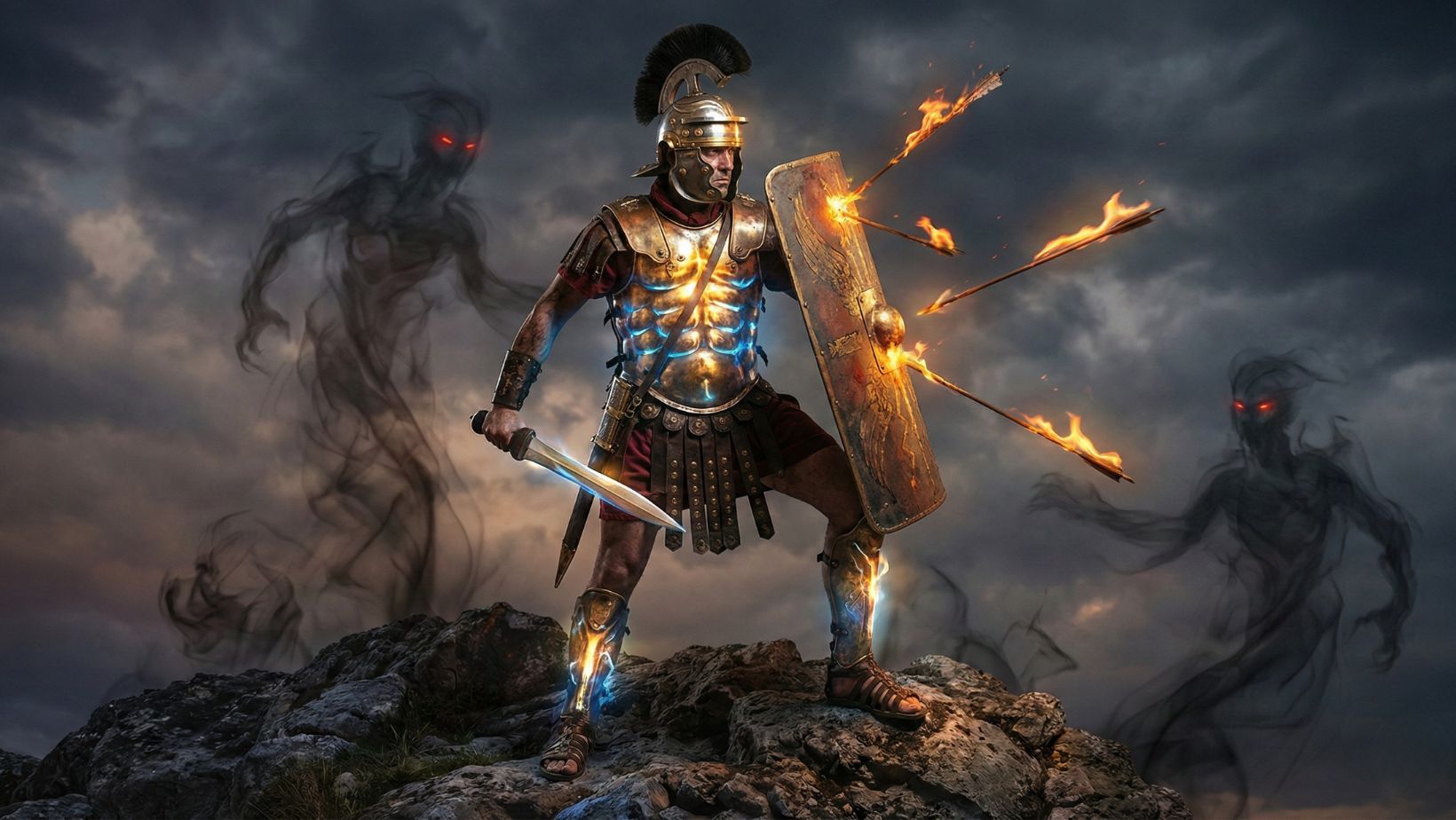
The Epistle to the Ephesians is often called the “Queen of the Epistles” or the “Alps of the New Testament” because of its lofty theology and majestic language. Unlike Galatians or Corinthians, which address specific crises, Ephesians is a general, circular letter meant to encourage believers in their standing before God. It offers the grandest view of the Church in the entire Bible—not as a local building or organization, but as the cosmic Body of Christ, chosen before the foundation of the world to unite all things in heaven and on earth. It is neatly divided into two halves: the first three chapters describe our wealth in Christ (doctrine), and the last three describe our walk in Christ (duty).
Quick Facts
- Author: The Apostle Paul
- Date Written: ~60–62 AD (One of the four “Prison Epistles”)
- Location: Written from house arrest in Rome
- Audience: The Church in Ephesus (and likely surrounding churches in Asia Minor)
- Courier: Tychicus (Ephesians 6:21)
- Theme: The Church as the Body of Christ / Unity
- Key Phrase: “In Christ” (used roughly 35 times)
- Key Verse: Ephesians 2:8–9 (“For it is by grace you have been saved, through faith…”)
- Structure: Doctrine (Sit) → Duty (Walk) → Warfare (Stand)
- Symbol: The Shield of Faith — part of the famous Armor of God passage
Title / Purpose
Title: The Epistle of Paul to the Ephesians.
Purpose:
- Identity: To remind believers of their immense spiritual wealth and blessings in the heavenly realms.
- Unity: To declare that God has reconciled Jews and Gentiles into “one new humanity” by destroying the dividing wall of hostility.
- Maturity: To exhort believers to live a life worthy of their high calling, culminating in the ability to stand against spiritual evil.
Authorship & Context
The Author: Paul writes as a prisoner “for the Lord.” He had a deep history with Ephesus, having spent three years there (Acts 19)—his longest stay in any one city.
The City: Ephesus was a massive commercial and religious center, home to the Temple of Artemis (one of the Seven Wonders of the Ancient World). It was a city obsessed with magic, idols, and spiritual power. Paul writes to show that Christ’s power is supreme over all “rule and authority, power and dominion.”
The Audience: Many early manuscripts lack the words “in Ephesus” in 1:1, suggesting this was a circular letter intended to be read by Laodicea, Colossae, and others.
Structure / Narrative Arc
The book follows a “Sit, Walk, Stand” progression (made famous by Watchman Nee), moving from what God has done to what we must do.
1. SIT: Our Position in Christ (Chapters 1–3):
- Theological Foundation: We are chosen, adopted, redeemed, and sealed by the Holy Spirit.
- Grace: We were dead in sin but made alive with Christ. We are seated with Him in heavenly places.
- The Mystery: The “mystery” hidden for ages is revealed: Gentiles are fellow heirs with Jews in one body.
- Paul’s Prayer: That they would know the height, depth, and width of Christ’s love.
2. WALK: Our Life in the World (Chapters 4–6:9):
- Unity: Make every effort to keep the unity of the Spirit.
- Purity: Put off the “old self” (lying, anger, stealing) and put on the “new self.”
- Relationships (The Household Code): Practical instructions for wives and husbands (modeling Christ and the Church), children and parents, and slaves and masters.
3. STAND: Our Attitude in Warfare (Chapter 6:10–24):
- Spiritual Warfare: Our struggle is not against flesh and blood.
- The Armor: Put on the full armor of God to stand firm against the devil’s schemes.
Major Themes
The Church (Ecclesiology): Ephesians presents the highest view of the Church in Scripture. It is not just a gathering, but the Body of Christ, the Bride of Christ, and the Temple of the Holy Spirit.
Sovereignty & Election: Chapter 1 outlines that believers were chosen “before the creation of the world” to be holy and blameless, emphasizing God’s initiative in salvation.
Reconciliation: Christ has destroyed the “dividing wall of hostility” (the Law) that separated Jew and Gentile, creating one new peace-filled humanity.
Spiritual Warfare: Paul reframes the battle. The enemy is not the Roman emperor or Jewish persecutors; the enemy is spiritual forces of evil. Therefore, the weapons must be spiritual (truth, righteousness, faith).
Key Characters
Paul: The prisoner-apostle. Tychicus: The “dear brother and faithful servant” who carried this letter (and Colossians/Philemon) to Asia Minor. The “Prince of the Power of the Air”: A title for Satan (2:2), highlighting the spiritual atmosphere Ephesus was battling against.
Notable Passages
Spiritual Blessings (1:3): “Praise be to the God… who has blessed us in the heavenly realms with every spiritual blessing in Christ.”
By Grace Through Faith (2:8–9): “For it is by grace you have been saved, through faith—and this is not from yourselves, it is the gift of God.”
Christ’s Workmanship (2:10): “For we are God’s handiwork (poiema), created in Christ Jesus to do good works…”
The Mystery of Marriage (5:31–32): “‘For this reason a man will leave his father and mother and be united to his wife…’ This is a profound mystery—but I am talking about Christ and the church.”
The Armor of God (6:10–18): “Finally, be strong in the Lord… Put on the full armor of God…”
Legacy & Impact
Theology of Marriage: Ephesians 5 is the foundational text for Christian marriage, framing it not as a social contract but as a living picture of the Gospel (Christ’s sacrificial love for the Church).
Calvinism & Predestination: The opening verses of Chapter 1 are central to Reformed theology regarding election and predestination.
Hymnody: The “spiritual songs” mentioned in 5:19 have inspired church music for two millennia.
Symbolism / Typology
The Dividing Wall: Paul references the physical wall in the Jewish Temple that separated the Court of the Gentiles from the inner courts. Warning signs threatened death to any Gentile who crossed it. Paul says Christ has smashed this wall.
The Bride: The Church is typified as a bride being washed with water through the word to be presented radiant and without blemish.
Sleepers: In 5:14, Paul quotes an early baptismal hymn: “Wake up, sleeper, rise from the dead, and Christ will shine on you.”







Leave a Reply