
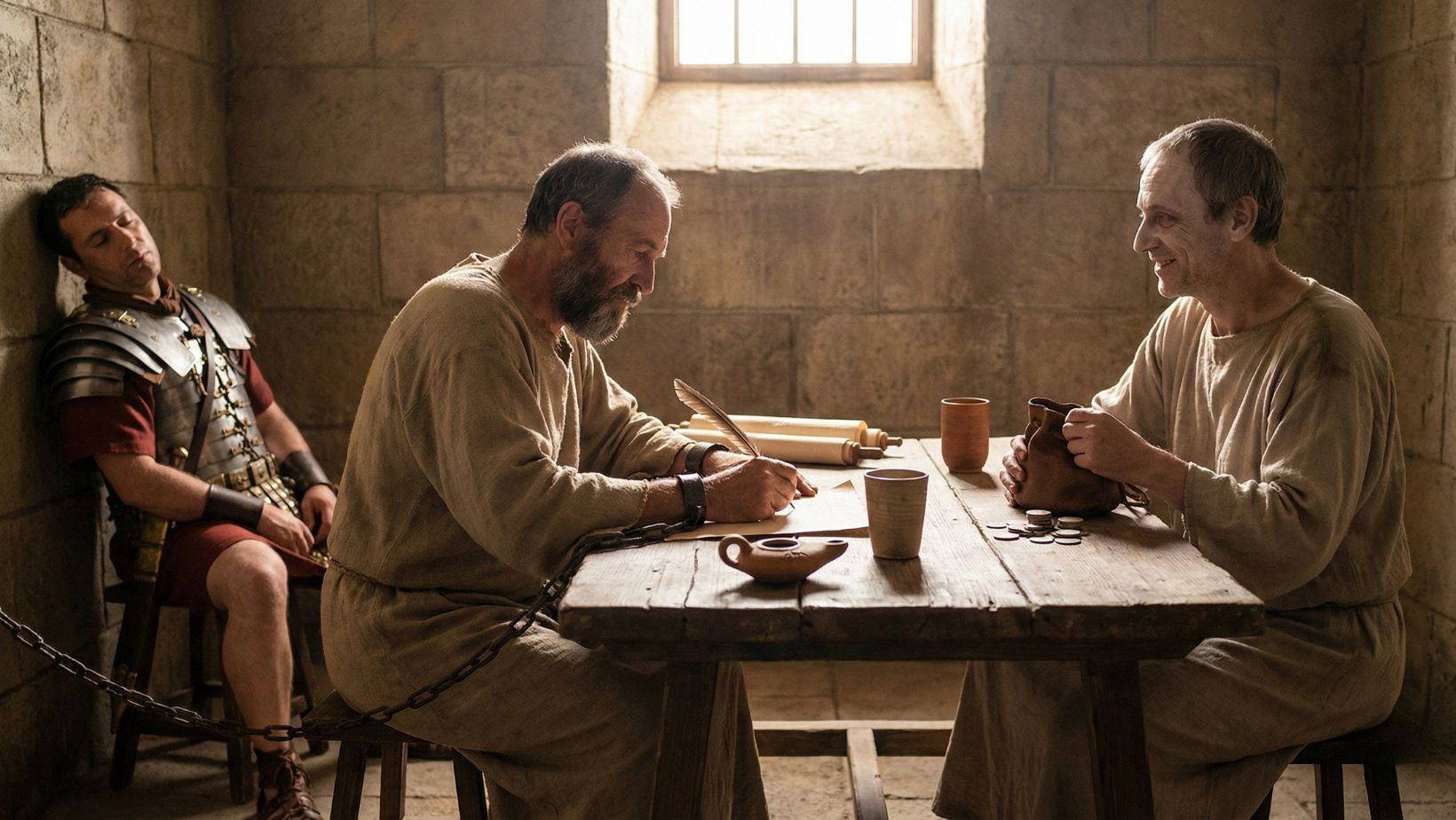
The Epistle to the Philippians is known as the “Epistle of Joy.” It is the most personal, affectionate, and optimistic of all Paul’s letters. Surprisingly, it was written while Paul was bound in chains, likely in a Roman prison facing potential execution. Unlike Galatians (which is a rebuke) or Corinthians (which is a correction), Philippians is primarily a “thank you” note to his beloved friends who had sent him financial support. It is a masterpiece of mindset, teaching that true joy is not dependent on external circumstances but on an internal relationship with Christ. It contains one of the most profound Christological passages in the New Testament—the “Hymn of Christ” (Chapter 2)—which describes the humility of God becoming man.
Quick Facts
- Author: The Apostle Paul (and Timothy)
- Date Written: ~61–62 AD
- Location: Written from prison (likely Rome)
- Audience: The Church in Philippi (the first church planted in Europe)
- Courier: Epaphroditus
- Theme: Joy in Suffering / The Mind of Christ
- Key Word: “Joy” or “Rejoice” (appears 16 times)
- Key Verse: Philippians 1:21 (“For to me, to live is Christ and to die is gain.”)
- Structure: Christ our Life (1) → Christ our Example (2) → Christ our Goal (3) → Christ our Strength (4)
- Symbol: The Runner — pressing on toward the prize
Title / Purpose
Title: The Epistle of Paul to the Philippians.
Purpose:
- Thanksgiving: To thank the Philippians for the gift sent via Epaphroditus.
- Update: To assure them that his imprisonment has actually served to advance the Gospel, not hinder it.
- Unity: To address a disagreement between two prominent women in the church (Euodia and Syntyche) by calling for humility.
Authorship & Context
The Author: Paul writes as a prisoner but considers himself a “slave of Christ Jesus.” His bond with this church was unique; they were his most consistent financial supporters.
The City: Philippi was a Roman colony in Macedonia (modern Greece). Its citizens were fiercely proud of their Roman citizenship. Paul plays on this by reminding them that their true “citizenship is in heaven” (3:20).
The History: The church began in Acts 16 with three unlikely converts: Lydia (a wealthy dealer in purple cloth), a demon-possessed slave girl, and a rugged Roman jailer.
Structure / Narrative Arc
The letter flows from Paul’s personal circumstances to the supreme example of Jesus, then to practical application.
1. The Perspective of Suffering (Chapter 1): Paul explains that his chains have emboldened others to preach. He wrestles with the dilemma: stay alive to help the church, or die and be with Jesus? He concludes, “To live is Christ, to die is gain.”
2. The Pattern of Humility (Chapter 2): To fix division, Paul points to Jesus. The “Kenosis Passage” (2:5–11) describes Jesus emptying Himself of glory to become a servant and die on a cross. Therefore, believers should do everything “without grumbling or arguing.”
3. The Prize of Pursuit (Chapter 3): Paul lists his impressive Jewish resume (Pharisee of Pharisees) and calls it “garbage” (rubbish) compared to the surpassing worth of knowing Christ. He describes the Christian life as a race, forgetting what lies behind and straining toward what is ahead.
4. The Power of Contentment (Chapter 4): Paul addresses the feud between Euodia and Syntyche. He gives the formula for peace (prayer + thanksgiving) and declares the secret of contentment: “I can do all things through Christ who gives me strength.”
Major Themes
Joy: This is the dominant atmosphere of the book. Paul demonstrates that joy is a defiant discipline that persists in spite of pain, prison, or poverty.
Humility (Kenosis): The path to exaltation is humiliation. Just as God exalted Jesus because He humbled Himself, believers are called to look to the interests of others.
Koinonia (Partnership): Paul uses this word to describe his deep fellowship with the Philippians. They are “partners” in grace and in the gospel.
Citizenship: In a city proud of being Roman, Paul reminds them that they belong to a heavenly colony and are waiting for a Savior from there.
Key Characters
Paul: The joyful prisoner. Timothy: Cited as the selfless example of someone who “takes a genuine interest in your welfare” (2:20). Epaphroditus: The “hero” of the letter. He risked his life to bring the gift to Paul, got sick and nearly died, and is now being sent back with this letter. Euodia and Syntyche: Two women who “contended at Paul’s side” but were currently fighting; Paul pleads with them to agree in the Lord.
Notable Passages
To Live is Christ (1:21): “For to me, to live is Christ and to die is gain.”
The Christ Hymn (2:5–11): “Who, being in very nature God… made himself nothing… therefore God exalted him to the highest place.”
The Rubbish Heap (3:8): “I consider them garbage, that I may gain Christ.”
The Peace of God (4:6–7): “Do not be anxious about anything… and the peace of God… will guard your hearts.”
The Secret of Contentment (4:13): “I can do all this through him who gives me strength.”
Legacy & Impact
Theology of Incarnation: Philippians 2 is the central text for understanding how Jesus was fully God and fully man (the Kenotic Theory).
Mental Health: Philippians 4:8 (“Whatever is true, whatever is noble…”) is often cited as an early form of cognitive reframing—teaching believers to discipline their thought life to maintain peace.
Symbolism / Typology
The Drink Offering: In 2:17, Paul describes his life as being “poured out like a drink offering.” In the Old Testament, wine was poured over a sacrifice to complete it. Paul views his potential martyrdom not as a tragedy, but as a joyful act of worship completing the church’s sacrifice.
The Race: The image of the runner leaning forward, eyes locked on the finish line, refusing to look back.







Leave a Reply