
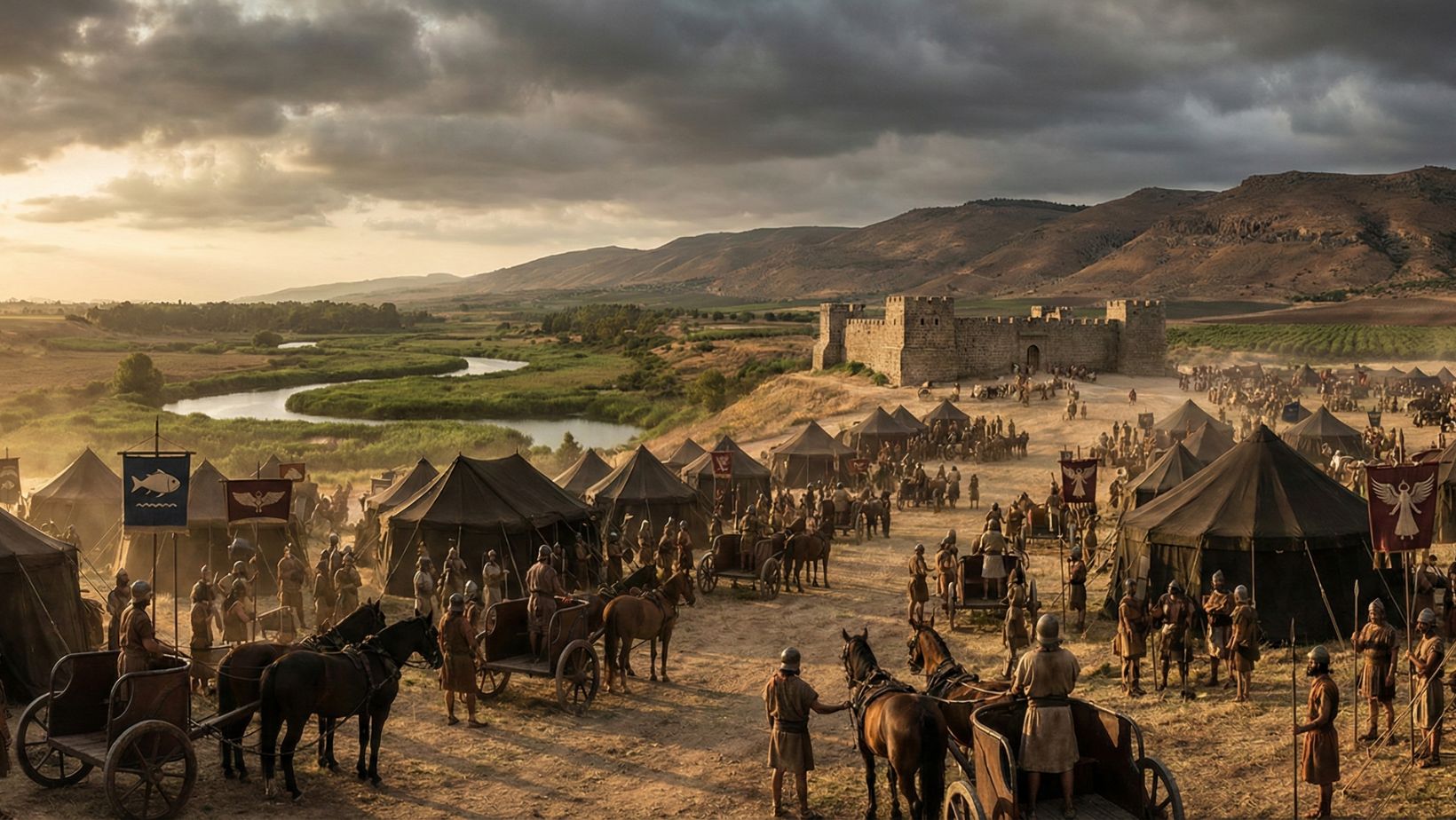
Aphek, meaning “Enclosure” or “Fortress,” is one of the most strategically significant locations in the biblical world. Situated on the Sharon Plain, it served as a vital military outpost and a frequent staging ground for international conflict. Throughout the Old Testament, Aphek repeatedly appears as a site of both Israelite defeat and divine encounter, most notably as the place where the Ark of the Covenant was captured and where King David was providentially spared from fighting his own people.
- Name: Aphek (Hebrew: ‘Afeq, meaning Fortress or Bed of a Stream)
- Location: Sharon Plain, near the headwaters of the Yarkon River (Modern-day Tel Afek)
- Era: Bronze and Iron Ages (Primary biblical mentions in 11th–9th centuries BCE)
- Significance: Strategic military camp on the Via Maris (The Way of the Sea)
- Key Enemies: The Philistines and the Arameans (Syrians)
- Biblical References: Joshua, 1 Samuel, 2 Samuel, 1 Kings, 2 Kings
- Legacy: Known as a site of military gathering and a “gateway” between the coast and the hills
- Symbol: A chariot or a fortress wall, symbolizing military might and territorial control
Name Meaning
The name Aphek likely refers to the strength of its fortifications or its location near the abundant springs of the Yarkon River. In the ancient world, “Aphek” was a common name for cities located near water sources or in defensible positions, but the Aphek of the Sharon Plain is the most prominent in the biblical narrative.
Geographical / Strategic Context
Location: Situated on the Via Maris, the ancient international highway connecting Egypt to the south with Mesopotamia to the north.
Strategic Position: It sat at a narrow “bottleneck” between the marshes of the Yarkon River and the foothills of Samaria. Controlling Aphek meant controlling the flow of trade and military movement through the region.
Terrain: The flat plains surrounding the city made it an ideal staging ground for armies utilizing chariots, which struggled in the rocky hill country where the Israelites typically resided.
Major Biblical Events
Capture of the Ark (1 Samuel 4): The Philistines camped at Aphek while Israel camped at Ebenezer. The Philistines defeated Israel, killed the sons of Eli, and captured the Ark of the Covenant, leading to the temporary spiritual desolation of Israel.
The Rejection of David (1 Samuel 29): The Philistine lords gathered at Aphek to prepare for battle against King Saul. David and his men were initially among them, but the Philistine commanders mistrusted David and forced him to leave. This prevented David from participating in the battle at Mount Gilboa where Saul and Jonathan were killed.
Victory Over the Arameans (1 Kings 20): Generations later, King Ahab of Israel defeated Ben-Hadad II of Aram at Aphek. The city wall famously fell, killing 27,000 Aramean soldiers, an event portrayed as a divine judgment.
Key Character Connections
Eli the Priest: Received the news of the disaster at Aphek (the loss of the Ark), which caused him to fall and die.
King Saul: His final military defeat was set in motion by the Philistine mobilization that began at the gates of Aphek.
David: His integrity and future kingship were preserved at Aphek when he was dismissed from the Philistine ranks, sparing him from “bloodguilt” against his own nation.
Prophet Elisha: Prophesied that King Jehoash would strike the Arameans at Aphek until they were destroyed (2 Kings 13:17).
Historical & Archaeological Significance
Tel Afek: Today, the site is a National Park in Israel (Antipatris). Archaeology has revealed layers of Canaanite palaces, Egyptian influence, and later Roman construction by Herod the Great.
Military Pattern: Aphek was the “staging ground of choice” for the Philistines. Because it was located on the border between the coastal plain and the Israelite hill country, it served as the jumping-off point for inland invasions.
Legacy & Spiritual Symbolism
The Turning Point: In the Bible, Aphek often represents a threshold or a moment of decision. For Saul, it was the beginning of the end; for David, it was a moment of divine protection.
God’s Sovereignty: The events at Aphek—whether the return of the Ark or the falling of the city walls—demonstrate that while man chooses the battlefield, God determines the outcome.







Leave a Reply