
Genesis 35 is a pivotal transition chapter marked by spiritual renewal, covenant confirmation, and significant family changes through birth and death. Following the violence at Shechem, God commands Jacob to return to Bethel, the site of his initial encounter with the Lord. Jacob leads his family in a necessary spiritual purging, burying their foreign gods before traveling under divine protection. At Bethel, God appears to Jacob again, reiterating the name change to “Israel” and confirming the Abrahamic covenant regarding land and numerous descendants. The narrative then turns tragic as they travel toward Ephrath; Rachel dies giving birth to Benjamin, the final of the twelve sons. The chapter records a grievous sin by Reuben against his father, lists the complete roster of the twelve sons of Jacob, and concludes with Jacob’s return to his father Isaac in Hebron, followed by Isaac’s death and his burial by Esau and Jacob together.
1. The Call to Bethel and Spiritual Cleansing (Genesis 35:1–8 NLT)
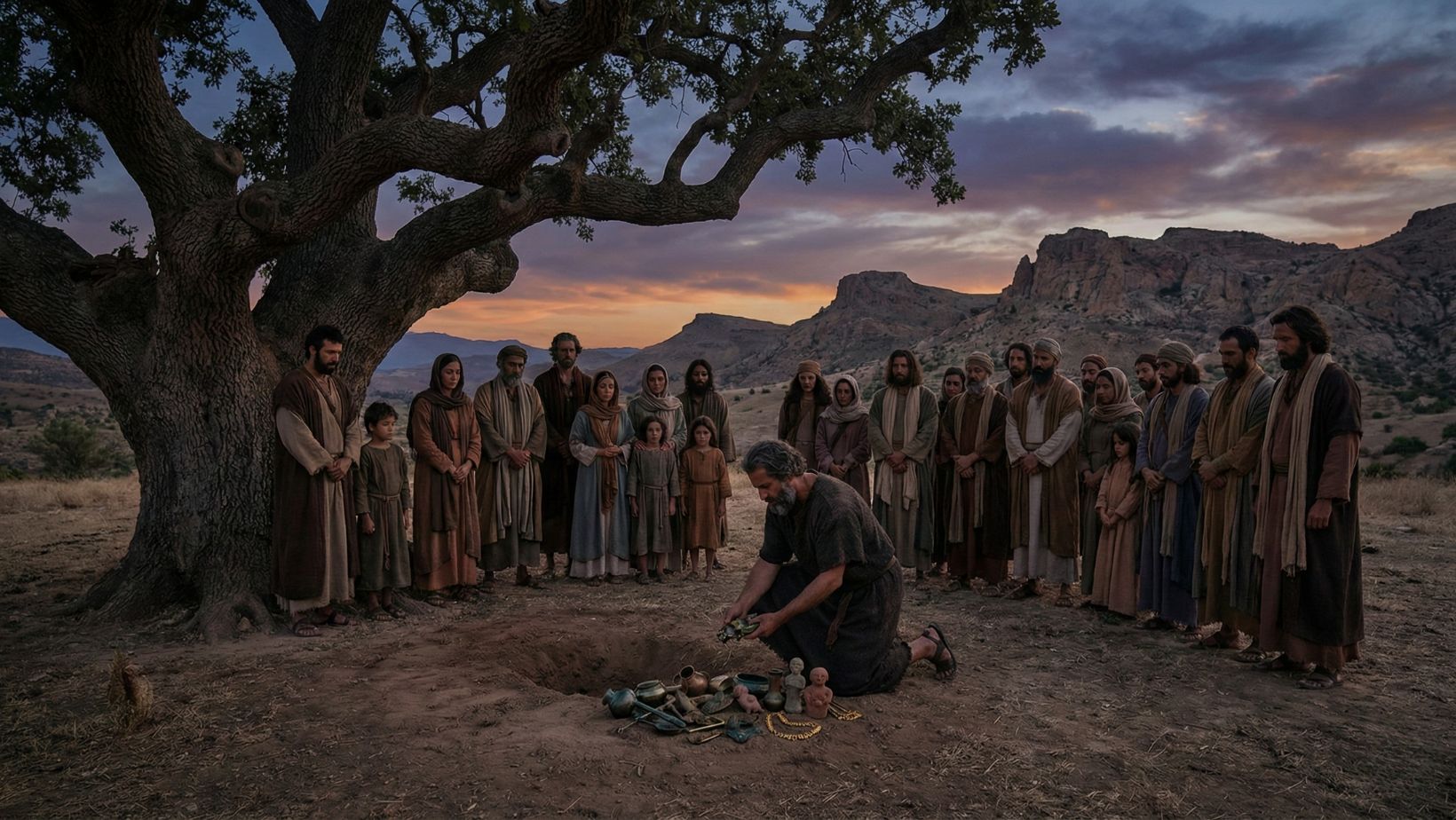
1 Then God said to Jacob, “Get up! Move to Bethel and settle there. Build an altar there to the God who appeared to you when you fled from your brother, Esau.” 2 So Jacob told everyone in his household, “Get rid of the pagan gods you own, and purify yourselves and put on clean clothes. 3 We are now going to Bethel, where I will build an altar to the God who answered my prayers when I was in distress. He has been with me wherever I have gone.” 4 So they gave Jacob all their pagan gods and earrings, and he buried them under the great tree near Shechem. 5 As they set out, a terror from God came over the people in all the towns of that area, so no one attacked them. 6 Eventually, Jacob and his household arrived at Luz (now called Bethel) in Canaan. 7 Jacob built an altar there and named the place El-bethel (which means “God of Bethel”), because God had appeared to him there when he was fleeing from his brother, Esau. 8 Soon after this, Rebekah’s old nurse, Deborah, died. She was buried beneath the oak tree in the valley below Bethel. Ever since, it has been known as Allon-bacuth (which means “Oak of Weeping”).
Commentary:
- The Divine Directive (v. 1): God initiates this movement. Following the disaster at Shechem (Genesis 34), Jacob is paralyzed. God directs him back to Bethel, the place of his original vow some twenty years earlier (Genesis 28:20–22). It is time for Jacob to fulfill his promise to make Yahweh his God having returned safely to the land.
- Spiritual Housecleaning (v. 2): Jacob finally assumes spiritual leadership of his clan. The command to “get rid of the pagan gods” indicates that his household had been tolerating idolatry. These idols likely included the teraphim Rachel stole from Laban (Genesis 31:19) and gods looted from the city of Shechem.
- Ritual Purification (v. 2): The instruction to “purify yourselves and put on clean clothes” involves external rites symbolizing an internal reality. They are preparing for a holy encounter with God, requiring a break from their defiled past.
- The God Who Answers (v. 3): Jacob identifies God not just by title, but by personal history: “the God who answered my prayers when I was in distress.” His faith is rooted in personal experience of divine deliverance.
- A Total Break (v. 4): The family surrenders not just idols but also “earrings,” which in the ancient Near East often functioned as amulets associated with pagan deities. Jacob buries them under a “great tree near Shechem,” signifying a permanent burial of their old life before moving to the new.
- Divine Protection (v. 5): After the massacre perpetrated by Simeon and Levi in chapter 34, Jacob feared retaliation from the Canaanites. God provides supernatural protection by sending a “terror from God” (divine panic) upon the surrounding towns, ensuring safe passage.
- El-bethel (v. 7): Upon arriving at Luz/Bethel, Jacob builds an altar. He names the sacred site El-bethel, meaning “God of the House of God.” He is worshipping the God of the place, not just the place itself.
- The Death of Deborah (v. 8): This is a touching historical note. Deborah was Rebekah’s nurse who had accompanied her from Paddan-aram years prior (Genesis 24:59). That she was with Jacob suggests she may have joined him after Rebekah’s death. The deep mourning and naming of the tree “Oak of Weeping” indicate she was a beloved and significant figure in the family structure.
2. God Confirms the Covenant and Jacob’s Name (Genesis 35:9–15 NLT)
9 Now that Jacob had returned from Paddan-aram, God appeared to him again at Bethel. God blessed him, 10 saying, “Your name is Jacob, but you will not be called Jacob any longer. From now on your name will be Israel.” So God renamed him Israel. 11 Then God said, “I am El-Shaddai—‘God Almighty.’ Be fruitful and multiply. You will become a great nation, even many nations. Kings will be among your descendants! 12 And I will give you the land I once gave to Abraham and Isaac. Yes, I will give it to you and your descendants after you.” 13 Then God went up from the place where he had spoken to Jacob. 14 Jacob set up a stone pillar to mark the place where God had spoken to him, and he poured wine over it as an offering to God and anointed it with olive oil. 15 Jacob named the place Bethel (which means “house of God”), because God had spoken to him there.
Commentary:
- The Reappearance (v. 9): This is God’s first direct appearance to Jacob since the wrestling match at Peniel (Genesis 32). It marks the successful completion of his long exile and return to the land.
- Confirming the Name Israel (v. 10): Although the name change occurred during the wrestling match, it is formally ratified here in the land of promise. The name “Jacob” (Grasper/Deceiver) is officially replaced with “Israel” (God Prevails/Struggles with God), marking his matured character and status.
- El-Shaddai and the Covenant (v. 11–12): God identifies Himself as El-Shaddai (God Almighty), the same title used when confirming the covenant with Abraham (Genesis 17:1). The promises are threefold and standard to the Abrahamic covenant:
- Jacob’s Worship (v. 14): Jacob responds with formal acts of worship. He sets up a memorial pillar, marking sacred space. He offers a drink offering (wine signifying joy or life poured out) and anoints it with oil (signifying consecration).
- Naming Bethel Again (v. 15): Jacob reaffirms the name he gave the place twenty years earlier, solidifying its identity as the “House of God.”
3. Tragic Birth of Benjamin and Death of Rachel; Reuben’s Sin (Genesis 35:16–22a NLT)
16 Leaving Bethel, they moved on toward Ephrath. But while they were still some distance away, Rachel went into labor. And she had terrible pain in childbirth. 17 When she was in the midst of her delivery, the midwife said to her, “Don’t be afraid! You have another son.” 18 Before she breathed her last—for she was dying—she named him Ben-oni (which means “son of my sorrow”). But his father called him Benjamin (which means “son of my right hand”). 19 So Rachel died and was buried on the way to Ephrath (that is, Bethlehem). 20 Jacob set up a stone pillar over Rachel’s grave, and it can be seen there to this day. 21 Then Jacob traveled on and camped beyond Migdal-eder. 22 While he was living there, Reuben, Jacob’s oldest son, slept with Bilhah, his father’s concubine. And Israel heard about it.
Commentary:
- Journey toward Ephrath (v. 16): The group moves south from Bethel toward Ephrath, an older name for the area around Bethlehem.
- Tragic Childbirth (v. 17–18): Rachel’s desire for children had been intense (“Give me children, or I shall die!” – Genesis 30:1). Ironically, she dies fulfilling that desire.
- Ben-oni vs. Benjamin (v. 18): In her final breaths, Rachel names the boy Ben-oni, “son of my sorrow” or “son of my misfortune,” defining him by the tragedy of his birth. Jacob intervenes, renaming him Benjamin, “son of my right hand.” The right hand symbolized strength, honor, and favor. Jacob refuses to let his youngest son carry the stigma of causing his mother’s death, instead bestowing a name of high standing.
- Rachel’s Burial (v. 19–20): Rachel is the only matriarch not buried in the ancestral tomb at Machpelah in Hebron. Jacob erects a pillar, creating a landmark of grief that existed for centuries. Some commentators see her premature death as a tragic fulfillment of Jacob’s unwitting curse pronounced against whoever stole Laban’s gods (Genesis 31:32).
- Reuben’s Transgression (v. 22a): In a shocking narrative turn, Reuben, the firstborn, commits incest with Bilhah, Rachel’s servant and Jacob’s concubine (the mother of Dan and Naphtali). In the ancient Near East, claiming a king’s or patriarch’s concubine was a claim to his authority and throne (cf. 2 Samuel 16:21–22). This was not merely lust; it was a power move challenging Jacob’s leadership.
- Israel’s Reaction (v. 22a): The text simply says, “And Israel heard about it.” The use of the name “Israel” here may emphasize his role as clan head. His silence is ominous. While immediate action isn’t recorded here, this act later disqualifies Reuben from the rights of the firstborn (Genesis 49:3–4; 1 Chronicles 5:1).
4. The Twelve Sons of Jacob (The Roster) (Genesis 35:22b–26 NLT)
These are the names of the twelve sons of Jacob: 23 The sons of Leah were Reuben (Jacob’s oldest son), Simeon, Levi, Judah, Issachar, and Zebulun. 24 The sons of Rachel were Joseph and Benjamin. 25 The sons of Bilhah, Rachel’s servant, were Dan and Naphtali. 26 The sons of Zilpah, Leah’s servant, were Gad and Asher. These were the sons born to Jacob at Paddan-aram.
Commentary:
- Consolidation of the Tribes (v. 22b–26): With the birth of Benjamin, the family unit is complete. The text pauses to provide a formal census. This is no longer just a family; it is the embryonic nation of Israel.
- Grouping by Mothers: The sons are grouped according to their mothers, reflecting the complex family dynamics.
- Geographical Note (v. 26): The text notes these were born in Paddan-aram, which is true for eleven of them. Benjamin, born in Canaan, is grouped with them dynamically to complete the list of twelve.
5. Jacob Returns to Isaac; Isaac’s Death (Genesis 35:27–29 NLT)
27 So Jacob returned to his father, Isaac, in Mamre, which is near Kiriath-arba (now called Hebron), where Abraham and Isaac had lived. 28 Isaac lived for 180 years. 29 Then he breathed his last and died at a ripe old age, joining his ancestors in death. And his sons, Esau and Jacob, buried him.
Commentary:
- Full Circle (v. 27): Jacob finally arrives at Hebron, completing the journey away from his father that began decades earlier because of his deception.
- Isaac’s Longevity (v. 28): Isaac lives to 180. It is noteworthy that years earlier, when Jacob tricked him, Isaac believed he was near death (Genesis 27:2). He lived possibly another 40+ years after that event, long enough to see Jacob return.
- Gathered to His People (v. 29): A common Old Testament phrase implying life beyond the grave—a reunion with ancestors in Sheol.
- Brotherly Unity in Grief (v. 29): The chapter closes with Esau and Jacob burying their father together. Just as Isaac and Ishmael united to bury Abraham (Genesis 25:9), this act signifies at least a functional reconciliation and peace between the twin brothers.
Theological Significance of Genesis 35
- Spiritual Renewal and Repentance: The chapter emphasizes that returning to God often requires active purgation of idolatry and a renewal of commitment. One cannot move forward spiritually while clinging to the sins of the past.
- Fidelity of God to the Covenant: Despite Jacob’s flaws and his family’s dysfunction, God remains faithful to the Abrahamic promise, confirming the land, descendants, and future kings. The covenant depends on God’s character, not human performance.
- The Sovereignty of God over Life and Death: The chapter encompasses the full spectrum of mortal life: childbirth, the death of a beloved nurse, the death of a cherished wife, and the death of a patriarch. God’s purposes move forward through generations, regardless of individual mortality.
- The Formation of Israel: The completion of the twelve sons marks the transition from the history of individual patriarchs (Abraham, Isaac, Jacob) to the history of the nation of Israel (the twelve tribes).
Practical Applications
- Buried Idols: We must regularly examine our lives for modern “idols”—anything that competes for the supreme loyalty and trust we owe to God—and decisively “bury” them.
- Returning to “Bethel”: It is valuable to revisit (physically or mentally) places or moments of past spiritual significance where God met us in a profound way, using them as anchor points for renewed faith.
- Naming the Narrative: Like Jacob renaming Ben-oni to Benjamin, we have a role in interpreting the events of our lives. Where trauma says “son of sorrow,” faith can intervene and speak “son of strength” or “son of the right hand.” We must not let tragedy define our future identity.
- God’s Protection in Obedience: When Jacob finally obeyed the call to go to Bethel, God supernaturally protected him from his enemies. Obedience to God is often the safest path, even when it seems dangerous.
Final Insight
Genesis 35 acts as a grand concluding chapter to the patriarchal narrative focused on individuals. It ties up loose ends—the fulfillment of Jacob’s vow, the burial of idols, the final naming of Israel, the completion of the twelve sons, and the death of Isaac. The stage is now fully set for the next major movement of Genesis: the story of Joseph and the descent of the entire nation into Egypt.







Leave a Reply