
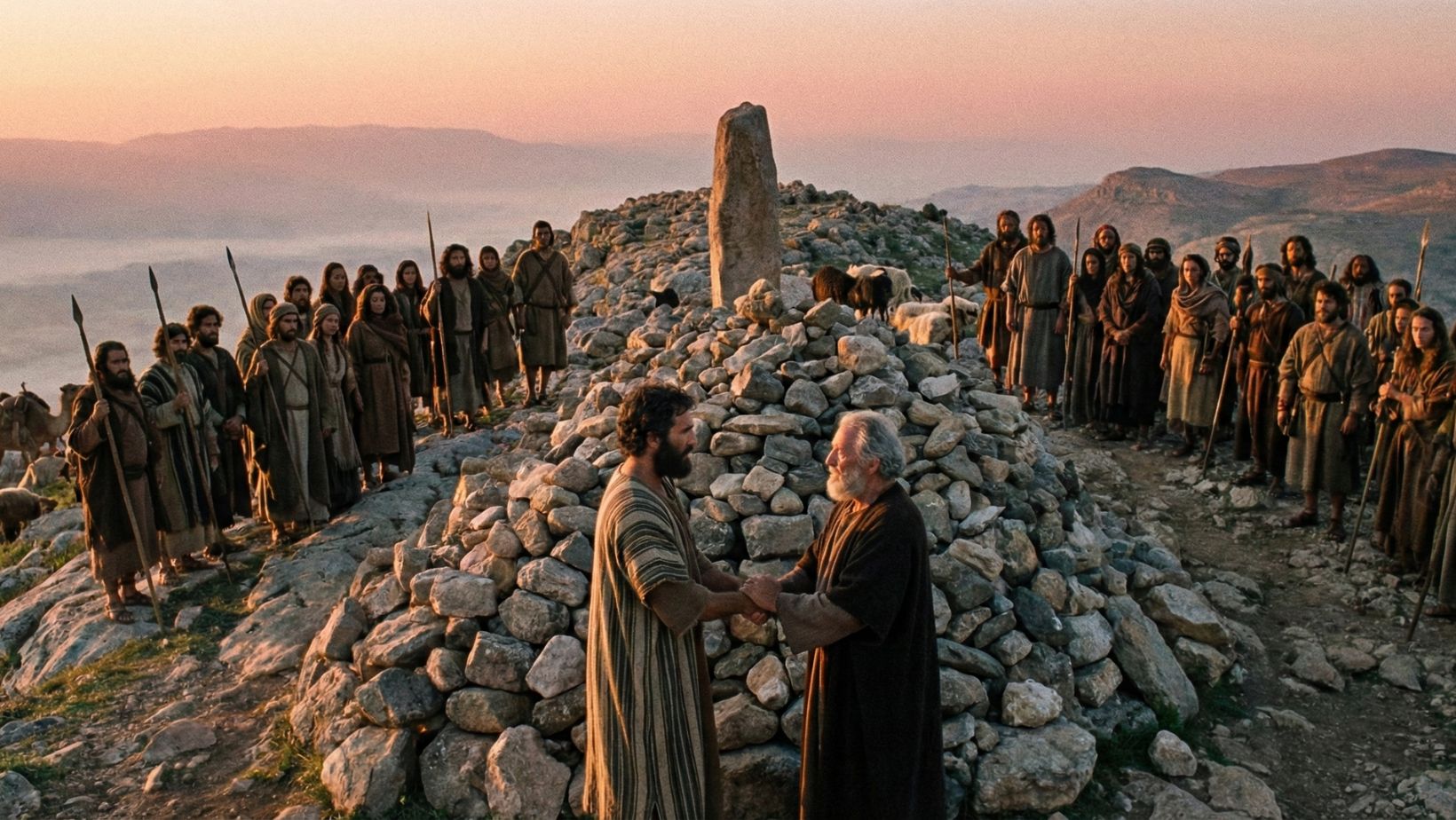
Genesis 31 marks a decisive turning point in the life of Jacob as he transitions from a life of servitude under his uncle Laban to a life of independence in the Promised Land. After twenty years of labor, divine intervention and increasing hostility from Laban’s family prompt Jacob’s departure. The chapter is characterized by themes of divine protection, family conflict, and the transition from deception to covenant. It concludes with a dramatic confrontation and a formal treaty at Mizpah, serving as a legal and spiritual boundary between Jacob’s past in Paddan-aram and his future in Canaan.
1. Jacob’s Decision to Leave (Genesis 31:1–16 NLT)
1 But Jacob soon learned that Laban’s sons were grumbling. “Jacob has robbed our father of everything!” they said. “He has gained all his wealth at our father’s expense.” 2 And Jacob began to notice a change in Laban’s attitude toward him. 3 Then the Lord said to Jacob, “Return to the land of your father and grandfather and to your relatives there, and I will be with you.” 4 So Jacob called Rachel and Leah out to the field where he was watching his flock. 5 He said to them, “I have noticed that your father’s attitude toward me has changed. But the God of my father has been with me. 6 You know how hard I have worked for your father, 7 but he has cheated me, changing my wages ten times. But God has not allowed him to do me any harm. 8 For if he said, ‘The speckled animals will be your wages,’ the whole flock began to have speckled young. And when he changed his mind and said, ‘The striped animals will be your wages,’ then the whole flock had striped young. 9 In this way, God has taken your father’s animals and given them to me. 10 One time during the mating season, I had a dream and saw that the male goats mating with the females were striped, speckled, and spotted. 11 Then in my dream, the angel of God said to me, ‘Jacob!’ And I replied, ‘Yes, here I am.’ 12 The angel said, ‘Look up and see that all the male goats mating with the females are striped, speckled, and spotted, for I have seen all that Laban has been doing to you. 13 I am the God who appeared to you at Bethel, the place where you anointed the pillar of stone and made a vow to me. Now get ready and leave this land and return to the land of your birth.’” 14 Rachel and Leah answered, “That’s fine with us! We won’t inherit any of our father’s wealth anyway. 15 He has reduced us to the level of foreigners. He sold us, and he has already used up the money he received from the sale. 16 All the wealth that God has given you from our father legally belongs to us and our children. So go ahead and do whatever God has told you to do.”
Commentary:
- Social and Divine Pressure (v. 1–3): Jacob’s departure is triggered by two factors: the envy of Laban’s sons and a direct command from God. This illustrates how God often uses “uncomfortable” circumstances to move His people toward their destiny.
- The Change in Wages (v. 7): Laban is portrayed as the ultimate deceiver. The “ten times” is likely a figurative expression for “many times,” showing Laban’s constant attempts to exploit Jacob.
- Divine Intervention in Biology (v. 8–12): Jacob attributes his success not to his own breeding techniques (as mentioned in Chapter 30) but to God’s sovereign justice. God essentially “transferred” the wealth from the oppressor to the oppressed.
- The God of Bethel (v. 13): God identifies Himself as the God of Bethel, reminding Jacob of the vow made twenty years prior. This emphasizes God’s long-term faithfulness.
- Unity of the Wives (v. 14–16): Rachel and Leah, often rivals, are united in their resentment of their father’s greed. They recognize that God has provided for them through Jacob’s flocks, effectively providing them with the “dowry” Laban never gave them.
2. The Flight from Laban (Genesis 31:17–24 NLT)
17 So Jacob put his children and his wives on camels, 18 and he drove all his livestock ahead of him. He packed all the belongings he had acquired in Paddan-aram and set out for the land of Canaan, where his father, Isaac, lived. 19 At the time they left, Laban was some distance away, shearing his sheep. Rachel stole her father’s household idols and took them with her. 20 Jacob misled Laban the Aramean by not telling him he was leaving. 21 So Jacob took all his possessions with him and fled across the Euphrates River, heading for the hill country of Gilead. 22 Three days later, Laban was told that Jacob had fled. 23 So he gathered a group of his relatives and set out in hot pursuit. He caught up with Jacob seven days later in the hill country of Gilead. 24 But the previous night God had appeared to Laban the Aramean in a dream. “I’m warning you,” God said. “Be careful about what you say to Jacob!”
Commentary:
- The Great Escape (v. 17–21): Jacob flees toward the hill country of Gilead (east of the Jordan River). His “misleading” of Laban (literally “stealing the heart”) shows that Jacob still relies on stealth when he feels threatened.
- The Teraphim (v. 19): Rachel steals the “household idols” (teraphim). In that culture, possession of these idols could signify legal rights to the family inheritance or provide a sense of spiritual protection. Her act shows that she is still untying herself from her pagan background.
- God as the Protector (v. 24): Even though Laban has “relatives” (a small militia) and has “caught up” to Jacob, God intervenes. God’s warning to Laban—”Be careful about what you say”—prevents Laban from using violence or forced repatriation.
3. The Confrontation and Search (Genesis 31:25–42 NLT)
25 Laban caught up with Jacob as he was camped in the hill country of Gilead, and he set up his camp not far from Jacob’s. 26 “What do you mean by deceiving me like this?” Laban demanded. “You brought my daughters here like prisoners of war! 27 Why did you slip away secretly? Why did you deceive me? Why didn’t you say you wanted to leave? I would have given you a farewell party with singing and music, with tambourines and harps. 28 Why didn’t you let me kiss my daughters and grandchildren good-bye? You have acted very foolishly! 29 I could destroy you, but the God of your father appeared to me last night and warned me, ‘Be careful about what you say to Jacob!’ 30 I know you feel you must go, and you long for your father’s home. But why have you stolen my gods?” 31 Jacob replied to Laban, “I rushed away because I was afraid. I thought you would take your daughters from me by force. 32 But as for your gods, see if you can find them, and let whoever has them be put to death! In the presence of our relatives, check everything I have, and if you find anything that belongs to you, take it.” For Jacob didn’t know that Rachel had stolen the household idols. 33 Laban went first into Jacob’s tent to search there, then into Leah’s tent, and then into the tents of the two servant wives—but he found nothing. Finally, he went into Rachel’s tent. 34 But Rachel had taken the household idols and hidden them in her camel saddle, and now she was sitting on them. When Laban had finished searching her tent and found nothing, 35 she said to her father, “Please, sir, forgive me if I don’t get up, but I am having my monthly period.” So Laban continued his search, but he could not find the household idols. 36 Then Jacob became very angry, and he challenged Laban. “What’s my crime?” he demanded. “What have I done wrong to make you chase me as though I were a criminal? 37 You have rummaged through everything I own. Now show me what you found that belongs to you! Set it out here in front of us, before our relatives, for them to judge between us! 38 “For twenty years I have been with you. The ewes and female goats in your flock never miscarried. In all that time I never ate a single ram of yours for food. 39 If any were attacked by wild animals, I never showed them to you and asked you to reduce the loss from my wages. No, I took the loss myself! You made me pay for every animal stolen from the flocks, whether they were taken by day or by night. 40 “I worked for you through the scorching heat of the day and through cold and sleepless nights. 41 Yes, twenty years—fourteen to pay for your two daughters and six from the flock. And you changed my wages ten times! 42 In fact, if the God of my father hadn’t been on my side—the God of Abraham and the fearsome God of Isaac—you would have sent me away empty-handed. But God has seen your abuse and my hard work. That is why he appeared to you last night and rebuked you.”
Commentary:
- Laban’s Hypocrisy (v. 26–30): Laban plays the victim, claiming he wanted to throw a “party.” However, his true intent is revealed when he mentions his “gods.”
- Rachel’s Deception (v. 34–35): In a moment of high irony, Rachel uses her menstrual cycle to prevent her father from searching the camel saddle. By sitting on the idols, she demonstrates their powerlessness—the “gods” are literally being sat upon by a “ritually unclean” woman.
- Jacob’s Defense (v. 38–42): Jacob finally vents twenty years of frustration. He describes the harsh reality of ancient shepherding—bearing the losses of the flock and enduring extreme weather.
- The Fear of Isaac (v. 42): Jacob uses a unique title for God here: “the fearsome God of Isaac” (or “Fear of Isaac”). This reflects a deep, reverent awe of the God who holds the power of life and death.
4. The Covenant at Mizpah (Genesis 31:43–55 NLT)
43 Then Laban replied to Jacob, “These women are my daughters, these children are my grandchildren, and these flocks are my flocks—in fact, everything you see is mine. But what can I do now about my daughters and their children? 44 So come, let us make a covenant, you and I, and it will be a witness to our commitment.” 45 So Jacob took a stone and set it up as a memorial pillar. 46 Then he said to his relatives, “Gather some stones.” So they gathered stones and piled them in a heap. Then Jacob and Laban ate together beside the pile of stones. 47 Laban called the memorial heap Jegar-sahadutha (which means “witness heap” in Aramaic), and Jacob called it Galeed (which means “witness heap” in Hebrew). 48 Then Laban declared, “This pile of stones will stand as a witness to our commitment today.” This explains why it was called Galeed. 49 It was also called Mizpah (which means “watchtower”), for Laban said, “May the Lord keep watch between us to make sure that we keep this covenant when we are out of each other’s sight. 50 If you mistreat my daughters or if you marry other wives, God will see it even if no one else does. He is a witness to this covenant between us.” 51 Laban continued, “See this pile of stones, and see this memorial pillar I have set up between us. 52 They stand between us as witnesses of our vows. I will never pass this pile of stones to harm you, and you must never pass these stones or this memorial pillar to harm me. 53 I call on the God of Abraham and the God of Nahor—the gods of their ancestors—to judge between us.” So Jacob took an oath before the fearsome God of his father, Isaac. 54 Then Jacob offered a sacrifice to God there on the mountain and invited his relatives to a feast. They ate together and spent the night there on the mountain. 55 Laban got up early the next morning, and he kissed his grandchildren and his daughters and blessed them. Then he left and returned home.
Commentary:
- A Reluctant Peace (v. 43–44): Laban still claims ownership over everything Jacob has (“these flocks are my flocks”), but he recognizes he is powerless against Jacob’s God. The covenant is a “non-aggression pact.”
- The Language Barrier (v. 47): The naming of the heap in two languages (Aramaic and Hebrew) highlights the cultural and linguistic separation now beginning between the Arameans (Laban) and the Israelites (Jacob).
- Mizpah (v. 49): The “Mizpah Blessing” is often used today as a sentiment of friendship, but in context, it was a warning: “Since I can’t trust you, may God watch you to make sure you don’t cheat me.”
- Final Separation (v. 55): Laban’s departure marks the end of Jacob’s association with Paddan-aram. He is now free to pursue the promise in Canaan, though he must soon face his brother, Esau.
Theological Significance of Genesis 31
- God’s Justice for the Oppressed: God actively watched Laban’s exploitation of Jacob and intervened to ensure Jacob was rewarded for his labor.
- Providence in “Exile”: Jacob’s twenty years in Haran were a form of discipline and growth. God used a “deceiver” (Laban) to refine a “deceiver” (Jacob).
- The Powerlessness of Idols: The narrative mocks the household gods of Laban, showing they cannot even protect themselves from being stolen or sat upon.
Practical Applications
- Recognizing God’s Timing: Jacob waited for the right “signs” (attitude change) and the right “word” (God’s command) before moving.
- Integrity in Hardship: Despite Laban’s cheating, Jacob served faithfully (v. 38–40). Our work ethic should be based on our relationship with God, not just our treatment by our employers.
- Trusting God as Witness: When we cannot protect ourselves from those who mean us harm, we can trust God to be our “Mizpah”—the one who watches and judges fairly.







Leave a Reply