
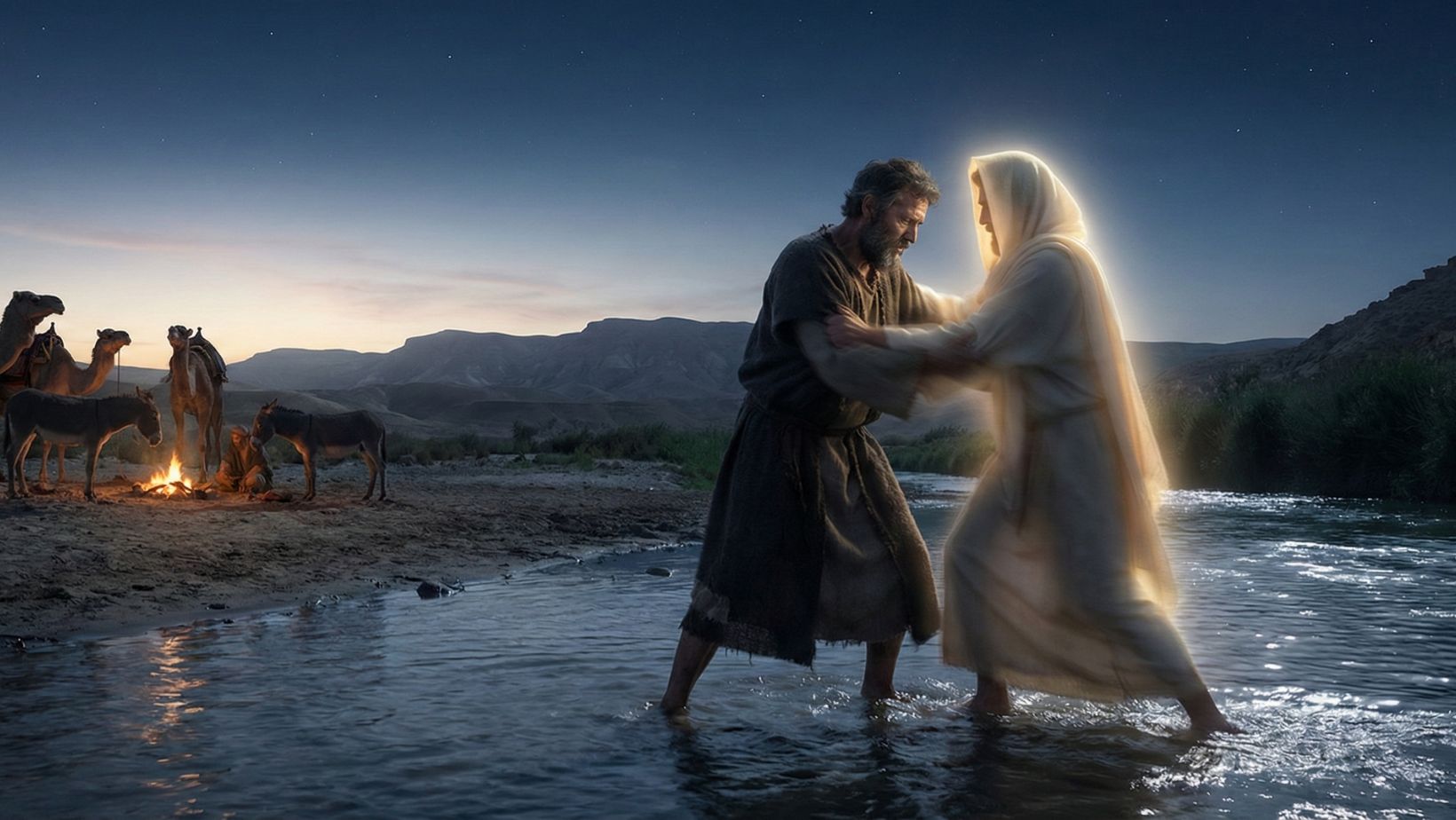
Genesis 32 is one of the most spiritually significant chapters in the life of Jacob. Having escaped Laban, Jacob now faces his greatest fear: a reunion with his brother Esau, whom he cheated twenty years earlier. The chapter is a masterclass in the tension between human preparation and divine dependence. It begins with an angelic encounter, continues with Jacob’s strategic and prayerful preparation for Esau, and culminates in a mysterious, all-night wrestling match with God at the Jabbok River. This encounter leaves Jacob physically limping but spiritually transformed, receiving the new name Israel.
1. The Angels of Mahanaim (Genesis 32:1–2 NLT)
1 As Jacob started on his way, some angels of God came to meet him. 2 When Jacob saw them, he exclaimed, “This is God’s camp!” So he named the place Mahanaim.
Commentary:
- Encouragement for the Journey (v. 1): Just as Jacob saw angels at Bethel when leaving Canaan (Gen 28), he sees them again upon his return. This serves as a “divine bookend,” assuring him of God’s presence.
- Mahanaim (v. 2): The name means “Two Camps.” Jacob recognizes that he is not alone; while he has his earthly camp of family and livestock, there is a visible heavenly camp protecting him.
2. Jacob Prepares to Meet Esau (Genesis 32:3–21 NLT)
3 Then Jacob sent messengers ahead to his brother, Esau, who was living in the region of Seir in the land of Edom. 4 He told them, “Give this message to my master Esau: ‘Humble greetings from your servant Jacob. Until now I have been living with Uncle Laban, 5 and now I own cattle, donkeys, flocks of sheep and goats, and many servants, both men and women. I have sent these messengers to inform my lord of my arrival, hoping that you will be friendly to me.’” 6 After delivering the message, the messengers returned to Jacob and reported, “We met your brother, Esau, and he is already on his way to meet you with an army of 400 men!” 7 Jacob was terrified at the news. He divided his household, along with the flocks and herds and camels, into two groups. 8 He thought, “If Esau meets one group and attacks it, the other group can escape.” 9 Then Jacob prayed, “O God of my grandfather Abraham, and God of my father, Isaac—O Lord, you told me, ‘Return to your own land and to your relatives.’ And you promised me, ‘I will treat you kindly.’ 10 I am not worthy of all the unfailing love and faithfulness you have shown to me, your servant. When I left home and crossed the Jordan River, I owned nothing but a walking stick. Now my household fills two large camps! 11 O Lord, please rescue me from the hand of my brother, Esau. I am afraid that he is coming to attack me and slaughter my wives and children. 12 But you promised me, ‘I will surely treat you kindly, and I will multiply your descendants until they become as numerous as the sands along the seashore—too many to count.’” 13 Jacob stayed there for the night. Then he selected these gifts from his possessions to present to his brother, Esau: 14 200 female goats, 20 male goats, 200 female sheep, 20 male sheep, 15 30 female camels with their young, 40 cows, 10 bulls, 20 female donkeys, and 10 male donkeys. 16 He divided these animals into herds and gave each herd to a different servant. Then he said to his servants, “Go ahead of me with the animals, but keep some distance between the herds.” 17 He gave these instructions to the men leading the first herd: “When my brother, Esau, meets you, he will ask, ‘Whose servant are you? Where are you going? Who owns these animals?’ 18 You must reply, ‘They belong to your servant Jacob, but they are a gift for his master Esau. Look, he is coming right behind us.’” 19 Jacob gave the same instructions to the second and third herdsmen and to all who followed behind the herds: “You must say the same thing to Esau when you meet him. 20 And be sure to say, ‘Look, your servant Jacob is right behind us.’” Jacob thought, “I will try to appease him with these gifts. When I finally see him, perhaps he will be friendly to me.” 21 So the gifts were sent on ahead, while Jacob stayed that night in the camp.
Commentary:
- The Report of 400 Men (v. 6): In the ancient world, 400 men constituted a small army. To Jacob, this sounds like a war party, not a welcoming committee.
- The Prayer of a Broken Man (v. 9–12): This is one of the most profound prayers in Genesis. Jacob displays:
- Strategy vs. Faith (v. 13–21): Jacob utilizes a “staggered gift” strategy. By sending five separate waves of livestock, he hopes to wear down Esau’s anger through repeated displays of generosity and submission.
3. Wrestling with God (Genesis 32:22–32 NLT)
22 During the night Jacob got up and took his two wives, his two servant wives, and his eleven sons and crossed the Jabbok River with them. 23 After he had sent them across the stream, he sent over all his possessions. 24 This left Jacob all alone in the camp, and a man came and wrestled with him until the dawn began to break. 25 When the man saw that he would not win the match, he touched Jacob’s hip and wrenched it out of its socket. 26 Then the man said, “Let me go, for the dawn is breaking!” But Jacob said, “I will not let you go unless you bless me.” 27 “What is your name?” the man asked. He replied, “Jacob.” 28 “Your name will no longer be Jacob,” the man told him. “From now on you will be called Israel, because you have fought with God and with men and have won.” 29 “Please tell me your name,” Jacob said. “Why do you want to know my name?” the man replied. Then he blessed Jacob there. 30 Jacob named the place Peniel (which means “face of God”), for he said, “I have seen God face to face, yet my life has been spared.” 31 The sun was rising as Jacob left Peniel, and he was limping because of his hip. 32 (Even today the people of Israel do not eat the tendon near the hip socket because of what happened that night when the man fought with Jacob and struck him on that tendon.)
Commentary:
- Solitude (v. 24): To meet God deeply, Jacob had to be stripped of his family, his wealth, and his cleverness. He is “all alone.”
- The Identity of the “Man”: While described as a man, Hosea 12:4 calls him an angel, and Jacob concludes he has seen God (v. 30). Most theologians see this as a theophany or a Christophany (a pre-incarnate appearance of Christ).
- The Dislocated Hip (v. 25): God touches the strongest muscle in Jacob’s body. By weakening his physical strength, God forces Jacob to cling to Him with spiritual strength. He wins by losing.
- A New Name (v. 27–28): * Jacob: “Heel-grabber” or “Deceiver.”
- The Limp (v. 31): Jacob leaves Peniel with a permanent limp. It is a reminder that a true encounter with God leaves us changed and permanently dependent on Him.
Theological Significance of Genesis 32
- The Necessity of Brokenness: Jacob’s self-reliance had to be broken before he could become the father of a nation. God often uses our “fearsome” encounters to bring us to the end of ourselves.
- Persistence in Prayer: “I will not let you go unless you bless me” is the ultimate cry of a desperate soul. It teaches that God honors holy persistence.
- Grace and Identity: God redefines Jacob not based on his past deceits, but based on his new relationship with the Almighty.
Practical Applications
- Take Your Fears to God: Jacob was “terrified” (v. 7), but he channeled that terror into a detailed, humble prayer.
- Wrestling in the Dark: Many of our greatest spiritual victories happen in seasons of loneliness and struggle. Don’t fear the “wrestling” matches of life.
- The Cost of Blessing: To walk with God often means walking with a “limp”—carrying the marks of our struggles as badges of God’s grace.







Leave a Reply