
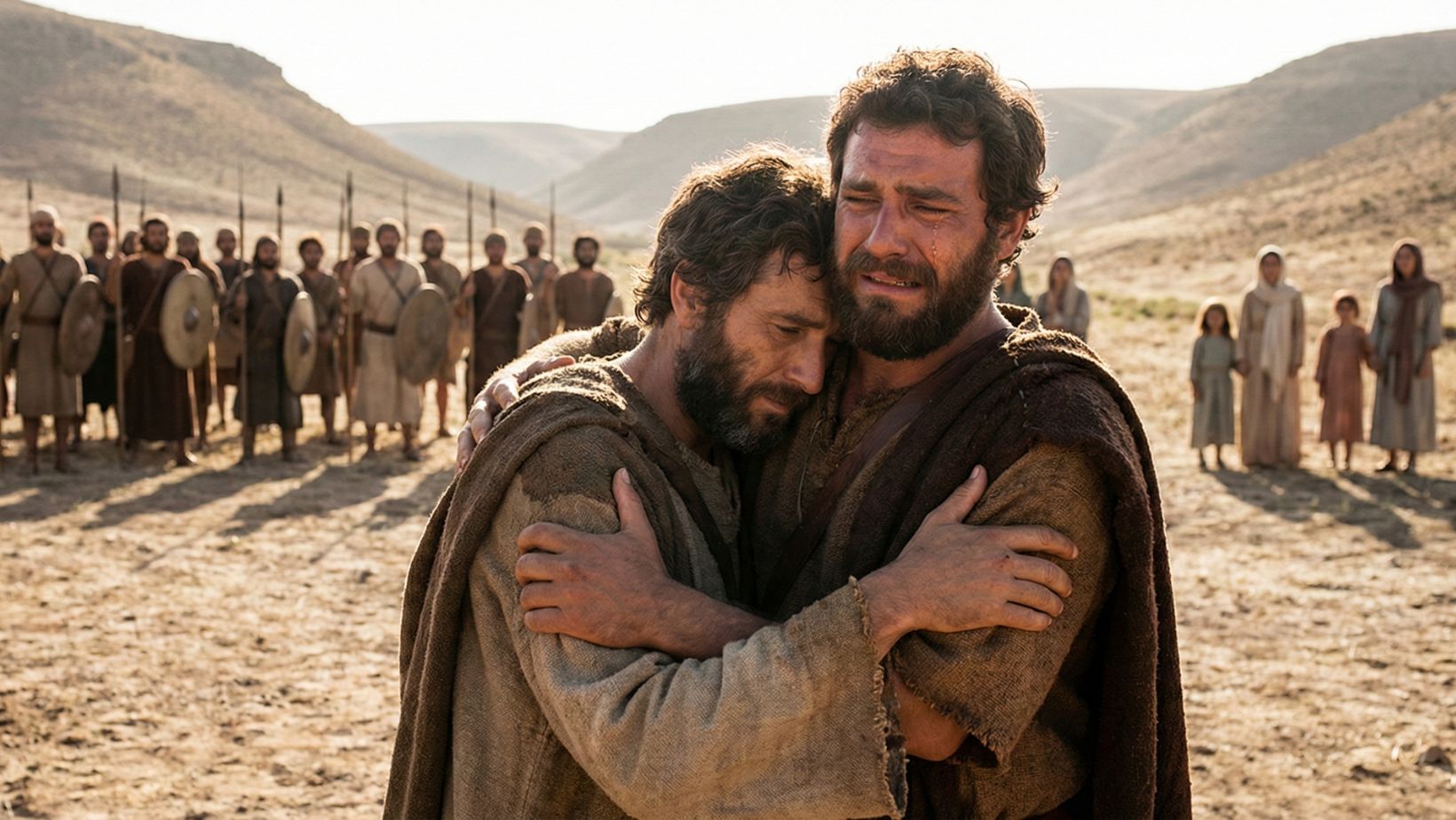
Genesis 33 marks the climax of the suspense built in the previous chapter. After a night of wrestling with God, a limping but transformed Jacob finally faces his brother, Esau. Instead of the anticipated bloodbath, the chapter records a miraculous reconciliation. It highlights the softening of hearts, the restoration of family bonds, and Jacob’s cautious transition into the Promised Land. The chapter concludes with Jacob settling near Shechem, signifying his return to the land of his inheritance and his continued commitment to the God who changed his name.
1. The Long-Awaited Meeting (Genesis 33:1–7 NLT)
1 Then Jacob looked up and saw Esau coming with his 400 men. So he divided the children among Leah, Rachel, and his two servant wives. 2 He put the servant wives and their children at the front, Leah and her children next, and Rachel and Joseph last. 3 Then Jacob went on ahead. As he approached his brother, he bowed to the ground seven times before him. 4 Then Esau ran to meet him and embraced him, threw his arms around his neck, and kissed him. And they both wept. 5 Then Esau looked at the women and children and asked, “Who are these people with you?” “These are the children God has graciously given to me, your servant,” Jacob replied. 6 Then the servant wives came forward with their children and bowed before him. 7 Next Leah came forward with her children and bowed before him. Finally, Joseph and Rachel came forward and bowed before him.
Commentary:
- The Order of Protection (v. 1–2): Jacob still shows favoritism, placing his most beloved (Rachel and Joseph) in the safest position at the rear. However, unlike his previous behavior, he no longer hides in the back; he now leads from the front.
- The Bowing of a King (v. 3): Bowing seven times was a formal protocol used when approaching a monarch or a superior. Jacob, though the bearer of the birthright, humbles himself completely to signal that he is not coming to claim political or material dominance over Esau.
- The Miracle of the Embrace (v. 4): This is the “Pentecost” of the Old Testament—a moment where years of hatred are washed away in a moment. Esau’s reaction is entirely unexpected; he runs, embraces, and kisses the brother he once vowed to kill. This is a clear answer to Jacob’s prayer in Genesis 32.
- The Grace of Children (v. 5): Jacob’s language has shifted. He doesn’t credit his own virility or planning; he speaks of what “God has graciously given.”
2. The Gift and the Reconciliation (Genesis 33:8–11 NLT)
8 “And what were all the flocks and herds I met as I came?” Esau asked. Jacob replied, “They are a gift, my lord, to ensure your friendship.” 9 “Look, my brother,” Esau said, “I have plenty. Keep what you have for yourself.” 10 But Jacob insisted, “No, if I have found favor with you, please accept this gift from me. And what a relief to see your friendly smile. It is like seeing the face of God! 11 Please take this gift I have brought you, for God has been very gracious to me. I have more than enough.” Because Jacob insisted, Esau finally accepted it.
Commentary:
- Esau’s Transformation (v. 9): Esau’s statement “I have plenty” shows that God had blessed him independently of the birthright. His lack of greed made reconciliation possible.
- The Face of God (v. 10): This is a stunning statement. Having just wrestled with God at “Peniel” (Face of God), Jacob tells Esau that seeing his face in peace is like seeing the face of God. Grace received from God is now reflected in grace received from a brother.
- The Blessing (v. 11): The word Jacob uses for “gift” is actually berakah (blessing). In a way, by giving this massive gift, Jacob is symbolically returning a portion of the material “blessing” he had stolen from Esau decades earlier.
3. Parting Ways (Genesis 33:12–17 NLT)
12 “Well,” Esau said, “let’s be going. I will lead the way.” 13 But Jacob replied, “My lord can see that the children are frail, and the flocks and herds have their young. If they are driven too hard, even for one day, all the animals could die. 14 Please, my lord, go ahead of your servant. We will follow slowly, at a pace that is comfortable for the livestock and the children. I will meet you at Seir.” 15 “Well,” Esau said, “at least let me leave some of my men to guide and protect you.” Jacob responded, “That’s not necessary. It’s enough just to have found favor with my lord!” 16 So Esau started back for Seir that same day. 17 Jacob, on the other hand, went on to Succoth. There he built himself a house and made shelters for his livestock. That is why the place was named Succoth (which means “shelters”).
Commentary:
- Jacob’s Caution (v. 13–14): Despite the reconciliation, Jacob remains “Jacob.” He is wary of Esau’s 400 men and politely declines the escort. He uses the fragility of the children and livestock as a reason to maintain his independence.
- The Unmet Promise (v. 14): Jacob tells Esau he will meet him in Seir (Edom), but there is no biblical record that he ever went there. Instead, he turns toward the heart of Canaan. This shows that while the relationship was restored, the paths of the two brothers—and the two nations they would become—remained distinct.
- Settling in Succoth (v. 17): Succoth is east of the Jordan. Building a “house” suggests a degree of permanence that was perhaps outside of God’s immediate plan for him to return to Bethel.
4. Arrival at Shechem (Genesis 33:18–20 NLT)
18 Later, having traveled all the way from Paddan-aram, Jacob arrived safely at the town of Shechem, in the land of Canaan. There he set up camp outside the town. 19 Jacob bought the plot of land where he camped from the family of Hamor, the father of Shechem, for 100 pieces of silver. 20 And there he built an altar and named it El-Elohe-Israel.
Commentary:
- Safe Arrival (v. 18): The text emphasizes he arrived “safely” (shalem—meaning in peace, or whole). After twenty years of exile and the fear of Esau, the journey is finally complete.
- The Purchase of Land (v. 19): Like his grandfather Abraham, Jacob buys a piece of the land. This is a legal “down payment” on the promise that his descendants would one day own the whole territory. This specific plot becomes significant later as the burial place of Joseph (Joshua 24:32).
- The Altar (v. 20): The name El-Elohe-Israel means “God, the God of Israel.” For the first time, Jacob uses his new name (Israel) in a formal, religious context. He is no longer just the grandson of Abraham; he is a man with his own covenant relationship with God.
Theological Significance of Genesis 33
- The Power of Prayer: The transformation of Esau’s heart is a testament to God’s sovereignty over human emotions. Jacob’s night of wrestling (Gen 32) was the spiritual battle that won the physical peace of Gen 33.
- Restitution and Grace: Jacob’s insistence that Esau accept his gift shows that true repentance involves an effort to make things right with those we have wronged.
- The Fragility of Peace: Jacob’s reluctance to follow Esau to Seir reminds us that reconciliation does not always mean a return to total intimacy; sometimes it means a peaceful, respectful separation.
Practical Applications
- Seek Reconciliation: If God has softened your heart, don’t wait for the other person to make the first move. Esau ran to meet Jacob.
- The Face of God in Others: When we see an enemy show mercy, we are catching a glimpse of the character of God. Treat moments of human grace as divine encounters.
- Be Careful with Success: After a major spiritual victory (like Peniel) and a major social victory (like meeting Esau), there is a temptation to “settle” (as Jacob did in Succoth/Shechem) rather than continuing to where God called you (Bethel).
Possible Sermon Titles
- When Enemies Embrace
- The Miracle of the Softened Heart
- Seeing God in the Face of a Brother
- Returning to the Land of Promise
- The Reluctant Reconciliation







Leave a Reply