
Summary of Genesis 36
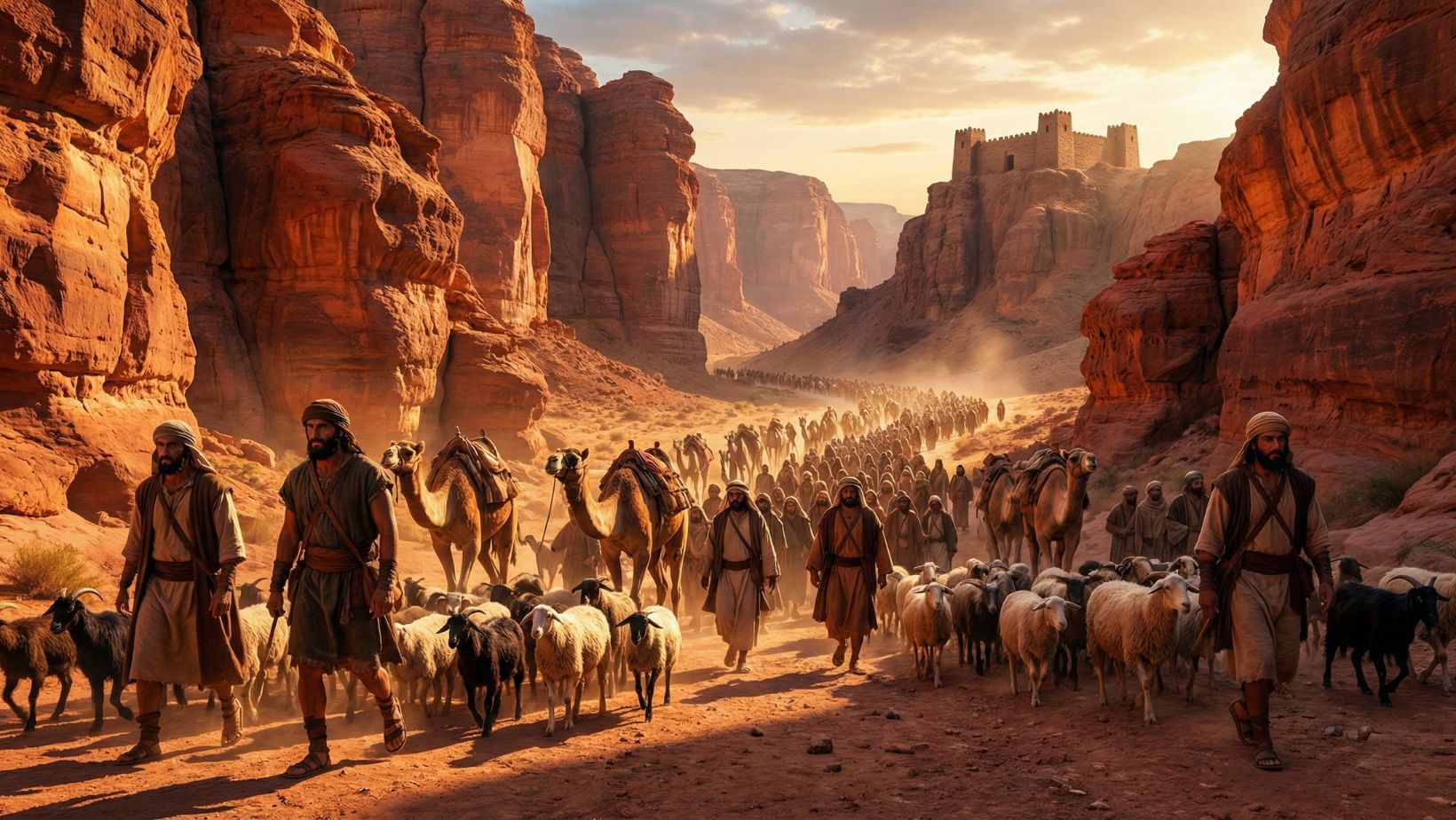
Genesis 36 stands as a monumental genealogical record, documenting the transformation of Esau’s family into the powerful nation of Edom. While the narrative of the Bible focuses on the covenant line through Jacob, this chapter fulfills God’s promises to Abraham and Isaac that Esau, too, would become a great nation. The chapter details Esau’s migration to the rugged hill country of Seir, his various wives and descendants, and the indigenous Horite clans he eventually absorbed or displaced. It concludes with a list of kings who reigned in Edom, emphasizing that Esau’s descendants achieved political statehood and monarchical structure long before Israel, yet remaining outside the specific land of promise.
1. Esau’s Family and Migration (Genesis 36:1–8 NLT)
1 This is the account of the descendants of Esau (also known as Edom). 2 Esau married two local women from Canaan: Adah, the daughter of Elon the Hittite; and Oholibamah, the daughter of Anah and granddaughter of Zibeon the Hivite. 3 He also married his cousin Basemath, who was the daughter of Ishmael and the sister of Nebaioth. 4 Adah gave birth to a son named Eliphaz. Basemath gave birth to a son named Reuel. 5 Oholibamah gave birth to sons named Jeush, Jalam, and Korah. These were the sons who were born to Esau in the land of Canaan. 6 Esau took his wives, his children, and his entire household, along with his livestock and cattle—all the wealth he had acquired in the land of Canaan—and moved away from his brother, Jacob. 7 There was no longer enough pasture from their combined herds and flocks to support them in the land where they were living. 8 So Esau settled in the hill country of Seir. (Esau is also known as Edom.)
Commentary:
- The Name Edom (v. 1): The parenthetical “also known as Edom” (Red) connects the man to the land. It serves as a reminder of the “red stew” incident in Genesis 25 and the physical landscape of Seir, known for its red sandstone.
- Marital Alliances (v. 2–3): Esau’s wives represent a blend of Canaanite and Ishmaelite lineages. While these marriages were originally a source of grief to Isaac and Rebekah, they provided the strategic alliances necessary for Esau to build a power base outside of Jacob’s territory.
- Prosperity and Separation (v. 6–7): The text notes that Esau moved “away from his brother, Jacob.” Ironically, the blessing of wealth caused their separation. Much like Abraham and Lot, their massive holdings of livestock required more land than one region could provide.
- The Hill Country of Seir (v. 8): Seir is the mountainous region south of the Dead Sea. By settling here, Esau claims a rugged, defensible territory, signaling his transition from a nomadic hunter to a territorial ruler.
2. The Lineage of Esau (Genesis 36:9–14 NLT)
9 This is the account of the descendants of Esau, the father of the Edomites, who lived in the hill country of Seir. 10 These are the names of Esau’s sons: Eliphaz, the son of Esau’s wife Adah; and Reuel, the son of Esau’s wife Basemath. 11 The sons of Eliphaz were Teman, Omar, Zepho, Gatam, and Kenaz. 12 (Eliphaz also had a concubine named Timna, who gave birth to a son named Amalek.) These were the descendants of Esau’s wife Adah. 13 The sons of Reuel were Nahath, Zerah, Shammah, and Mizzah. These were the descendants of Esau’s wife Basemath. 14 Esau also had sons through Oholibamah, the daughter of Anah and granddaughter of Zibeon. Their names were Jeush, Jalam, and Korah.
Commentary:
- The Father of the Edomites (v. 9): This section establishes the foundational families of the Edomite nation.
- Amalek (v. 12): This is a significant historical detail. Amalek, the son of a concubine, became the father of the Amalekites—the first nation to attack Israel after the Exodus and a recurring enemy throughout the Old Testament.
- Structure of the Lineage (v. 10–14): The sons are grouped by their mothers (Adah, Basemath, and Oholibamah), reflecting the importance of maternal lines in tribal identity and inheritance.
3. The Clan Leaders of Edom (Genesis 36:15–19 NLT)
15 These are the descendants of Esau who became the leaders of various clans: The sons of Eliphaz, the firstborn of Esau, were the leaders of the clans of Teman, Omar, Zepho, Kenaz, 16 Korah, Gatam, and Amalek. These were the clan leaders descended from Eliphaz in the land of Edom; they were all descendants of Adah. 17 The sons of Esau’s son Reuel were the leaders of the clans of Nahath, Zerah, Shammah, and Mizzah. These were the clan leaders descended from Reuel in the land of Edom; they were all descendants of Basemath. 18 The sons of Esau’s wife Oholibamah were the leaders of the clans of Jeush, Jalam, and Korah. These were the clan leaders descended from Esau’s wife Oholibamah, the daughter of Anah. 19 These were the clans descended from Esau (also known as Edom), identified by their clan leaders.
Commentary:
- Emergence of Clan Leaders (v. 15): The term for “leader” or “chief” (alluph) indicates a high-ranking military or administrative official. This shows that Edom was moving toward a sophisticated political structure while Jacob’s family was still a single nomadic household.
- Teman (v. 15): The clan of Teman became particularly famous for its military prowess and for producing men of great wisdom (Jeremiah 49:7).
- The Strength of Edom (v. 19): By organizing into clans, Edom became a formidable presence in the Transjordan, controlling vital trade routes.
4. The Horite Clans of Seir (Genesis 36:20–30 NLT)
20 These are the names of the sons of Seir the Horite, the people who lived in the land of Edom: Lotan, Shobal, Zibeon, Anah, 21 Dishon, Ezer, and Dishan. These were the Horite clan leaders, the descendants of Seir, who lived in the land of Edom. 22 The sons of Lotan were Hori and Hemam. Lotan’s sister was named Timna. 23 The sons of Shobal were Alvan, Manahath, Ebal, Shepho, and Onam. 24 The sons of Zibeon were Aiah and Anah. (This is the Anah who discovered the hot springs in the wilderness while he was pasturing the donkeys of his father, Zibeon.) 25 The children of Anah were a son named Dishon and a daughter named Oholibamah. 26 The sons of Dishon were Hemdan, Eshban, Ithran, and Keran. 27 The sons of Ezer were Bilhan, Zaavan, and Akan. 28 The sons of Dishan were Uz and Aran. 29 So these were the Horite clan leaders: Lotan, Shobal, Zibeon, Anah, 30 Dishon, Ezer, and Dishan. These were the leaders of the Horite clans, identified by their clans, in the land of Seir.
Commentary:
- The Indigenous Horites (v. 20): Before Esau’s arrival, the land was held by the Horites. The mention of their genealogy shows that Esau did not just conquer a vacuum but integrated with or displaced an existing society.
- The Hot Springs (v. 24): This fascinating detail about Anah discovering hot springs highlights the reality of life in the wilderness—finding water was the key to survival and wealth.
- Assimilation (v. 25): Esau married Oholibamah, a descendant of these Horites, showing how he used marriage to cement his claim to the land of Seir.
5. The Kings of Edom (Genesis 36:31–39 NLT)
31 These are the kings who ruled in the land of Edom before any king ruled over the Israelites: 32 Bela son of Beor reigned in Edom from the city of Dinhabah. 33 When Bela died, Jobab son of Zerah from Bozrah became king in his place. 34 When Jobab died, Husham from the land of the Temanites became king in his place. 35 When Husham died, Hadad son of Bedad became king in his place. He was the one who defeated the Midianites in the land of Moab. He reigned from the city of Avith. 36 When Hadad died, Samlah from the city of Masrekah became king in his place. 37 When Samlah died, Shaul from the city of Rehoboth-on-the-River became king in his place. 38 When Shaul died, Baal-hanan son of Acbor became king in his place. 39 When Baal-hanan son of Acbor died, Hadad became king in his place. His city was named Pau, and his wife was Mehetabel, the daughter of Matred and granddaughter of Me-zahab.
Commentary:
- Early Monarchy (v. 31): The author notes that Edom had a monarchy “before any king ruled over the Israelites.” This is a profound theological statement. The “rejected” line seemed to flourish first, while the “chosen” line remained in humble circumstances.
- Elective or Diverse Kingship (v. 32–39): Note that these kings are not all from the same family or even the same city. Edom’s early monarchy seems to have been more about power and military achievement than hereditary succession.
- Military Prowess (v. 35): King Hadad’s defeat of the Midianites demonstrates that Edom was a significant military player in the ancient Near East.
6. The Clan Leaders of Edom (Genesis 36:40–43 NLT)
40 These are the names of the leaders of the clans descended from Esau, who lived in the places named after them: Timna, Alvah, Jetheth, 41 Oholibamah, Elah, Pinon, 42 Kenaz, Teman, Mibzar, 43 Magdiel, and Iram. These were the leaders of the clans of Edom, listed according to their settlements in the land they occupied. They all descended from Esau, the ancestor of the Edomites.
Commentary:
- Settlements and Names (v. 40): This list anchors the leaders to specific geographic locations. In antiquity, clans and the lands they occupied were often called by the same name.
- The Ancestor of the Edomites (v. 43): The chapter closes by reiterating Esau’s legacy. He is the singular patriarch of a complex and enduring nation.
Theological Significance of Genesis 36
- God’s Promises to All: Even though Esau was not the son of the promise regarding the Messiah, God was faithful to the general promises made to Abraham’s descendants. Edom became a great nation with many kings.
- The Worldly First, the Spiritual Second: This chapter illustrates a common biblical pattern where the worldly power (Edom) rises quickly and visibly, while the spiritual kingdom (Israel) grows slowly, through suffering and waiting.
- The End of Esau’s Narrative: This chapter serves as the “hand-off.” Having accounted for Esau’s line, the Bible now focuses exclusively on Jacob’s family and the road to the Exodus.
Practical Applications
- Avoid Comparing Success: It is easy to look at those outside of God’s specific calling and see them “succeeding” faster (like the kings of Edom). We must trust God’s timing for our own “kingdom” promises.
- The Impact of Heritage: The legacy of Esau produced both wisdom (Teman) and persistent enmity (Amalek). Our choices and character today set the trajectory for our descendants.
- God Rules Over All Nations: This detailed record shows that God is the Lord of history, keeping track of every nation and every leader, not just those within the church.
Possible Sermon Titles
- The Kings Who Came Too Early.
- Esau’s Legacy: Prosperity Without a Promise.
- The Red Rock Nation: God’s Faithfulness to the “Other” Son.
- When Success Outpaces Spirituality.
- From Family to Nation: The Evolution of Edom.







Leave a Reply