
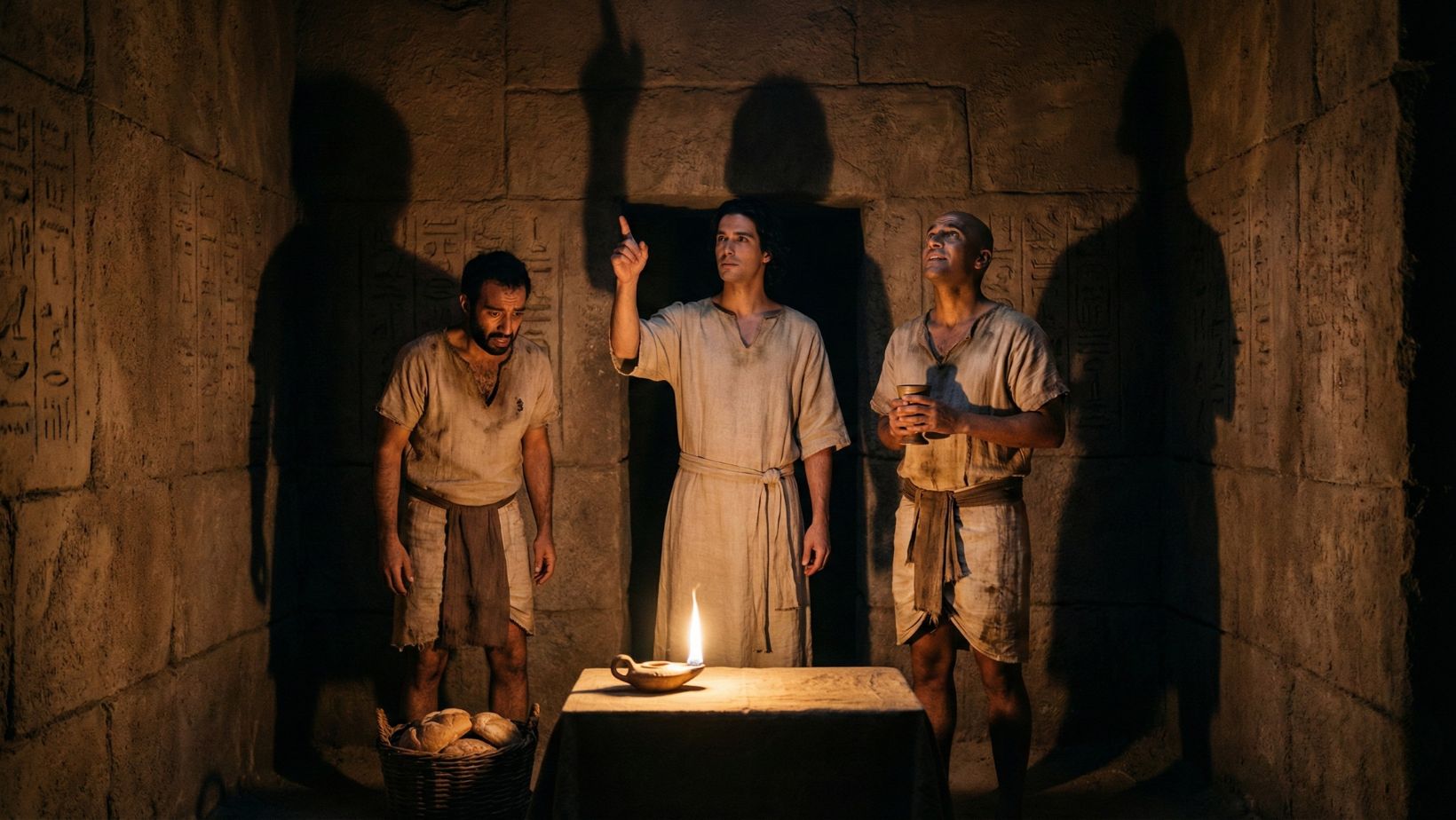
Summary of Genesis 40
Genesis 40 continues the story of Joseph in the Egyptian prison, highlighting the intersection of divine timing and human faithfulness. Joseph, though a prisoner, finds himself serving two high-ranking officials of Pharaoh—his chief cupbearer and chief baker. The chapter centers on two prophetic dreams experienced by these officials, which Joseph interprets through the power of God. This narrative serves as a bridge between Joseph’s humiliation in the dungeon and his eventual exaltation, demonstrating that God is the true interpreter of mysteries and that Joseph’s gift of discernment remains sharp even in the darkest circumstances. The chapter ends on a note of human failure—the cupbearer forgets Joseph—setting the stage for a two-year test of patience and ultimate divine intervention.
1. Two Officials in Custody (Genesis 40:1–4 NIV)
1 Some time later, the cupbearer and the baker of the king of Egypt offended their master, the king of Egypt. 2 Pharaoh was angry with his two officials, the chief cupbearer and the chief baker, 3 and put them in custody in the house of the captain of the guard, in the same prison where Joseph was confined. 4 The captain of the guard assigned them to Joseph, and he attended them. After they had been in custody for some time,
Commentary:
- The Power of Providence (v. 1–3): The “offense” of these officials remains unnamed, but their imprisonment in the “same prison where Joseph was confined” is no accident. God is orchestrating a meeting between Joseph and the inner circle of Pharaoh’s court.
- The Roles of the Officials:
- The Cupbearer: Not just a waiter, but a highly trusted advisor responsible for protecting the king from poisoning.
- The Baker: Responsible for the king’s food and vulnerable to charges of negligence or sabotage.
- Joseph’s Service (v. 4): Even in prison, Joseph is recognized for his integrity and administrative skill. He is not just a prisoner; he is a servant to those who were once elite. This highlights the theme of “humility before honor.”
2. The Dreams and Joseph’s Discernment (Genesis 40:5–8 NIV)
5 each of the two men—the cupbearer and the baker of the king of Egypt, who were being held in prison—had a dream the same night, and each dream had a meaning of its own. 6 When Joseph came to them the next morning, he saw that they were dejected. 7 So he asked Pharaoh’s officials who were in custody with him in his master’s house, “Why do you look so sad today?” 8 “We both had dreams,” they answered, “but there is no one to interpret them.” Then Joseph said to them, “Do not interpretations belong to God? Tell me your dreams.”
Commentary:
- Joseph’s Empathy (v. 6–7): Despite his own suffering, Joseph is sensitive to the emotions of others. His question, “Why do you look so sad today?” shows a heart that has not been hardened by its own trials.
- The Source of Interpretation (v. 8): In Egypt, dream interpretation was a professional industry involving magicians and scholars. Joseph immediately pivots away from human “wisdom” and points toward God as the source of all secret knowledge.
- The Confidence of Faith: Joseph doesn’t hesitate to offer his help, trusting that God will provide the meaning. This is a bold move for a prisoner.
3. The Cupbearer’s Dream and Interpretation (Genesis 40:9–15 NIV)
9 So the chief cupbearer told Joseph his dream. He said to him, “In my dream I saw a vine in front of me, 10 and on the vine were three branches. As soon as it budded, it blossomed, and its clusters ripened into grapes. 11 Pharaoh’s cup was in my hand, and I took the grapes, squeezed them into Pharaoh’s cup and put the cup in his hand.” 12 “This is what it means,” Joseph said to him. “The three branches are three days. 13 Within three days Pharaoh will lift up your head and restore you to your position, and you will put Pharaoh’s cup in his hand, just as you used to do when you were his cupbearer. 14 But when all goes well with you, remember me and show me kindness; mention me to Pharaoh and get me out of this prison. 15 I was forcibly carried off from the land of the Hebrews, and even here I have done nothing to deserve being put in a dungeon.”
Commentary:
- The Symbology of the Vine (v. 9–11): The rapid growth and squeezing of the grapes symbolize a swift restoration of service. The number “three” is the key temporal marker.
- Lifting the Head (v. 13): This phrase can mean “restoration” or “execution” (as seen in the next section). In the cupbearer’s case, it meant honor and return to his post.
- Joseph’s Plea (v. 14–15): This is a rare moment where Joseph speaks about his own innocence and the injustice of his situation. He uses the word “dungeon” (literally “the pit”), the same word used for the cistern his brothers threw him into.
4. The Baker’s Dream and Interpretation (Genesis 40:16–19 NIV)
16 When the chief baker saw that the interpretation was favorable, he said to Joseph, “I too had a dream: On my head were three baskets of bread. 17 In the top basket were all kinds of baked goods for Pharaoh, but the birds were eating them out of the basket on my head.” 18 “This is what it means,” Joseph said. “The three baskets are three days. 19 Within three days Pharaoh will lift off your head and impale your body on a pole. And the birds will eat away your flesh.”
Commentary:
- The Symbology of the Birds (v. 16–17): In ancient Near Eastern thought, birds eating food intended for a king was a highly ominous sign. It suggested that the baker’s work—and life—was no longer under his control or the king’s protection.
- Truth Over Comfort (v. 18–19): Joseph does not sugarcoat the interpretation. He demonstrates the integrity of a true prophet by delivering a message of death as faithfully as he delivered the message of life.
- The “Lifting” Irony: Just as the cupbearer’s head was “lifted up” in honor, the baker’s head was “lifted off” in execution.
5. Fulfillment and Forgotten (Genesis 40:20–23 NIV)
20 Now the third day was Pharaoh’s birthday, and he gave a feast for all his officials. He lifted up the heads of the chief cupbearer and the chief baker in the presence of his officials: 21 He restored the chief cupbearer to his position, so that he once again put the cup into Pharaoh’s hand— 22 but he impaled the chief baker, just as Joseph had said to them in his interpretation. 23 The chief cupbearer, however, did not remember Joseph; he forgot him.
Commentary:
- God’s Timing (v. 20): Pharaoh’s birthday serves as the setting for the fulfillment. It shows that even a pagan king’s celebrations are under the sovereign timeline of God.
- The Cruelty of Silence (v. 23): The closing verse is one of the most poignant in the Bible. The phrase “he did not remember Joseph; he forgot him” emphasizes the totality of the cupbearer’s neglect.
- The Purpose of the Delay: While it seemed like a failure, the two-year delay that follows ensured Joseph would be called upon only when Pharaoh himself had a dream that no one else could solve.
Theological Significance of Genesis 40
- God as the Revealer of Secrets: This chapter establishes that God communicates through dreams and that He alone grants the power to understand them.
- Faithfulness in Obscurity: Joseph serves with excellence and speaks the truth of God while still in chains. He doesn’t wait for his circumstances to change before using his gifts.
- The Testing of Faith: Joseph’s plea to be remembered went unheeded for two years. This highlights the reality that even when we are doing God’s will, we may face periods of being “forgotten” by men.
Practical Applications
- Ask About Others’ “Sadness”: Like Joseph, we should notice the dejection in those around us, even when we are going through our own struggles.
- Be a Truth-Teller: Joseph told the baker the hard truth. Integrity requires us to be honest, even when the news is not favorable.
- Trust the Silence of God: When people forget you, God has not. The cupbearer’s forgetfulness was the very thing that eventually led Joseph to the throne at the perfect moment.







Leave a Reply