
Genesis 41 is the dramatic turning point in Joseph’s life, transitioning from the darkness of a dungeon to the pinnacle of Egyptian power. After two years of silence and being “forgotten,” Joseph is summoned by Pharaoh to interpret two disturbing dreams that the wisest men of Egypt cannot solve. Joseph credits God alone for the interpretation, predicting seven years of unprecedented abundance followed by seven years of devastating famine. Impressed by Joseph’s divine wisdom and administrative foresight, Pharaoh appoints him as Vizier (second-in-command) over all Egypt. The chapter concludes with Joseph’s strategic storage of grain, his marriage into Egyptian nobility, and the birth of his two sons, Manasseh and Ephraim, as the global famine begins to drive the world to Joseph’s feet for survival.
1. Pharaoh’s Troubling Dreams (Genesis 41:1–8 NLT)
1 Two full years later, Pharaoh dreamed that he was standing on the bank of the Nile River. 2 In his dream he saw seven fat, healthy cows come up out of the river and begin grazing in the marsh grass. 3 Then he saw seven more cows come up behind them from the Nile, but these were scrawny and thin. These cows stood beside the fat cows on the riverbank. 4 Then the scrawny, thin cows ate the seven fat, healthy cows! At this point in the dream, Pharaoh woke up. 5 But he fell asleep again and had a second dream. This time he saw seven heads of grain, plump and beautiful, growing on a single stalk. 6 Then seven more heads of grain appeared, but these were shriveled and withered by the east wind. 7 And these thin heads of grain swallowed up the seven plump, well-formed heads! Then Pharaoh woke up again and realized it was a dream. 8 The next morning Pharaoh was very disturbed by the dreams. So he called for all the magicians and wise men of Egypt. When Pharaoh told them his dreams, not one of them could tell him what they meant.
Commentary:
- The Two-Year Wait (v. 1): The “two full years” emphasizes the testing of Joseph’s patience. God’s timing is precise; Joseph was released only when his presence was required at the highest level of government.
- The Nile Setting (v. 1): In Egyptian theology, the Nile was the source of life and a god itself. For dreams about the Nile to turn nightmarish was a direct threat to the perceived stability and divinity of the Egyptian state.
- The Seven Cows and Grain (v. 2–7): The number seven represents completeness. The “scrawny cows” eating the “fat cows” is a physical impossibility that signaled a supernatural warning.
- The Failure of Human Wisdom (v. 8): Egypt was the center of occult and scientific learning. The inability of the “magicians and wise men” to interpret the dreams highlights that spiritual mysteries can only be decoded by the Spirit of God.
2. Joseph is Remembered (Genesis 41:9–16 NLT)
9 Finally, the king’s chief cupbearer spoke up. “Today I have been reminded of my failure,” he said. 10 “Some time ago, you were angry with the chief baker and me, and you imprisoned us in the palace of the captain of the guard. 11 One night the chief baker and I each had a dream, and each dream had its own meaning. 12 There was a young Hebrew man with us in the prison who was a slave of the captain of the guard. We told him our dreams, and he told us what each of them meant. 13 And everything happened just as he had predicted. I was restored to my position as cupbearer, and the chief baker was executed and impaled on a pole.” 14 Pharaoh sent for Joseph at once, and he was quickly brought from the prison. After he shaved and changed his clothes, he went in and stood before Pharaoh. 15 Then Pharaoh said to Joseph, “I had a dream last night, and no one here can tell me what it means. But I have heard that when you hear about a dream you can interpret it.” 16 “It is beyond my power to do this,” Joseph replied. “But God can tell you what it means and set you at ease.”
Commentary:
- The Cupbearer’s Confession (v. 9): The cupbearer calls his forgetfulness a “failure” (literally, a sin). His memory is jogged by the king’s crisis, proving that God uses human failures to align His timing.
- Preparation for Presence (v. 14): Joseph “shaved and changed his clothes.” Egyptians were clean-shaven, unlike the bearded Semitic peoples. Joseph’s willingness to adapt culturally shows his readiness to serve without compromising his core identity.
- Deflecting Glory (v. 16): Joseph’s first words to the most powerful man on earth are a testimony to God. He refuses to take credit for the gift, establishing that he is merely a vessel for the Almighty.
3. Joseph Interprets the Dreams (Genesis 41:17–32 NLT)
17 So Pharaoh told Joseph his dream… 25 Joseph responded, “Both of Pharaoh’s dreams mean the same thing. God is telling Pharaoh in advance what he is about to do. 26 The seven healthy cows and the seven healthy heads of grain both represent seven years of prosperity. 27 The seven thin, scrawny cows that came up later and the seven thin heads of grain withered by the east wind also represent seven years. These will be seven years of famine. 28 “This will happen just as I have described it, for God has revealed to Pharaoh what he is about to do. 29 The next seven years will be a period of great prosperity throughout the land of Egypt. 30 But afterward there will be seven years of famine so severe that all the prosperity will be forgotten in Egypt. Famine will destroy the land. 31 This famine will be so terrible that even the memory of the good years will be erased. 32 As for having two similar dreams, it means that these events have been decreed by God, and he will soon make them happen.
Commentary:
- Unity of the Dreams (v. 25): Joseph explains that the repetition of the dream reinforces its certainty. In Hebrew thought, the doubling of a matter means it is “fixed” or “decreed” by God.
- The Devouring Famine (v. 30–31): Joseph warns that the famine will be so intense it will “erase” the memory of the good years. This is a sober reminder that without God’s provision, human resources are quickly exhausted.
- Prophetic Confidence (v. 32): Joseph speaks with the authority of one who has heard from the Lord, transitioning from a prisoner to a prophet.
4. Joseph’s Plan and Promotion (Genesis 41:33–45 NLT)
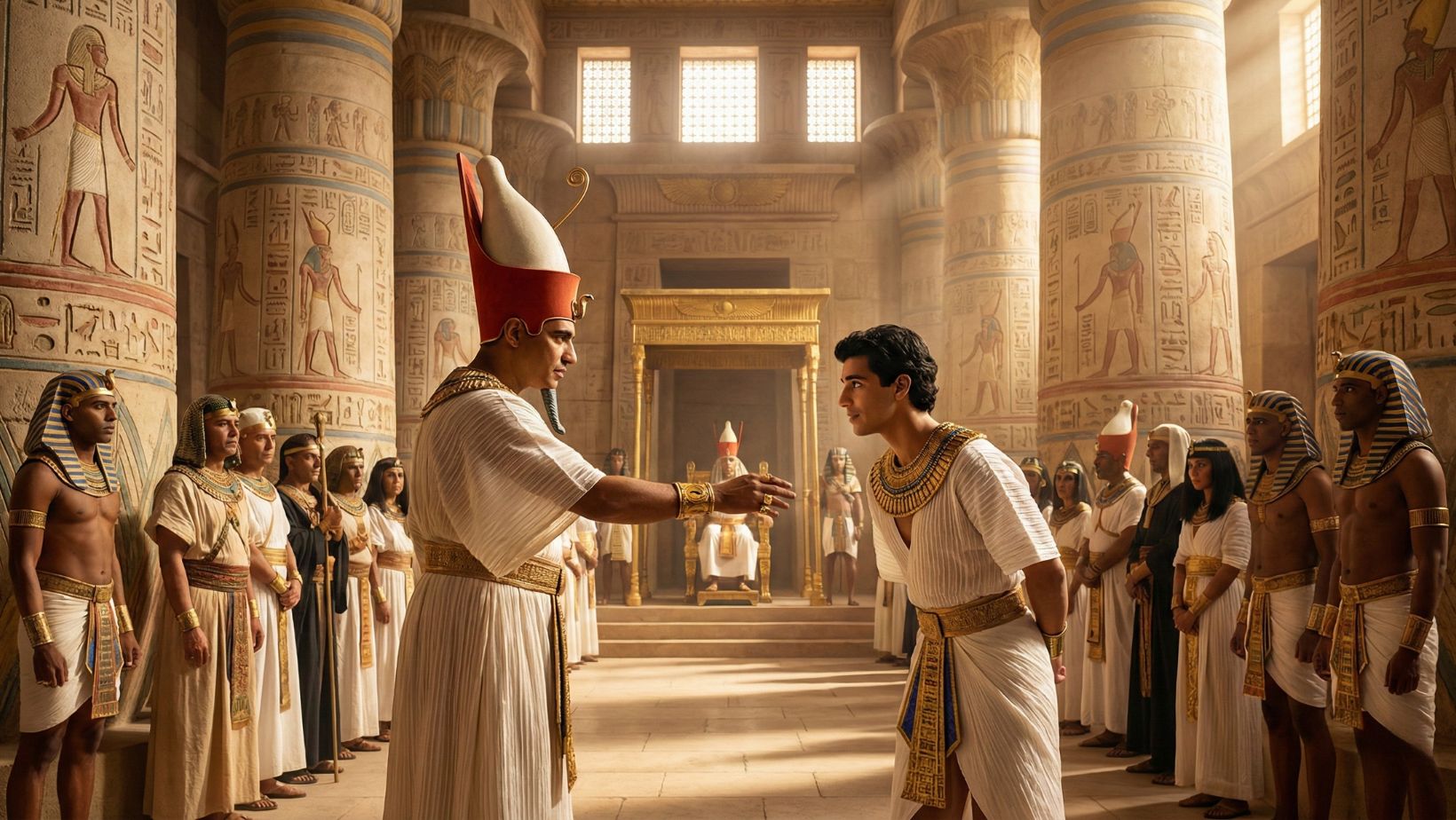
33 “Therefore, Pharaoh should find an intelligent and wise man and put him in charge of the entire land of Egypt. 34 Then Pharaoh should appoint supervisors over the land and collect one-fifth of all the crops during the seven good years. 35 Have them gather all the food produced in the good years that are just ahead and bring it to Pharaoh’s storehouses. Over her should be a supervisor to guard it in each city. 36 That way there will be enough food to survive the seven years of famine that will come upon the land of Egypt. Otherwise, this famine will destroy the land.” 37 Joseph’s suggestions were well received by Pharaoh and his officials. 38 So Pharaoh asked his officials, “Can we find anyone else like this man, so obviously filled with the spirit of God?” 39 Then Pharaoh said to Joseph, “Since God has revealed the meaning of the dreams to you, clearly no one else is as intelligent or wise as you are. 40 You will be in charge of my court, and all my people will take orders from you. Only I, sitting on my throne, will have a rank higher than yours.” 41 Pharaoh said to Joseph, “I hereby put you in charge of the entire land of Egypt.” 42 Then Pharaoh removed his signet ring from his own finger and put it on Joseph’s finger. He dressed him in robes of fine linen and put a gold chain around his neck. 43 He had Joseph ride in the chariot reserved for his second-in-command, and wherever Joseph went, the command was shouted, “Kneel down!” So Pharaoh put Joseph in charge of all Egypt. 44 And Pharaoh said to Joseph, “I am Pharaoh, but no one will lift a hand or foot in the entire land of Egypt without your approval.” 45 Then Pharaoh gave Joseph a new Egyptian name, Zaphenath-paneah. He also gave him a wife, whose name was Asenath. She was the daughter of Potiphera, the priest of On. So Joseph took charge of the entire land of Egypt.
Commentary:
- The Spirit of God (v. 38): Pharaoh, a pagan, recognizes that Joseph’s wisdom is not human but divine. This is the first time in Scripture someone is described as being “filled with the spirit of God.”
- Symbols of Authority (v. 42):
- Signet Ring: Authorized Joseph to sign royal decrees.
- Fine Linen: Represented his new status as royalty.
- Gold Chain: A specific Egyptian award for high civil service.
- Zaphenath-paneah (v. 45): His new name likely means “God speaks and he lives” or “Revealer of Secrets.”
- The Marriage (v. 45): By marrying Asenath, Joseph is integrated into the highest social class—the priesthood. This ensured he would be respected by the native Egyptian bureaucracy.
5. Years of Plenty and Birth of Sons (Genesis 41:46–52 NLT)
46 Joseph was thirty years old when he began serving in the court of Pharaoh, the king of Egypt. And when Joseph left Pharaoh’s presence, he inspected the entire land of Egypt. 47 As predicted, for seven years the land produced bumper crops. 48 During those years, Joseph gathered all the crops grown in Egypt and stored the grain from the surrounding fields in the cities. 49 He piled up huge amounts of grain—as magnificent as the sand of the seashore. Finally, he stopped keeping records because there was too much to measure. 50 During this time, before the first of the famine years, two sons were born to Joseph and his wife, Asenath, the daughter of Potiphera, the priest of On. 51 Joseph named his older son Manasseh, for he said, “God has made me forget all my troubles and everyone in my father’s family.” 52 Joseph named his second son Ephraim, for he said, “God has made me fruitful in this land of my grief.”
Commentary:
- Age Thirty (v. 46): Joseph spent 13 years in slavery/prison (sold at 17, promoted at 30). This is the same age at which David became king and Jesus began His ministry.
- Manasseh (“Making to Forget”): This does not mean Joseph forgot his family existed, but that God healed the pain of their betrayal.
- Ephraim (“Double Fruitfulness”): Joseph acknowledges that his blessing came out of “the land of my grief.” God does not just remove suffering; He makes it productive.
6. The Famine Begins (Genesis 41:53–57 NLT)
53 At last the seven years of bumper crops throughout the land of Egypt came to an end. 54 Then the seven years of famine began, just as Joseph had predicted. The famine also struck all the neighboring countries, but there was plenty of food in all Egypt. 55 Eventually, however, the famine spread throughout the land of Egypt as well. And when the people cried out to Pharaoh for food, he told them, “Go to Joseph, and do whatever he tells you.” 56 So with the famine severe everywhere, Joseph opened up the storehouses and distributed grain to the Egyptians, for the famine was severe throughout the land of Egypt. 57 And people from all around the world came to Egypt to buy grain from Joseph because the famine was severe throughout the world.
Commentary:
- Global Crisis (v. 54, 57): The famine serves as the “hook” to bring Joseph’s brothers to Egypt. God uses a world-wide disaster to facilitate a family reconciliation.
- “Go to Joseph” (v. 55): Pharaoh yields total trust to Joseph. This mirrors the New Testament concept of all authority being given to the Son.
Theological Significance of Genesis 41
- Divine Reversal: Joseph goes from the pit to the palace in a single day. It demonstrates that God can change a person’s entire destiny in a moment when the appointed time arrives.
- Common Grace: God uses Joseph to save not just the covenant family, but the pagan world. This reflects God’s concern for all humanity.
- Christ as the Bread of Life: Joseph is a “type” of Christ—rejected by his brothers, exalted to the right hand of the throne, and the only source of “bread” for a starving world.
Practical Applications
- Prepare in the Plenty: We must use seasons of blessing to prepare for the inevitable lean seasons of life.
- Give God the Credit: Like Joseph before Pharaoh, we must be bold in identifying God as the source of our success.
- Patience in the “Two Years”: If you feel forgotten in a “prison” season, remember that God is preparing the “Pharaoh” who will eventually call for you.
Possible Sermon Titles
- From the Dungeon to the Driveway.
- The Revealer of Secrets.
- Managing the Abundance.
- When God Makes You Forget.
- The Only Source of Bread.







Leave a Reply