
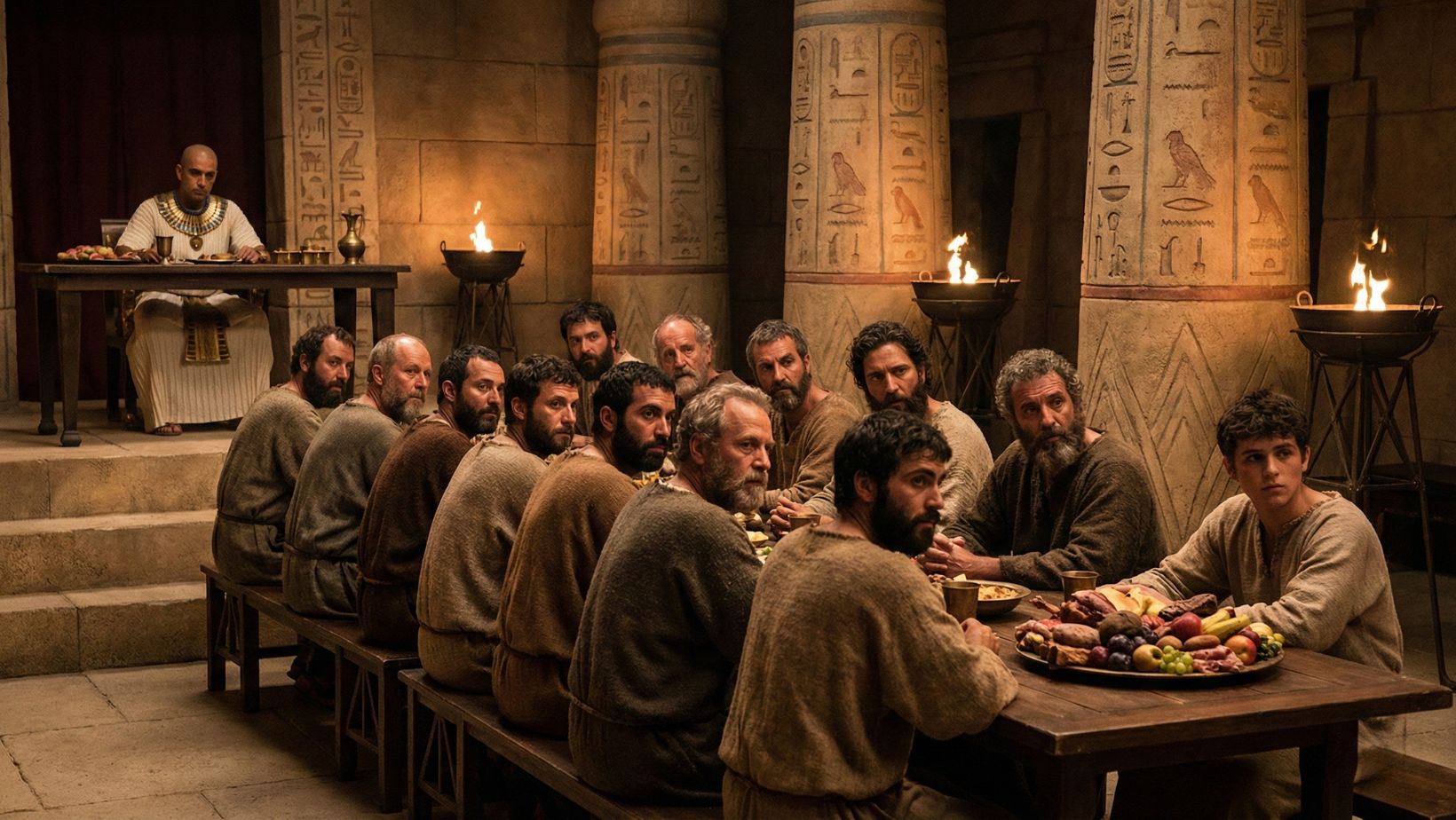
Genesis 43 marks a pivotal shift in the Joseph narrative, moving from the isolation of the first journey to the vulnerable necessity of the second. The famine remains relentless, forcing Jacob (Israel) to face his deepest fear: losing Benjamin, the last remaining son of his beloved Rachel. After a tense negotiation where Judah emerges as a leader by pledging his own life as surety, the brothers return to Egypt. The chapter is defined by the tension between the brothers’ fear of punishment and Joseph’s overwhelming, yet hidden, brotherly affection. It culminates in a lavish banquet where Joseph tests their reactions to favoritism, setting the stage for the final test of their character.
1. The Necessity of Return (Genesis 43:1–10 NLT)
1 But the famine continued to pound the land of Canaan. 2 When all the grain they had brought from Egypt was almost gone, Jacob said to his sons, “Go back and buy us a little more food.” 3 But Judah said, “The man was serious when he warned us, ‘You won’t see my face again unless your brother is with you.’ 4 If you send Benjamin with us, we will go down and buy more food. 5 But if you don’t let Benjamin go, we won’t go either. Remember what the man said: ‘You won’t see my face again unless your brother is with you.’” 6 “Why were you so cruel to me?” Israel moaned. “Why did you tell him you had another brother?” 7 “The man asked us specific questions about our family,” they replied. “He asked, ‘Is your father still alive? Do you have another brother?’ So we answered his questions. How could we know he would say, ‘Bring your brother down here’?” 8 Judah said to his father, Israel, “Send the boy with me, and we will be on our way. Otherwise we will all die of starvation—and not only we, but you and our little ones. 9 I personally guarantee his safety. You may hold me responsible if I don’t bring him back to you. Then let me bear the blame forever. 10 If we hadn’t wasted all this time, we could have gone and returned twice by now.”
Commentary:
- The Pressure of Circumstance (v. 1-2): The phrase “the famine continued to pound the land” emphasizes that God was using external pressure to accomplish internal family reconciliation. Hunger eventually overrode Jacob’s fear.
- Judah’s Emergence (v. 3-5): Reuben had previously offered his sons’ lives (Gen 42:37), which Jacob rejected. Judah, however, speaks with logical authority. He recognizes that without Benjamin, the mission is a death sentence.
- Jacob’s Complaint (v. 6): Jacob focuses on his own pain, accusing his sons of “cruelty.” He is still operating from a place of self-protection rather than trust.
- The Transformation of Judah (v. 8-9): This is a critical theological turning point. Judah, who originally suggested selling Joseph into slavery (Gen 37:26-27), now offers himself as a “substitutionary surety” for Benjamin. This foreshadows the character of his descendant, Jesus Christ, who would become the ultimate surety for His people.
- The Cost of Delay (v. 10): Judah highlights that indecision born of fear is often more dangerous than the risk itself.
2. Jacob’s Reluctant Surrender (Genesis 43:11–15 NLT)
11 So their father, Israel, finally said to them, “If it can’t be avoided, then do this. Pack your bags with the best products of this land. Take them down to the man as gifts—balm, honey, gum, aromatic resin, pistachio nuts, and almonds. 12 Also take double the money that was put back in your sacks, as it was probably someone’s mistake. 13 Then take your brother, and go back to the man. 14 May God Almighty give you mercy as you go before the man, so that he will release your other brother and Benjamin. And if I must die of bereavement, so be it.” 15 So the men packed the gifts and double the money and took Benjamin. They hurried down to Egypt and presented themselves to Joseph.
Commentary:
- Appeasement Strategy (v. 11): Jacob resorts to the same strategy he used with Esau (Gen 32)—sending gifts to soften a superior’s heart. Ironically, he sends products of the land that are scarce due to the famine, showing the value of the gesture.
- Integrity in Restitution (v. 12): Jacob insists on “double the money.” He wants to ensure no accusation of theft can be leveled against them, demonstrating a commitment to honesty despite their dire situation.
- El Shaddai (v. 14): Jacob invokes the name God Almighty (El Shaddai). This name is associated with God’s fruitfulness and protection of the patriarchs. It marks the moment Jacob moves from self-reliance to divine reliance.
- The Language of Resignation (v. 14): “If I must die of bereavement, so be it.” This echoes Esther’s “If I perish, I perish.” It is a surrender of his most idols—his children—to the providence of God.
3. Fear in the House of Joseph (Genesis 43:16–25 NLT)
16 When Joseph saw Benjamin with them, he said to the manager of his household, “These men will eat with me this noon. Take them to the palace. Slaughter an animal and prepare a big feast.” 17 So the man did as Joseph told him and took them into Joseph’s palace. 18 The brothers were terrified when they saw that they were being taken into Joseph’s house. “It’s because of the money they put back in our sacks last time,” they said. “He plans to pretend we stole it. Then he will seize us, make us slaves, and take our donkeys.” 19 The brothers approached the manager of Joseph’s household and spoke to him at the entrance to the palace. 20 “Sir,” they said, “we came to Egypt once before to buy food. 21 But as we were returning home and stopped for the night, we opened our sacks. Then we found that each man’s money—the exact amount paid—had been replaced in the mouth of his sack. So we have brought it back with us. 22 We also have additional money to buy more food. We have no idea who put our money in our sacks.” 23 “Relax,” the manager replied. “Don’t be afraid. Your God and the God of your father must have put this treasure in your sacks. I know I received your payment.” Then he released Simeon and brought him out to them. 24 The manager then led the men into Joseph’s palace. He gave them water to wash their feet and fed their donkeys. 25 They got their gifts ready for Joseph’s arrival at noon, for they were told they would be eating there.
Commentary:
- Grace Interpreted as Judgment (v. 18): The brothers are invited to a feast, but they perceive it as a trap. This is a common psychological reaction of those carrying a guilty conscience; they interpret Joseph’s hospitality through the lens of their past crimes.
- The Steward’s Witness (v. 23): The steward’s response is remarkable. He attributes the returned money to “Your God and the God of your father.” Joseph’s influence had clearly reached his household staff, leading them to acknowledge Yahweh.
- The Restoration of Simeon (v. 23): Simeon is released, marking the first physical evidence that Joseph’s intentions might not be purely hostile.
4. The Banquet and the Test of Favoritism (Genesis 43:26–34 NLT)
26 When Joseph came home, they gave him the gifts they had brought and bowed low to the ground before him. 27 After greeting them, he asked, “How is your father, the old man you spoke about? Is he still alive?” 28 “Yes,” they replied. “Our father, your servant, is alive and well.” And they bowed low again. 29 Then Joseph looked at his brother Benjamin, the son of his own mother. “Is this your youngest brother, the one you told me about?” Joseph asked. “May God be gracious to you, my son.” 30 Then Joseph hurried from the room because he was overcome with emotion for his brother. He went into his private room, where he broke down and wept. 31 After he had washed his face, he came out, keeping himself under control. Then he ordered, “Bring out the food!” 32 The waiters served Joseph at his own table, and his brothers were served at a separate table. The Egyptians who ate with Joseph sat at their own table, because Egyptians despise Hebrews and refuse to eat with them. 33 Joseph told each man where to sit, and to their amazement, he seated them according to age, from oldest to youngest. 34 And Joseph filled their plates with food from his own table, but he gave Benjamin five times as much as he gave the others. So they feasted and drank freely with him.
Commentary:
- Fulfillment of Dreams (v. 26, 28): Again, the brothers bow to the ground. Joseph’s childhood dreams (Gen 37) are being fulfilled repeatedly and literally.
- Joseph’s Humanity (v. 30): Joseph is not a cold administrator. His “bowels yearned” (KJV) for his brother. His weeping shows that his testing of the brothers is not for revenge, but for the purpose of genuine reconciliation.
- Egyptian Segregation (v. 32): The text notes that Egyptians found it an “abomination” to eat with Hebrews. This cultural detail highlights the social distance Joseph had to bridge and the unique position he held.
- The Supernatural Seating (v. 33): The probability of seating eleven brothers in the correct birth order by chance is $1$ in $39,916,800$ (calculated as $11!$). This “amazement” was intended to show the brothers that Joseph possessed supernatural knowledge.
- The Five-Fold Portion (v. 34): Giving Benjamin five times as much was a calculated move. Joseph was recreating the environment of favoritism that had originally fueled the brothers’ hatred toward him. He was observing whether they would react with the same murderous jealousy they felt twenty years prior.
Theological Significance of Genesis 43
- Substitutionary Atonement: Judah’s offer to take Benjamin’s place is one of the earliest biblical types of the Gospel. He takes the responsibility of the “beloved son” upon himself to save the father from grief.
- The Burden of Guilt: The brothers’ constant fear (v. 18) illustrates how unconfessed sin distorts one’s perception of reality. Even when they are shown grace, they expect judgment.
- Providence through Hunger: God uses the physical reality of famine to break the spiritual deadlock of the family. The “House of Israel” is being preserved through the very son they tried to destroy.
Practical Applications
- Surrendering Your “Benjamins”: Like Jacob, we often hold onto things so tightly that we prevent God from working. True peace often comes only after we say, “If I am bereaved, I am bereaved.”
- Integrity in the Details: The brothers brought back the money they found. Even when we think we are being framed, maintaining honesty is the best defense.
- Testing for Growth: Sometimes God allows us to be in “pressure cooker” situations (like the banquet) to see if we have truly changed from our past behaviors.







Leave a Reply