
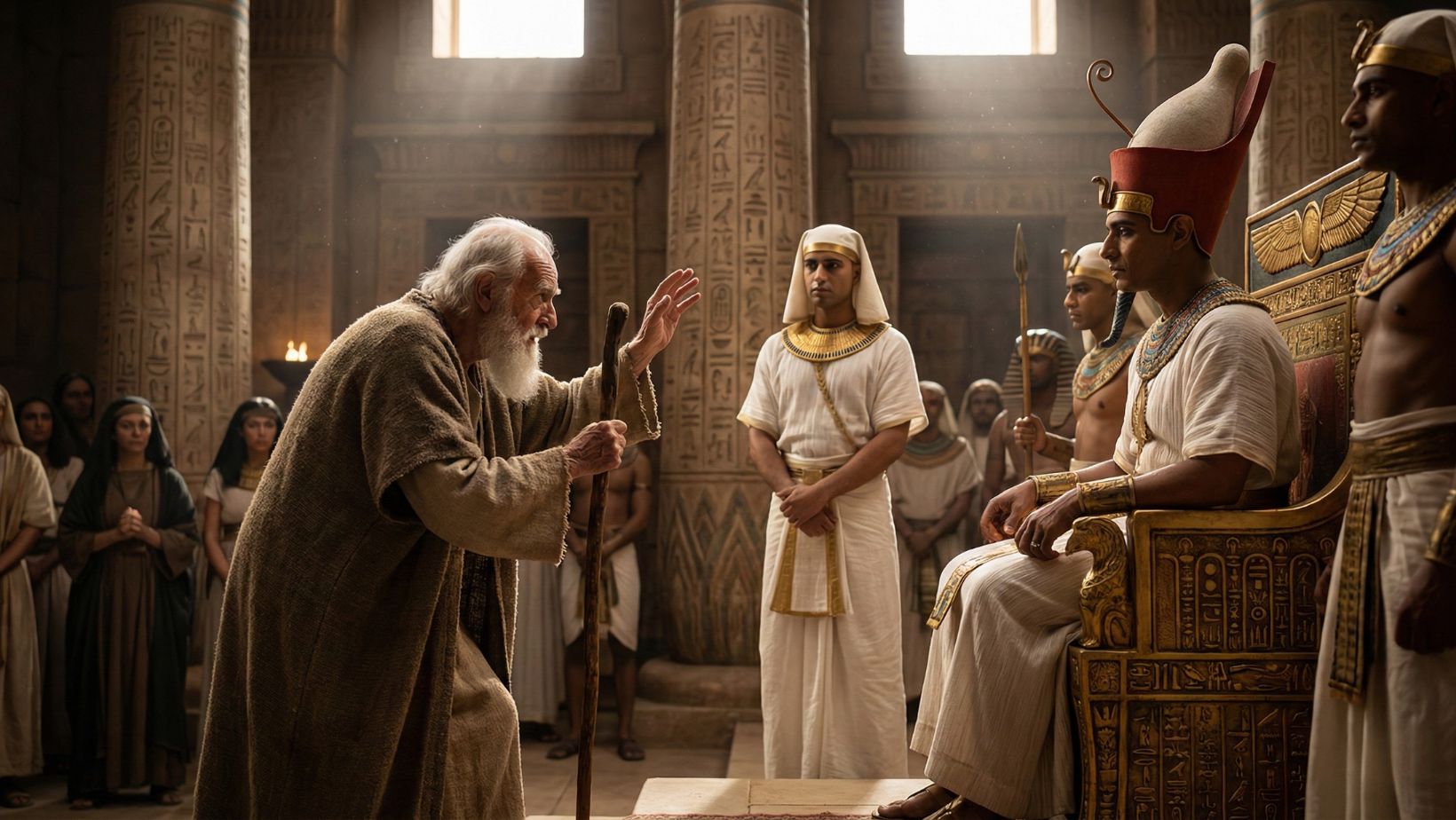
Genesis 47 contrasts the rising fortunes of the house of Israel with the desperation of the Egyptian populace. As the famine reaches its peak, Joseph skillfully navigates the political landscape to secure the best land (Goshen) for his family. In a striking reversal of roles, the refugee patriarch Jacob blesses the mighty Pharaoh. The chapter also details Joseph’s severe but effective economic administration, where the Egyptian people voluntarily sell their land and liberty to Pharaoh in exchange for survival. The narrative concludes with Jacob, nearing death, binding Joseph with a solemn oath to bury him not in Egypt, but in the Promised Land, signifying that their stay in Egypt—though comfortable—is temporary.
1. The Audience with Pharaoh (Genesis 47:1–12 NLT)
1 Then Joseph went to see Pharaoh and told him, “My father and my brothers have arrived from the land of Canaan. They have come with all their flocks and herds and possessions, and they are now in the region of Goshen.” 2 Joseph took five of his brothers with him and presented them to Pharaoh. 3 And Pharaoh asked the brothers, “What is your occupation?” They replied, “We, your servants, are shepherds, just like our ancestors. 4 We have come to live here for a while, for we have no pasture for our flocks in Canaan. The famine is very severe there. So please, we request permission to live in the region of Goshen.” 5 Then Pharaoh said to Joseph, “Now that your father and brothers have joined you here, 6 choose any place in the entire land of Egypt for them to live. Give them the best land of Egypt. Let them live in the region of Goshen. And if any of them have special skills, put them in charge of my livestock, too.” 7 Then Joseph brought in his father, Jacob, and presented him to Pharaoh. And Jacob blessed Pharaoh. 8 “How old are you?” Pharaoh asked him. 9 Jacob replied, “I have traveled this earth for 130 hard years. But my life has been short compared to the lives of my ancestors.” 10 Then Jacob blessed Pharaoh again before leaving his court. 11 So Joseph assigned the best land of Egypt—the region of Rameses—to his father and his brothers, and he settled them there, just as Pharaoh had commanded. 12 And Joseph provided food for his father and his brothers in amounts appropriate to the number of their dependents, including the youngest children.
Commentary:
- Strategic Presentation (v. 2): Joseph selects only five brothers (likely the most impressive or perhaps the most diplomatic) to represent the family. This prevents the large clan from appearing as an invading force.
- “For a While” (v. 4): The brothers frame their request as a temporary sojourn (“live here for a while”). They do not intend to become Egyptians; they are guests waiting out the famine.
- Shepherds in Goshen (v. 6): Pharaoh grants them the “best of the land.” Goshen was ideal for grazing but less desirable for Egyptian agriculture. By placing them there, Pharaoh isolates them culturally (avoiding the “abomination” issue mentioned in Gen 46:34) while utilizing their skills for royal livestock.
- Jacob Blesses Pharaoh (v. 7, 10): This is the theological highlight. A homeless, famine-stricken old man blesses the ruler of the superpower of the day.
- Jacob’s Pessimism (v. 9): Jacob describes his 130 years as “short and hard” (or “few and evil”). His life has been marked by conflict (Esau/Laban), grief (Rachel/Joseph), and fear. He does not sugarcoat his reality, even before a king.
- Region of Rameses (v. 11): This is likely an anachronistic update by the author (Moses) for his readers, as the city of Rameses was built later (Exodus 1:11). It helps the Israelites identify the location.
2. The Consolidation of Power (Genesis 47:13–26 NLT)
13 Meanwhile, the famine became so severe that all the food was used up. People throughout the land of Egypt and Canaan were starving. 14 Joseph collected all the money in Egypt and Canaan in exchange for grain, and he brought the money to Pharaoh’s treasure-house. 15 When the people of Egypt and Canaan ran out of money, all the Egyptians came to Joseph. “Our money is gone!” they cried. “But please, give us food, or we will die before your very eyes!” 16 Joseph replied, “Since your money is gone, bring me your livestock. I will give you food in exchange for your livestock.” 17 So they brought their livestock to Joseph in exchange for food. In exchange for their horses, sheep, goats, cattle, and donkeys, Joseph provided them with food for that year. 18 But that year ended, and the next year they came again and said, “We cannot hide the truth from you, my lord. Our money is gone, and all our livestock and cattle are yours. We have nothing left to give but our bodies and our land. 19 Why should we die before your very eyes? Buy us and our land in exchange for food; we offer our land and ourselves as slaves for Pharaoh. Give us grain so we may live and not die, and so the land does not become empty and desolate.” 20 So Joseph bought all the land of Egypt for Pharaoh. All the Egyptians sold their fields because the famine was so severe, and soon all the land belonged to Pharaoh. 21 As for the people, he made them all slaves, from one end of Egypt to the other. 22 The only land he did not buy was the land belonging to the priests. They received an allotment of food directly from Pharaoh, so they didn’t need to sell their land. 23 Then Joseph said to the people, “Look, today I have bought you and your land for Pharaoh. I will provide you with seed so you can plant the fields. 24 Then when you harvest it, one-fifth of your crop will belong to Pharaoh. You may keep the remaining four-fifths as seed for your fields and as food for you, your households, and your little ones.” 25 “You have saved our lives!” they exclaimed. “May it please you, my lord, to let us be Pharaoh’s servants.” 26 Joseph then enacted a land law still in effect today in the land of Egypt: Pharaoh takes one-fifth of the harvest. Only the land owned by the priests was not bought by Pharaoh.
Commentary:
- The Three Stages of Desperation: The text outlines a progressive economic collapse:
- Money fails (v. 14): Liquid assets are exhausted.
- Livestock fails (v. 16): Productive capital (animals) is traded for survival.
- Liberty fails (v. 19): People sell their land and their bodies (serfdom).
- Joseph’s Administration (v. 20): Critics sometimes view Joseph as a tyrant here, creating a feudal state. However, in the context of the ancient world, he is seen as a “Savior” (v. 25). He prevented mass starvation and social anarchy. He nationalized the land but allowed the people to remain on it as tenant farmers.
- The 20% Tax (v. 24): Joseph institutes a 20% tax (one-fifth) on the harvest. This was actually a reasonable rate in the ancient Near East, where taxation could often reach 33-50%. The people retained 80% for their own use.
- Exemption of Priests (v. 22): The Egyptian priesthood was a powerful institution. Joseph, likely respecting the religious structure (and his father-in-law, a priest of On), exempts them. This creates a fascinating parallel: the priests of Egypt kept their land, and the “priestly nation” (Israel) kept their land in Goshen.
3. Jacob’s Last Wish (Genesis 47:27–31 NLT)
27 Meanwhile, the people of Israel settled in the region of Goshen in Egypt. There they acquired property, and they were fruitful, and their population grew rapidly. 28 Jacob lived for seventeen years after his arrival in Egypt, so he was 147 years old when he died. 29 As the time of his death drew near, Jacob called for his son Joseph and said to him, “Please do me this favor. Put your hand under my thigh and swear that you will treat me with unfailing love by honoring this last request: Do not bury me in Egypt. 30 When I die, please take my body out of Egypt and bury me with my ancestors.” So Joseph promised, “I will do as you ask.” 31 “Swear to me,” Jacob insisted. So Joseph swore it. And Jacob bowed humbly at the head of his bed.
Commentary:
- Prosperity in Goshen (v. 27): While the Egyptians were selling themselves into slavery (v. 21), the Israelites were “acquiring property” and “growing rapidly.” The contrast is stark: the world is diminishing, but the people of God are expanding.
- The 17 Years (v. 28): Jacob lived in Egypt for 17 years—the exact same amount of time Joseph lived with Jacob before being sold (Gen 37:2). God graciously restores the “lost years” of their relationship.
- The Hand Under the Thigh (v. 29): This ancient custom (seen also with Abraham in Gen 24:2) was a solemn way of swearing an oath. It is linked to the “loins” or reproductive power, invoking the covenant of circumcision and the future seed. Jacob is saying, “Swear by the future of our people.”
- The Rejection of Egypt (v. 30): Jacob refuses an Egyptian pyramid or tomb. His request to be buried in the Cave of Machpelah (Canaan) is a supreme act of faith. He declares that Egypt is not home. His dead body will preach a sermon to his descendants: “We don’t belong here.”
- Jacob Worships (v. 31): The chapter ends with Jacob bowing in worship (Hebrews 11:21 says he “worshiped as he leaned on the top of his staff”). Even in his frailty, his focus is on God.
Theological Significance of Genesis 47
- The Theology of Exile: The Israelites prosper within a pagan nation without becoming that nation. They are in the world (Egypt) but not of it (Goshen).
- Provident Stewardship: Joseph demonstrates that Godly wisdom applies to economics and government. He manages resources to save lives, even if it requires drastic structural changes to society.
- Hope Beyond Death: Jacob’s burial instructions are not just sentimental; they are theological. He anchors his hope in God’s promise of the land, looking forward to the resurrection and the fulfillment of the Covenant.
Practical Applications
- Bloom Where Planted: Like the Israelites in Goshen, believers can flourish even in “famine” times or hostile cultures if they remain faithful to their identity.
- Planning for the End: Jacob did not ignore his mortality. He prepared for it by securing a promise that aligned with God’s will. We should approach the end of life with spiritual clarity, not denial.
- The Power of Blessing: We should never underestimate the power of a believer’s blessing. Like Jacob with Pharaoh, we have spiritual resources to offer the “powerful” of this world who may be spiritually bankrupt.







Leave a Reply