
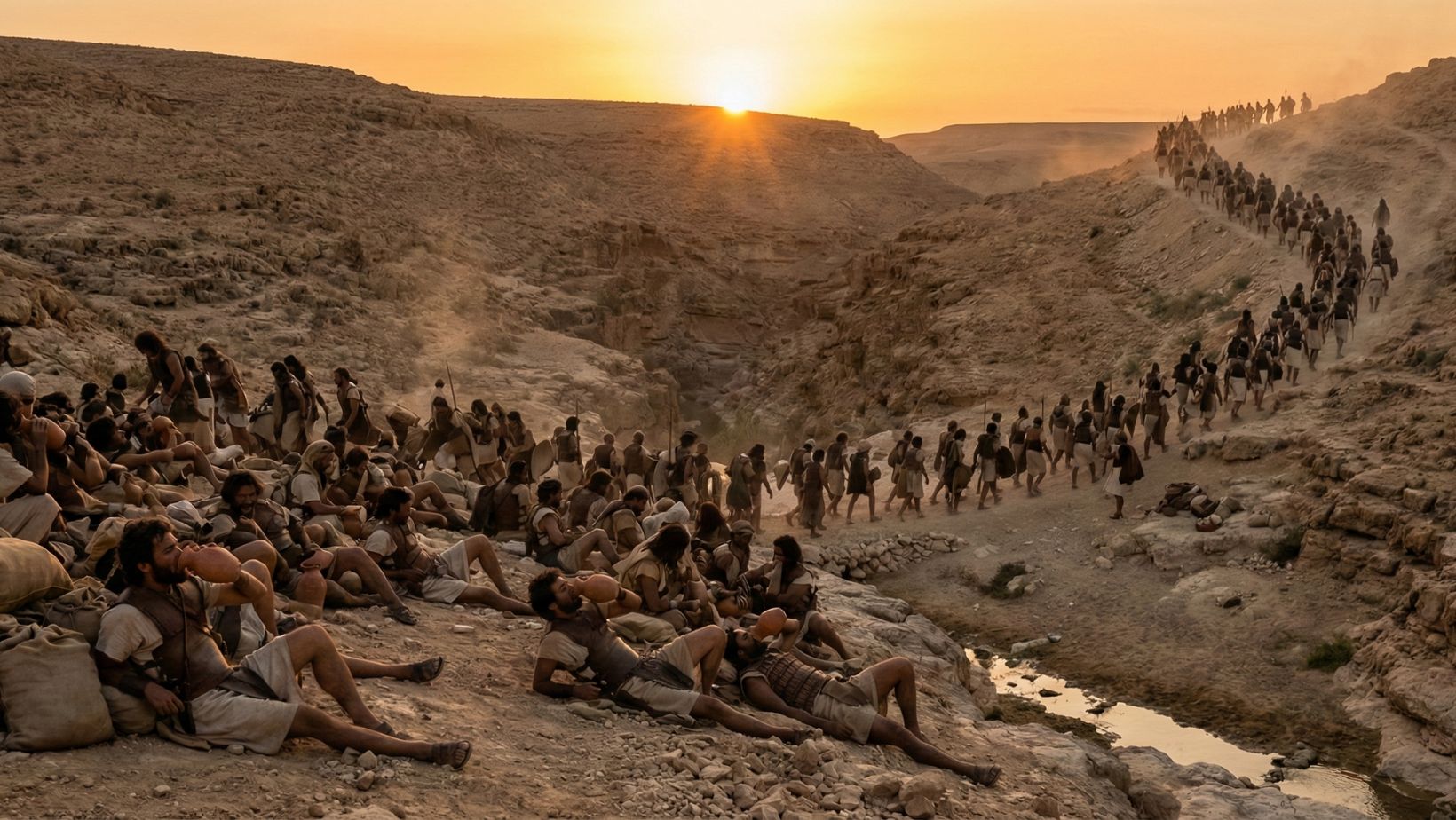
The Brook Besor is a significant geographical landmark in the narrative of 1 Samuel 30, serving as a critical testing ground for David’s leadership and the unity of his men. It was at this ravine in the Negev desert that David’s force of 600 men, exhausted from marching and distress, was split. While 400 continued the pursuit of the Amalekites, 200 were too physically depleted to cross the stream and remained behind to guard the baggage. The events at Besor led to one of David’s most enduring statutes regarding justice and community: that those who support the battle by guarding the supplies share equally in the victory with those who fight on the front lines.
Quick Facts
- Name: Brook Besor (Wadi Besor)
- Location: The Negev region, likely the modern Wadi Ghaza, south of Ziklag
- Event: The division of David’s army during the pursuit of the Amalekites
- Key Figures: David, 400 fighting men, 200 exhausted men
- Biblical Reference: 1 Samuel 30
- Key Statute: The “Law of the Spoils” (Equal sharing between warriors and baggage guards)
- Symbolism: Compassion for the weary; the value of support roles in God’s work
Name Meaning
Besor: The Hebrew root likely relates to “cheerful,” “good news” (basar), or potentially “cool.” This creates a thematic connection, as the location became a place of “good news” (victory and restoration) and “cooling/refreshment” for the exhausted men who stayed behind.
Geography / Physical Setting
Type: A wadi (seasonal riverbed) in the desert. In the dry season, it might be a trickle or dry, but during the rainy season, it can be a torrent with steep, difficult banks.
Terrain: The terrain was rugged enough that crossing it became the breaking point for men who had already marched from Aphek to Ziklag (approx. 50 miles) and then found their homes destroyed.
Strategic Function: It served as a natural barrier and a defensible position where the baggage and heavy supplies could be left safely.
Major Roles / Narrative Significance
The Point of Exhaustion: Besor represents the physical limits of humanity. Even the most loyal soldiers have breaking points. The 200 men were not rebellious; they were simply faint (1 Samuel 30:10).
The Place of Preservation: By leaving the 200 men there, David not only showed mercy but also strategic wisdom. He created a rear guard and a secure base for the supplies, ensuring the 400 pursuing men could travel light and fast.
The Site of Justice: Upon the return of the victors, “wicked and worthless fellows” among the 400 wanted to deny the spoils to the 200 who stayed. Besor became the courtroom where David ruled that unity and shared mission supersede individual physical contribution.
Key Themes & Lessons
Unity of the Body: David recognized that the mission was one corporate effort. Whether marching or guarding, all played a role.
Grace vs. Merit: The wicked men argued based on merit (“they didn’t fight, they don’t eat”). David argued based on grace and corporate identity (“God gave us the victory”).
Protection of the Vulnerable: David refused to ostracize those who were too weak to continue. He validated their worth despite their inability to perform the primary task.
Main Event Sequence
The Arrival: David and 600 men arrive at the brook after discovering Ziklag burned.
The Separation: 200 men are too exhausted to cross. David leaves them with the baggage; 400 cross over (1 Samuel 30:9-10).
The Waiting: The 200 men guard the supplies while the battle rages ahead.
The Reunion: David returns victorious with the recovered families and livestock. The 200 come out to meet them.
The Dispute: Hardliners among the fighters demand the 200 receive nothing but their wives and children.
The Decree: David silences the dissenters, attributing the victory to God and establishing the statute of equal sharing (1 Samuel 30:23-25).
Notable Passages
1 Samuel 30:10: “But David pursued, he and four hundred men. Two hundred stayed behind, who were too exhausted to cross the brook Besor.”
1 Samuel 30:24: “For as his share is who goes down into the battle, so shall his share be who stays by the baggage. They shall share alike.”
Legacy & Impact
Legal Precedent: This ruling became a “statute and a rule for Israel from that day forward” (1 Samuel 30:25). It echoes God’s instructions to Moses in Numbers 31:27 regarding the division of spoils.
Missiological Application: In Christian theology, this principle is often applied to missionary work—those who “go down into the well” (missionaries/frontline workers) and those who “hold the rope” (supporters/prayer partners) are equal partners in the work and the reward.
Symbolism / Typology
The River of Testing: Like the Jordan or the Red Sea, the brook represents a boundary. Here, it separated those with physical strength from those without, yet God’s grace bridged the gap.
Rest for the Weary: Besor symbolizes the validity of rest. God does not demand more than a human can give; there is a place in the kingdom for those who need to “stay by the baggage.”







Leave a Reply