
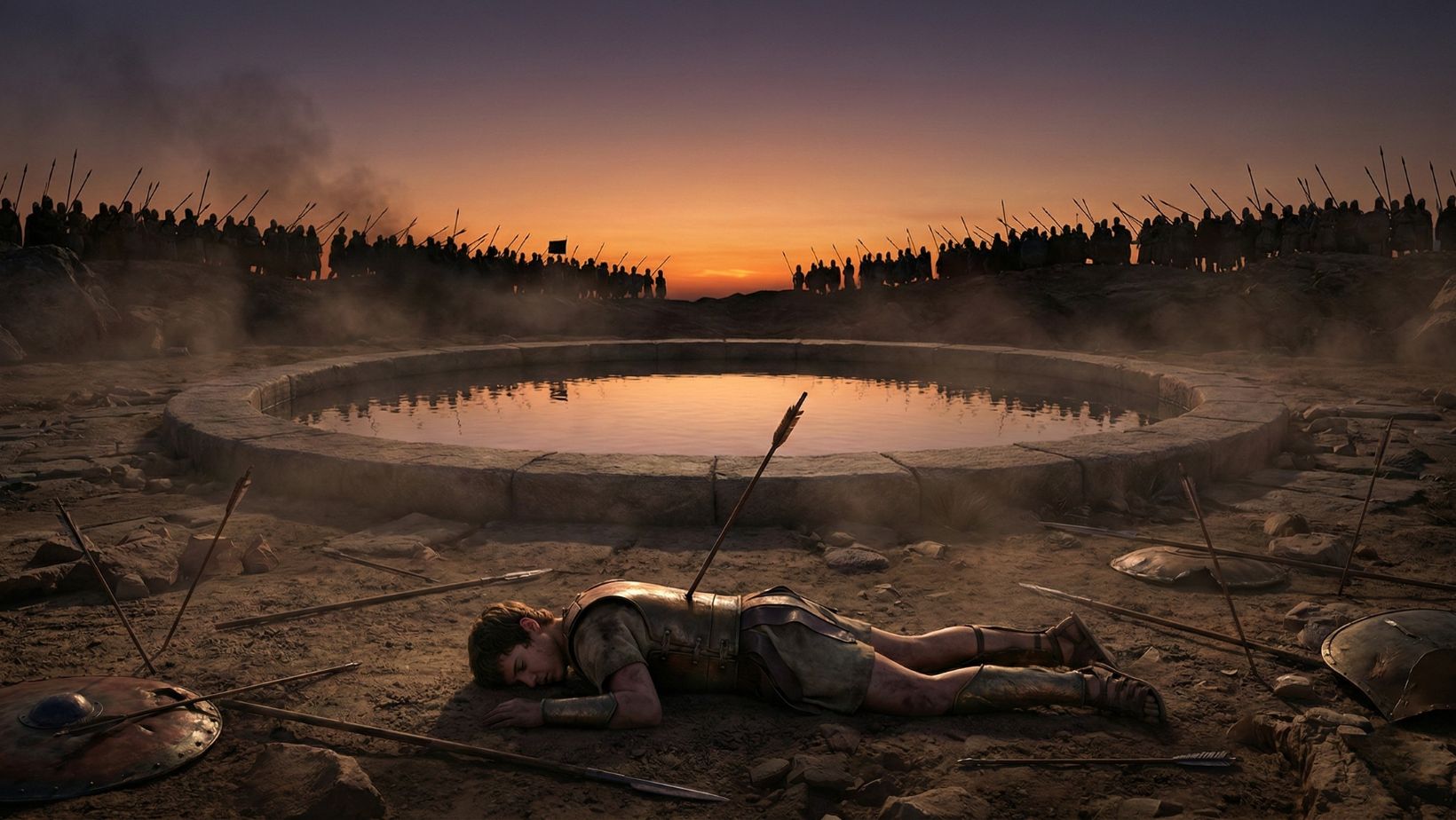
2 Samuel 2 chronicles the beginning of the divided kingdom. Following Saul’s death, David inquires of the Lord and moves to Hebron, where the men of Judah anoint him king. David immediately demonstrates kingly diplomacy by thanking the men of Jabesh-gilead for burying Saul. However, the transition is not smooth. Abner, Saul’s general, installs Saul’s surviving son, Ishbosheth, as king over the northern tribes (Israel), creating a rival regime. The tension escalates into a civil war, sparked by a “tournament” at the Pool of Gibeon that turns into a bloodbath. The chapter ends with a personal tragedy for David’s army: his nephew Asahel is killed by Abner in self-defense, sowing the seeds for a blood feud that will complicate David’s consolidation of power.
1. David Anointed King of Judah (2 Samuel 2:1–7 NLT)
1 After this, David asked the Lord, “Should I move back to one of the towns of Judah?” “Yes,” the Lord replied. Then David asked, “Which town should I go to?” “To Hebron,” the Lord answered. 2 So David’s two wives—Ahinoam from Jezreel and Abigail, the widow of Nabal from Carmel—went along with him. 3 David also took the men who were with him and their families, and they settled in the towns around Hebron. 4 Then the men of Judah came to David and anointed him king over the people of Judah. When David heard that the men of Jabesh-gilead had buried Saul, 5 he sent them this message: “May the Lord bless you for being so loyal to your master Saul and giving him a decent burial. 6 May the Lord be loyal to you in return and reward you with his unfailing love! And I, too, will reward you for what you have done. 7 Now that Saul is dead, I ask you to be strong and brave, for the people of Judah have anointed me their king.”
Commentary:
- Guidance First (v. 1): Unlike many leaders who rush into power vacuums, David pauses to “ask the Lord.” This dependence on divine guidance distinguishes his reign. He asks if he should go and where he should go.
- Why Hebron? (v. 1): Hebron was a strategic choice. It was the highest point in Judah, easily defensible, a Levitical city of refuge, and possessed deep ancestral roots (burial place of Abraham, Isaac, and Jacob).
- Public Anointing (v. 4): David had been anointed privately by Samuel years earlier (1 Samuel 16). Now, he receives public ratification by his own tribe. This is the second of his three anointings (the third will be over all Israel in 2 Samuel 5).
- Diplomacy with Jabesh-gilead (v. 4–7): Jabesh-gilead was a city historically loyal to Saul (Saul saved them in 1 Samuel 11). By burying Saul, they risked Philistine retaliation.
Insight: David does not treat Saul’s loyalists as enemies. He recognizes that loyalty is a virtue, even when directed at his rival, and seeks to incorporate that virtue into his new kingdom.
2. The Rival King: Ishbosheth Installed (2 Samuel 2:8–11 NLT)
8 But Abner son of Ner, the commander of Saul’s army, had already gone to Mahanaim with Saul’s son Ishbosheth. 9 There he proclaimed Ishbosheth king over Gilead, Jezreel, Ephraim, Benjamin, the land of the Ashurites, and all the rest of Israel. 10 Ishbosheth son of Saul was forty years old when he became king of Israel, and he reigned two years. Meanwhile, the people of Judah remained loyal to David. 11 David made Hebron his capital, and he reigned as king of Judah for seven and a half years.
Commentary:
- The Power Behind the Throne (v. 8): Abner, Saul’s cousin and general, is the true power here. He takes Ishbosheth to Mahanaim (across the Jordan River), safe from the Philistines.
- Ishbosheth’s Name:
- The Division (v. 10–11): Israel is now formally divided.
- David: Rules Judah (South) from Hebron (7.5 years).
- Ishbosheth: Rules “all the rest of Israel” (North) from Mahanaim (2 years).
- Note on Timeline: The discrepancy between David’s 7.5 years and Ishbosheth’s 2 years suggests a gap. Either Ishbosheth didn’t ascend immediately, or there was a 5-year period after his death before David united the kingdom.
Insight: God’s promise to David is delayed by human resistance. Abner acts out of family preservation and thirst for power, creating a “king” who was never chosen by God.
3. Civil War at the Pool of Gibeon (2 Samuel 2:12–17 NLT)
12 One day Abner led Ishbosheth’s troops from Mahanaim to Gibeon. 13 Joab son of Zeruiah led David’s troops and met them at the pool of Gibeon. The two groups sat down there, facing each other from opposite sides of the pool. 14 Then Abner suggested to Joab, “Let’s have a few of our warriors fight hand to hand here in front of us.” “All right,” Joab agreed. 15 So twelve men were chosen to fight from the tribe of Benjamin to represent Ishbosheth son of Saul, and twelve were chosen from David’s men. 16 Each one grabbed his opponent by the hair and thrust his sword into the other’s side so that all of them died. So this place at Gibeon has been known ever since as the Field of Swords. 17 A fierce battle followed that day, and Abner and the men of Israel were defeated by the forces of David.
Commentary:
- The Standoff (v. 12–13): Gibeon is centrally located. The two armies meet at a large water cistern (archaeology has uncovered a massive cylindrical shaft at Gibeon, confirming the “pool”).
- The Commanders:
- The “Tournament” (v. 14): Abner proposes a contest to perhaps decide the outcome without mass slaughter or simply to “play” (sport). The Hebrew word suggests “entertainment.”
- Mutually Assured Destruction (v. 16): The representative combat fails spectacularly. The 12 pairs of soldiers kill each other simultaneously (“grabbed by the hair… thrust sword into side”).
- Helkath-hazzurim (v. 16): The place is named “Field of Swords” (or Field of Flints/Sharp Edges).
- Total War (v. 17): With the diplomatic/representative solution failing, chaos erupts. David’s forces (Joab) win the day.
Insight: Trying to solve deep conflicts with “games” or half-measures often leads to greater disaster. Violence begets violence.
4. The Death of Asahel (2 Samuel 2:18–32 NLT)
18 Joab, Abishai, and Asahel—the three sons of Zeruiah—were among David’s forces that day. Asahel could run like a gazelle, 19 and he began chasing Abner. He pursued him relentlessly, not stopping for anything. 20 When Abner looked back and saw him, he asked, “Is that you, Asahel?” “Yes, it is,” he replied. 21 “Go fight someone else!” Abner warned. “Take on one of the younger men, and strip him of his weapons.” But Asahel refused and kept right on chasing Abner. 22 Again Abner warned him, “Get away from here! I don’t want to kill you. How could I ever face your brother Joab again?” 23 But Asahel refused to turn back, so Abner thrust the butt end of his spear through Asahel’s stomach, and the spear came out through his back. He stumbled to the ground and died there. And everyone who came by that spot stopped and stood still when they saw Asahel lying there. … 26 Abner shouted down to Joab, “Must we always be killing each other? Don’t you realize that only bitterness will come of this? How long before you call off your men from chasing their kinsmen?” 27 Then Joab said, “God only knows what would have happened if you hadn’t spoken, for we would have chased you all night if necessary.” … 30 When Joab regrouped his men, he found that nineteen of them and Asahel were missing. 31 But David’s men had killed 360 of the Benjaminites and Abner’s men.
Commentary:
- The Sons of Zeruiah (v. 18): Joab, Abishai, and Asahel are David’s nephews (sons of his sister). They are fierce, loyal, but often violent and hard for David to control.
- Asahel’s Folly (v. 19–23): Asahel is fast (“like a gazelle”) but inexperienced compared to the veteran Abner.
- He chases a prize too big for him (killing the enemy commander).
- Abner’s Mercy: Abner tries twice to spare him (v. 21, 22), knowing that killing Asahel will start a blood feud with the terrifying Joab.
- The Kill: Abner uses the butt end of the spear (often shod with metal) to perform a backward thrust, killing Asahel instantly.
- The Halt (v. 23): The sight of the fallen hero stops the pursuing soldiers. It creates a moment of horror.
- Abner’s Appeal (v. 26): Abner, realizing he is losing, calls for a ceasefire. “Must the sword devour forever?” He appeals to their shared kinship (“kinsmen”).
- The Body Count (v. 30–31): The victory is decisive for David (19 losses vs. 360 losses for Abner), but the loss of Asahel casts a long shadow.
- Burial (v. 32): Asahel is buried in Bethlehem. This sets the stage for Joab’s future revenge (2 Samuel 3), which will threaten David’s kingdom.
Insight: Asahel relied on his natural gift (speed) but lacked wisdom and caution. His refusal to heed the warning of a seasoned veteran cost him his life. Zeal without knowledge is dangerous.
Theological Significance of 2 Samuel 2
- Divine Guidance vs. Human Scheme: David begins with prayer (“Shall I go up?”), resulting in a steady, though partial, kingdom. Abner begins with scheming (making Ishbosheth king), resulting in war and instability.
- The Slow Fulfillment of Promise: God promised David the kingdom years ago, but he only receives one tribe (Judah) initially. This teaches the theology of “already/not yet.” The believer must possess patience while God works out His plan in stages.
- The Tragic Cost of Division: The chapter highlights the horror of civil war among God’s people (“kinsmen,” v. 26). When unity fractures, the result is “bitterness” (v. 26).
Practical Applications
- Consult Before Moving: Before making major life changes (relocation, career shifts), we should imitate David and ask, “Shall I go up?”
- Know Your Limits: Asahel’s death is a warning against arrogance. Just because we are gifted (fast), it doesn’t mean we are ready for every battle. We must know when to disengage.
- De-escalation: Abner eventually calls for the fighting to stop to prevent “bitterness.” In our conflicts, someone must be the first to say, “Must we keep devouring each other?”
- Handling Rivals: David’s kindness to Jabesh-gilead (Saul’s supporters) shows that we should try to win over our detractors with grace rather than crushing them with force.
Sermon Titles
- One Tribe at a Time.
- The Danger of Ambition (The Asahel Syndrome).
- When Brothers Fight.
- Asking God “Where?”
- The Field of Swords: The Cost of Division.







Leave a Reply