
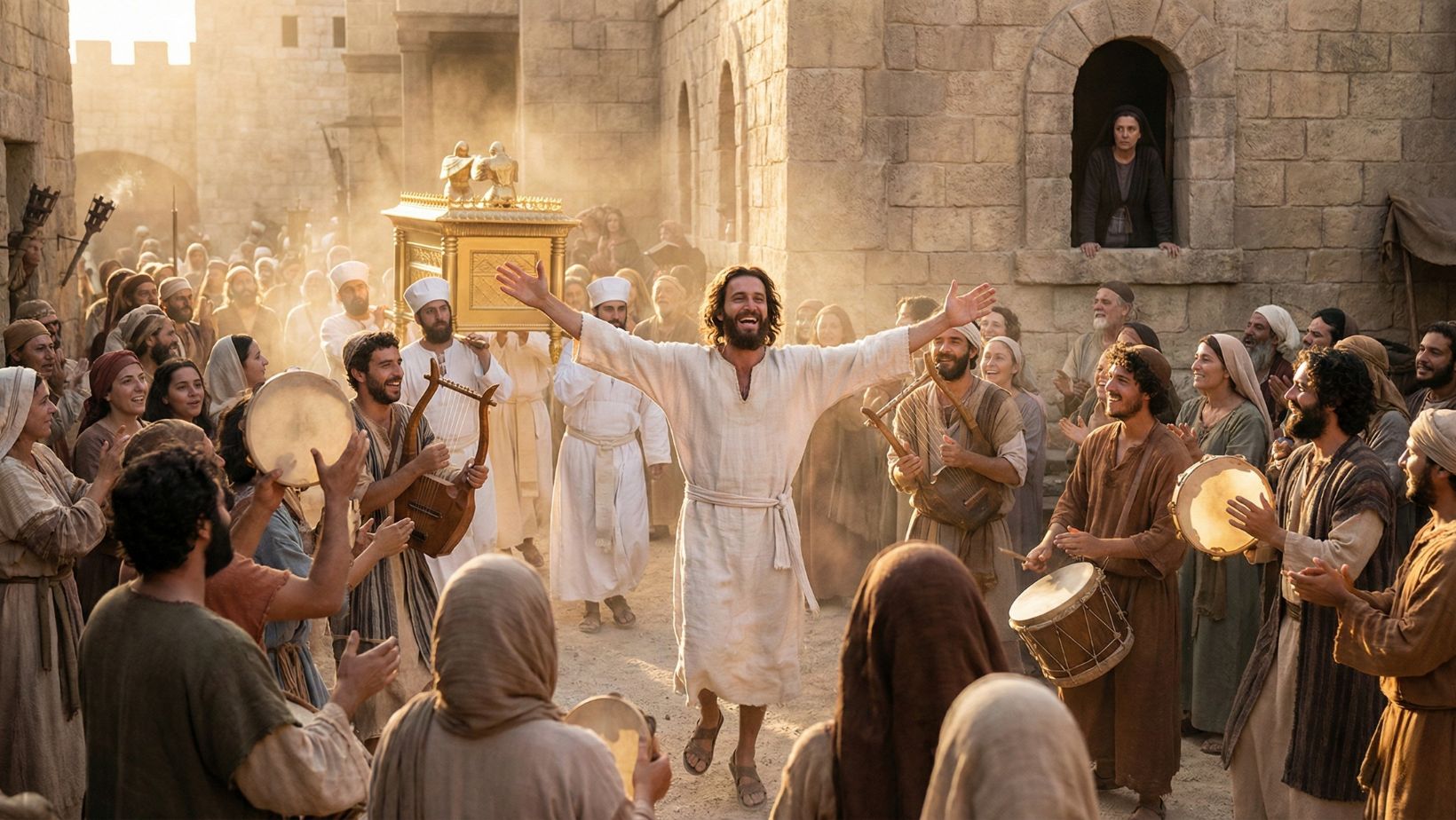
2 Samuel 6 describes the dramatic and emotional journey of bringing the Ark of the Covenant into Jerusalem. This event is central to David’s reign, as he seeks to make Jerusalem not just the political capital, but the spiritual center of Israel. The narrative is divided into two movements: a failed, tragic first attempt that results in the death of Uzzah due to irreverence, and a successful, joyous second attempt characterized by proper ritual and David’s uninhibited worship. The chapter concludes with a sharp domestic conflict between David and his wife Michal, contrasting true worship with prideful dignity.
1. The Failed Attempt and Uzzah’s Death (2 Samuel 6:1–11 NLT)
1 Then David mobilized thirty thousand special troops. 2 He led them to Baalah of Judah to bring back the Ark of God, which bears the name of the Lord of Heaven’s Armies, who is enthroned between the cherubim. 3 They placed the Ark of God on a new cart and brought it from Abinadab’s house, which was on a hill. Uzzah and Ahio, Abinadab’s sons, were guiding the cart 4 that carried the Ark of God. Ahio walked in front of the Ark. 5 David and all the people of Israel were celebrating before the Lord, singing songs and playing all kinds of musical instruments—lyres, harps, tambourines, castanets, and cymbals. 6 But when they arrived at the threshing floor of Nacon, the oxen stumbled, and Uzzah reached out his hand and steadied the Ark of God. 7 Then the Lord’s anger was aroused against Uzzah, and God struck him dead because of this. So Uzzah died right there beside the Ark of God. 8 David was angry because the Lord’s anger had burst out against Uzzah. He named that place Perez-uzzah (which means “to burst out against Uzzah”), as it is still called today. 9 David was now afraid of the Lord, and he asked, “How can I ever bring the Ark of the Lord to me?” 10 So David decided not to move the Ark of the Lord into the City of David. Instead, he took it to the house of Obed-edom of Gath. 11 The Ark of the Lord remained there in Obed-edom’s house for three months, and the Lord blessed Obed-edom and his entire household.
Commentary:
- The Mission (v. 1-2): David prioritizes God’s presence. The Ark had been neglected during Saul’s reign (1 Chronicles 13:3), sitting in obscurity at Kiriath-jearim (Baalah) for decades.
- The Methodological Error (v. 3): They put the Ark on a “new cart.”
- The Problem: This was the Philistine method of transport (1 Samuel 6:7). The Law of Moses explicitly stated the Ark must be carried on the shoulders of Kohathite Levites using poles through its rings (Numbers 4:15, Exodus 25:14).
- The Symbolism: A cart is efficient and mechanical. Shoulders are personal and require effort. They tried to use a convenient method rather than the obedient method.
- The Tragedy (v. 6-7): The oxen stumble, and Uzzah (whose name means “Strength”) instinctively reaches out to steady the Ark.
- The Offense: It seemed helpful, but it was presumptuous. It assumed that Uzzah’s sinful hand was cleaner than the dirt of the ground. It treated the holy Presence of God like a piece of furniture that needed human support.
- David’s Reaction (v. 8-10):
- Anger: David is initially resentful that his “good celebration” was ruined.
- Fear: He realizes the terrifying holiness of God. “How can the Ark come to me?”
- Obed-edom’s Blessing (v. 11): The Ark is diverted to the home of Obed-edom (a Gittite, possibly a Levite from Gath-rimmon). Instead of death, the Ark brings blessing. This proves God is not capricious; the danger lies in irreverence, not in the Ark itself.
Insight: Good intentions (bringing the Ark) do not excuse bad theology (using a cart). God cares about how we worship Him, not just that we worship Him.
2. The Joyful Entry into Jerusalem (2 Samuel 6:12–19 NLT)
12 Then King David was told, “The Lord has blessed Obed-edom’s household and everything he has because of the Ark of God.” So David went there and brought the Ark of God from the house of Obed-edom to the City of David with a great celebration. 13 After the men who were carrying the Ark of the Lord had gone six steps, David sacrificed a bull and a fattened calf. 14 And David danced before the Lord with all his might, wearing a priestly garment. 15 So David and all the people of Israel brought up the Ark of the Lord with shouts of joy and the blowing of rams’ horns. 16 But as the Ark of the Lord entered the City of David, Michal, the daughter of Saul, looked down from her window. When she saw King David leaping and dancing before the Lord, she was filled with contempt for him. 17 They brought the Ark of the Lord and set it in its place inside the special tent David had prepared for it. And David sacrificed burnt offerings and peace offerings to the Lord. 18 When he had finished his sacrifices, David blessed the people in the name of the Lord of Heaven’s Armies. 19 Then he gave to every Israelite man and woman in the crowd a loaf of bread, a cake of dates, and a cake of raisins. Then all the people returned to their homes.
Commentary:
- The Correction (v. 13): Note the shift: “The men who were carrying the Ark.” David learned his lesson (1 Chronicles 15 explicitly states he ordered the Levites to carry it).
- Sacrifice of Atonement (v. 13): Every six steps, they stopped to sacrifice. This signifies that the approach to God is only possible through blood atonement. It slows the procession down, making it a journey of reverence rather than efficiency.
- David’s Dance (v. 14):
- “With all his might”: This implies violent, energetic physical expression. It was undignified for a king but appropriate for a worshiper.
- “Priestly Garment” (Linen Ephod): David sets aside his royal robes (symbols of his authority over men) and wears a simple linen ephod (symbol of his submission to God). He enters not as a King, but as a Priest-worshiper.
- Michal’s Gaze (v. 16): Michal watches from a “window.” She is a spectator, separated from the community and the worship. She despises David’s vulnerability.
- Generosity (v. 19): True worship leads to generosity. David feeds the entire nation (raisin cakes were a luxury/delicacy).
Insight: When David focused on efficiency (cart), death ensued. When he focused on sacrifice and obedience (carrying/offerings), joy ensued.
3. The Domestic Dispute: Dignity vs. Humility (2 Samuel 6:20–23 NLT)
20 When David returned home to bless his own family, Michal, the daughter of Saul, came out to meet him. She said in disgust, “How distinguished the king of Israel looked today, shamelessly exposing himself to the servant girls like any vulgar person might do!” 21 David retorted to Michal, “I was dancing before the Lord, who chose me above your father and all his family! He appointed me as the leader of Israel, the people of the Lord, so I am willing to dance before the Lord. 22 Yes, and I will be even more undignified than this, even in my own eyes! But those servant girls you mentioned will indeed think I am distinguished.” 23 So Michal, the daughter of Saul, remained childless throughout her entire life.
Commentary:
- Michal’s Attack (v. 20): Michal attacks David’s dignity. Her sarcasm (“How distinguished…”) reveals her values. As Saul’s daughter, she was raised to believe a king must maintain distance and an image of superiority. To her, David’s emotional display was “vulgar.”
- David’s Defense (v. 21):
- Undignified (v. 22): This is the key verse. “I will be even more undignified than this.” David defines true spiritual greatness as the willingness to become “low” (humble) in one’s own estimation.
- The Consequence (v. 23): Michal remains childless.
Insight: The “Religious Spirit” (represented by Michal) is always critical of the “Worshiping Spirit” (represented by David). Pride hates humility because humility exposes pride’s shallowness.
Theological Significance of 2 Samuel 6
- The Holiness of God: The death of Uzzah reminds us that God is not a “buddy.” He is a consuming fire (Hebrews 12:29). His presence brings life (Obed-edom) or death (Uzzah) depending on whether we approach Him with holiness/obedience or presumption.
- Theology of Worship: True worship involves the whole person (emotions, body, will). It requires shedding our “royal robes” (status, ego) to become simple children before the Father.
- The Centrality of Zion: By bringing the Ark to Jerusalem, David unites the political and the religious. The earthly king submits to the Divine King in the center of the city.
Practical Applications
- Check Your “Cart”: Are we trying to do God’s work using worldly methods because they are easier or more popular? God prefers the “shoulders” of consecrated servants over the “carts” of innovation.
- Don’t Touch the Glory: Like Uzzah, we must be careful not to take credit for God’s work or try to “manage” God’s reputation with our human strength.
- Be Willing to Look Foolish: If your worship or obedience to God invites criticism from the “Michals” of the world (who call you fanatical or undignified), wear it as a badge of honor.
- Worship is Not a Spectator Sport: Michal watched from the window and judged. David got into the street and danced. We are called to be participants, not critics.
Sermon Titles
- When Good Intentions Kill (The Error of Uzzah).
- Undignified: The Cost of True Worship.
- The Window vs. The Street.
- Don’t Put God on a Cart.
- The King in a Linen Ephod.







Leave a Reply