
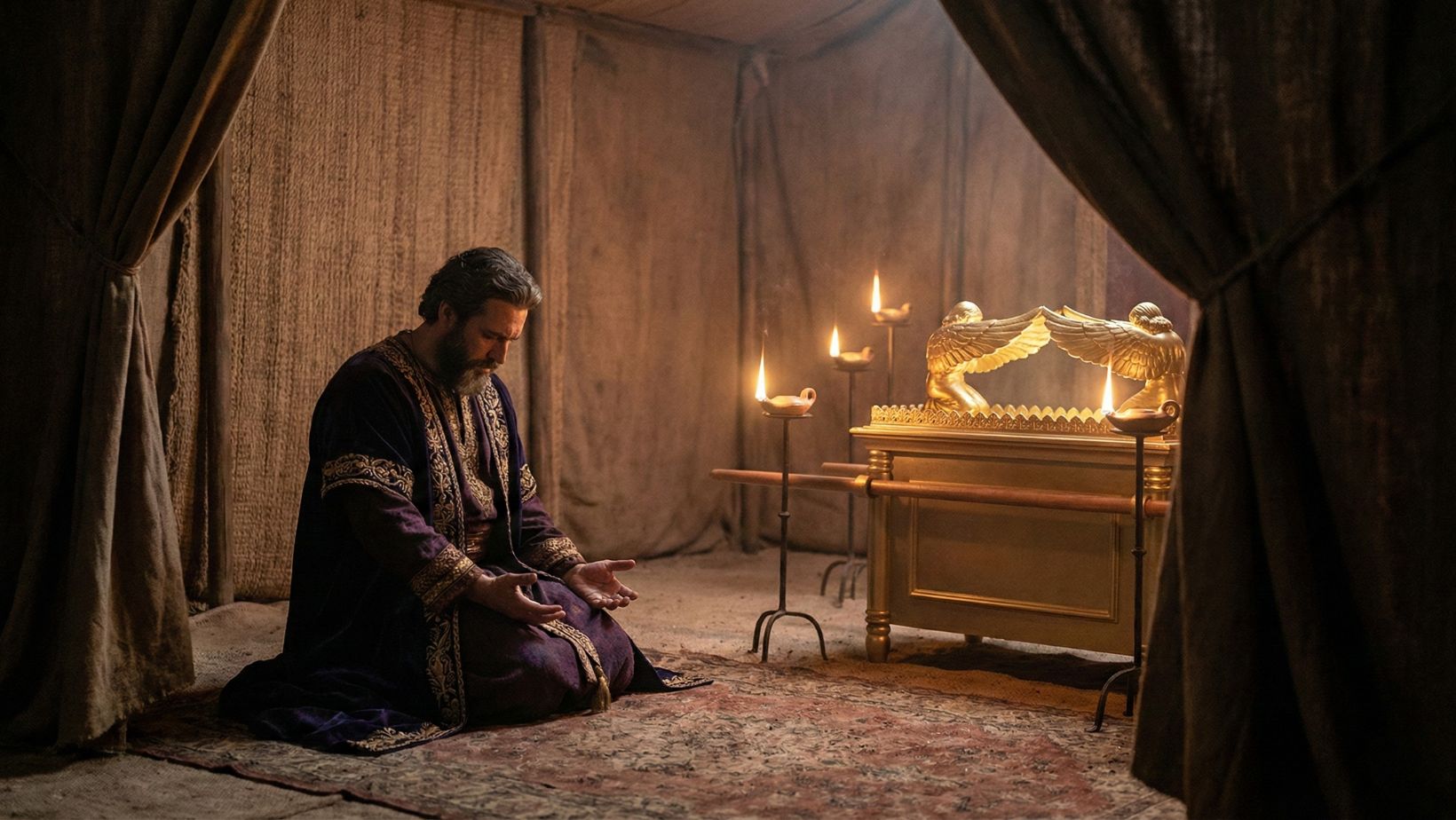
2 Samuel 7 is often considered the theological peak of the Historical Books and one of the most crucial chapters in the entire Bible. It records the establishment of the Davidic Covenant. The context is peaceful: David, now settled in his cedar palace, feels convicted that God’s Ark still resides in a tent. He proposes building a permanent Temple. Although the prophet Nathan initially encourages him, God intervenes with a surprising message: David will not build God a house (Temple); instead, God will build David a “house” (an eternal dynasty). This chapter serves as the foundation for Jewish Messianic hope and is ultimately fulfilled in Jesus Christ, the “Son of David” who reigns forever.
1. David’s Proposal and God’s Refusal (2 Samuel 7:1–7 NLT)
1 When King David was settled in his palace and the Lord had given him rest from all the surrounding enemies, 2 the king summoned Nathan the prophet. “Look,” David said, “I am living in a beautiful cedar palace, but the Ark of God is out there in a tent!” 3 Nathan replied to the king, “Go ahead and do whatever you have in mind, for the Lord is with you.” 4 But that same night the Lord said to Nathan, 5 “Go and tell my servant David, ‘This is what the Lord has declared: Are you the one to build a house for me to live in? 6 I have never lived in a house, from the day I brought the Israelites out of Egypt until this very day. I have always moved from one place to another with a tent and a Tabernacle as my dwelling. 7 Yet no matter where I have gone with the Israelites, I have never once complained to Israel’s tribal leaders, the shepherds of my people Israel. I have never asked them: “Why haven’t you built me a beautiful cedar house?”’
Commentary:
- Context of Rest (v. 1): The chapter opens with “rest.” This is significant because Deuteronomy 12:10–11 promised that when Israel had “rest” from enemies, they would establish a central sanctuary. David rightly interprets the peace as the time to build.
- The Contrast (v. 2): David feels a “holy inequality.” He lives in a house of cedar (expensive, imported timber from Tyre), while Yahweh dwells in a “tent” (literally “curtains”). His conscience is bothered by his own luxury compared to God’s modest accommodation.
- Nathan’s Presumption (v. 3): Nathan initially says “Go ahead.”
- The Theology of Mobility (v. 5–7): God corrects Nathan that night.
- “Are you the one?”: The Hebrew implies a strong negative. “You are NOT the one.”
- Portable Presence: God emphasizes that He has always been a mobile God (“moved from one place to another”). He is not a local deity confined to a shrine. He moves with His people.
- Lack of Demand: God points out that He never asked for a cedar house. He is content with the Tabernacle. This checks David’s assumption that God needs an upgrade.
Insight: God often says “No” to our good plans because He has a different timing or a different instrument in mind. David is a man of war; the Temple was to be a house of peace, built by a man of peace (Solomon).
2. The Davidic Covenant (2 Samuel 7:8–17 NLT)
8 “Now go and say to my servant David, ‘This is what the Lord of Heaven’s Armies has declared: I took you from tending sheep in the pasture and selected you to be the leader of my people Israel. 9 I have been with you wherever you have gone, and I have destroyed all your enemies before your eyes. Now I will make your name as famous as anyone who has ever lived on the earth! 10 And I will provide a homeland for my people Israel, planting them in a secure place where they will never be disturbed. Evil nations won’t oppress them as they’ve done in the past, 11 starting from the time I appointed judges to rule my people Israel. And I will give you rest from all your enemies. “‘Furthermore, the Lord declares that he will make a house for you—a dynasty of kings! 12 For when you die and are buried with your ancestors, I will raise up one of your descendants, your own offspring, and I will make his kingdom strong. 13 He is the one who will build a house—a temple—for my name. And I will secure his royal throne forever. 14 I will be his father, and he will be my son. If he sins, I will correct him and discipline him with the rod, like any father would do. 15 But my favor will not be taken from him as I took it from Saul, whom I removed from your sight. 16 Your house and your kingdom will continue before me for all time, and your throne will be secure forever.’” 17 So Nathan went back to David and told him everything the Lord had said in this vision.
Commentary:
- The Great Reversal (v. 11): This is the hinge of the chapter. David wanted to build God a house (Temple/Building). God replies that He will build David a house (Dynasty/Lineage). God out-gives David.
- The Promise of a Great Name (v. 9): God fulfills the promise made to Abraham (Genesis 12:2) through David.
- The Immediate Fulfillment: Solomon (v. 12–13):
- “Raise up your descendant… he is the one who will build a house.” This refers historically to Solomon, who built the Temple.
- The Father-Son Relationship (v. 14):
- “I will be his father, and he will be my son.” This adopts the Davidic king as God’s representative on earth.
- Discipline Clause: Unlike Saul, who was rejected permanently for disobedience, David’s line will be disciplined but not rejected. God commits to hesed (steadfast love/favor) that will not be withdrawn (v. 15).
- The Ultimate Fulfillment: Jesus (v. 13, 16):
- The promise shifts from the immediate to the eternal. “I will secure his royal throne forever.” No human king reigns forever.
- The New Testament identifies Jesus as the fulfillment of this promise (Luke 1:32–33: “The Lord God will give him the throne of his father David, and he will reign… forever”).
Insight: This covenant is unconditional. It depends on God’s faithfulness, not David’s perfection. Even when David’s descendants fail (which they will), God will preserve the line until the Messiah comes.
3. David’s Prayer of Gratitude (2 Samuel 7:18–29 NLT)
18 Then King David went in and sat before the Lord and prayed, “Who am I, O Sovereign Lord, and what is my family, that you have brought me this far? 19 And now, Sovereign Lord, in addition to everything else, you speak of giving your servant a lasting dynasty! Do you deal with everyone this way, O Sovereign Lord? 20 “What more can I say to you? You know what your servant is really like, Sovereign Lord. 21 Because of your promise and according to your will, you have done all these great things and have made them known to your servant. 22 “How great you are, O Sovereign Lord! There is no one like you. We have never even heard of another God like you! 23 What other nation on earth is like your people Israel? What other nation, O God, have you redeemed from slavery to be your own people? You made a great name for yourself when you redeemed your people from Egypt. You performed awesome miracles and drove out other nations and gods that stood in their way. 24 You made Israel your very own people forever, and you, O Lord, became their God. 25 “And now, O Lord God, I am your servant; do as you have promised concerning me and my family. Confirm it as a promise that will last forever. 26 And may your name be honored forever so that everyone will say, ‘The Lord of Heaven’s Armies is God over Israel!’ And may the house of your servant David continue before you forever. 27 “O Lord of Heaven’s Armies, God of Israel, I have been bold enough to pray this prayer to you because you have revealed all this to your servant, saying, ‘I will build a house for you.’ 28 For you are God, O Sovereign Lord. Your words are truth, and you have promised these good things to your servant. 29 “And now, may it please you to bless the house of your servant, so that it may continue forever before you. For you have spoken, and when you grant a blessing to your servant, O Sovereign Lord, it is an eternal blessing!”
Commentary:
- Posture of Prayer (v. 18): “David went in and sat before the Lord.” Standing or kneeling was customary; sitting suggests a posture of rest, intimacy, and being overwhelmed. He likely sat in the tent before the Ark.
- Humility (v. 18–19): David’s first response is “Who am I?” He recognizes that this promise is not based on his merit but on God’s sovereign choice.
- Uniqueness of Israel (v. 23): David pivots from his own house to God’s people. He marvels that God is the only deity who redeems a people for Himself (referencing the Exodus).
- Praying the Promise (v. 25): “Do as you have promised.”
- Concern for God’s Glory (v. 26): David asks for the dynasty to be established not for his own fame, but “so that everyone will say, ‘The Lord of Heaven’s Armies is God over Israel!’”
Insight: David accepts God’s “No” (to the Temple) and God’s “Yes” (to the Dynasty) with equal grace. He aligns his will perfectly with God’s revelation.
Theological Significance of 2 Samuel 7
- The Davidic Covenant: This is one of the major biblical covenants (along with Noahic, Abrahamic, Mosaic, and New). It promises a King, a Throne, and a Kingdom that will last forever. It narrows the Messianic line: Human -> Abraham -> Judah -> David.
- Typology of the Temple: The chapter distinguishes between the material Temple (which Solomon would build) and the spiritual House (the church/believers) that the Messiah would build. Jesus refers to his body as the Temple (John 2:19).
- Divine Sovereignty: The initiative is entirely God’s. David volunteers to do something for God, but God insists on doing everything for David. Grace is not God accepting our best efforts; it is God giving us what we could never earn.
Practical Applications
- When God Says “No”: Sometimes we have good, spiritual desires (like building a ministry or doing a specific work), but God says “No” or “Not you.” We must accept that God’s plan is superior to our good intentions.
- Praying Scripture: David’s prayer teaches us how to pray. We should study God’s promises and then say, “Lord, do as You have said.” This gives us confidence in prayer.
- Legacy vs. Dynasty: We often worry about what we will leave behind (building a house). God is more interested in who we are becoming and the spiritual lineage we leave.
- Resting in Grace: Like David sitting before the Lord, we need moments where we stop “doing” for God and simply sit in awe of what He has done for us.







Leave a Reply