
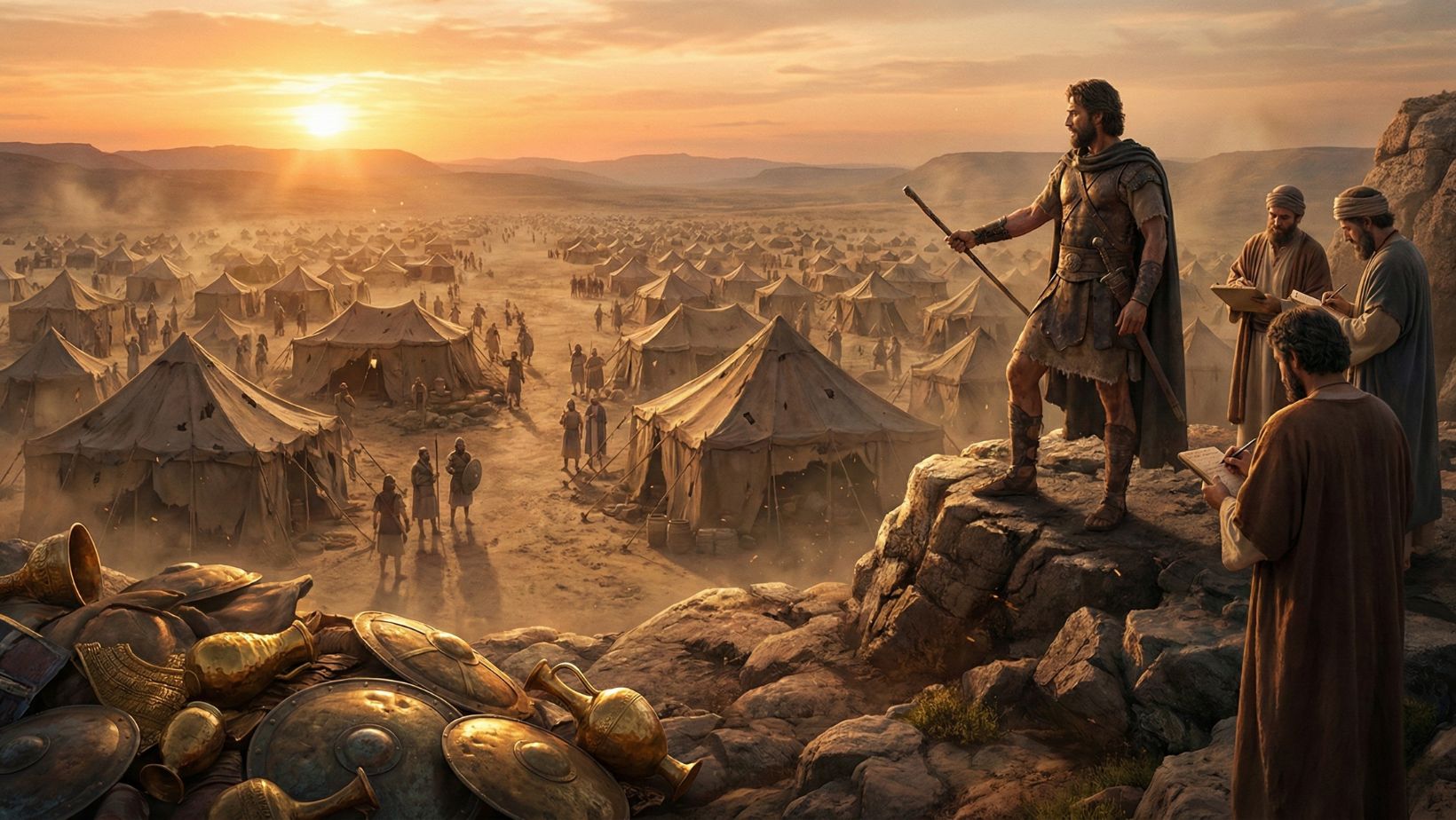
2 Samuel 8 serves as a summary report of David’s military campaigns and the establishment of his administration. Following the spiritual high point of the Davidic Covenant in Chapter 7, this chapter demonstrates the practical fulfillment of God’s promise to give Israel “rest from all enemies” and to secure the land. David systematically defeats the surrounding nations—Philistia (West), Moab (East), Zobah and Syria (North), and Edom (South)—expanding Israel’s borders to the full extent promised to Abraham in Genesis 15:18. The chapter concludes by listing the key officials in David’s cabinet, showing that he was not only a conqueror but also an organized administrator of justice.
1. Conquests in the West and East (2 Samuel 8:1–2 NLT)
1 After this, David defeated the Philistines and subdued them. He conquered Metheg-ammah, taking control from the Philistines. 2 David also conquered Moab, and he made the people lie down on the ground in a row. He measured them with a rope. He chose two out of every three groups to be executed, and the third group was spared. The Moabites became David’s subjects and paid him tribute money.
Commentary:
- “After this” (v. 1): This connects the military victories directly to the Covenant in Chapter 7. God promised to make David’s name great; these victories are the mechanism of that fame.
- Philistia [West] (v. 1): The Philistines had been Israel’s primary antagonist for generations (Samson, Saul).
- Metheg-ammah: Literally “The Bridle of the Mother City.” This likely refers to Gath, the chief city of the Philistines (1 Chronicles 18:1 confirms it is Gath). By taking the “bridle,” David took control of the Philistine leadership, ending their dominance over Israel forever.
- Moab [East] (v. 2):
- The Harsh Judgment: David’s treatment of the Moabites (executing two-thirds) seems shockingly brutal, especially since his great-grandmother Ruth was a Moabite and he had entrusted his parents to the King of Moab (1 Samuel 22:3–4).
- Context: Jewish tradition suggests the Moabites may have betrayed that trust and killed David’s parents, prompting this vengeance, though the text does not specify.
- Tribute: The survivors became vassal subjects, paying taxes to Israel. This fulfills the prophecy of Balaam in Numbers 24:17 (“A ruler will rise in Israel… he will crush the heads of Moab”).
Insight: David secures the western coast and the eastern flank, neutralizing the immediate threats to the heartland of Judah.
2. Conquests in the North (2 Samuel 8:3–8 NLT)
3 David also destroyed the forces of Hadadezer son of Rehob, king of Zobah, when Hadadezer marched out to strengthen his control along the Euphrates River. 4 David captured one thousand chariots, seven thousand charioteers, and twenty thousand foot soldiers. He crippled all the chariot horses except enough for one hundred chariots. 5 When the Arameans from Damascus arrived to help King Hadadezer of Zobah, David killed twenty-two thousand of them. 6 Then David placed military garrisons in Damascus, the Aramean capital, and the Arameans became David’s subjects and paid him tribute money. So the Lord made David victorious wherever he went. 7 David brought the gold shields of Hadadezer’s officers to Jerusalem, 8 along with a large amount of bronze from the towns of Betah and Berothai, which belonged to Hadadezer.
Commentary:
- Zobah [North] (v. 3): Zobah was a powerful Aramean (Syrian) kingdom located north of Damascus. Hadadezer was attempting to expand his empire to the Euphrates River. By defeating him, David extended Israel’s influence all the way to Mesopotamia.
- Hamstringing the Horses (v. 4): David “crippled” (hamstrung) the horses.
- The Reason: Deuteronomy 17:16 forbade the king from accumulating horses (which represented military reliance on flesh rather than God).
- The Strategy: David neutralized the enemy’s offensive capability without adopting their technology of war. He kept only a small number (100) for likely ceremonial or logistical use.
- Damascus (v. 5–6): The Arameans (Syrians) came to aid Zobah and were crushed. David placed “garrisons” (military outposts) in Damascus, effectively annexing modern-day Syria.
- The Spoils (v. 7–8):
- Gold Shields: Taken from the elite guard of Hadadezer.
- Bronze: Large quantities of bronze were taken. 1 Chronicles 18:8 notes that Solomon later used this specific bronze to make the Sea of Bronze (the large basin) and the pillars for the Temple.
- Preparation: David is unwittingly gathering the materials for the Temple his son will build.
Insight: “The Lord made David victorious wherever he went” (v. 6). This refrain emphasizes that David’s tactical brilliance was secondary to Yahweh’s sovereign empowerment.
3. Diplomacy and Conquest in the South (2 Samuel 8:9–14 NLT)
9 When King Toi of Hamath heard that David had destroyed the entire army of Hadadezer, 10 he sent his son Joram to congratulate King David on his successful campaign. Hadadezer and Toi had been enemies and were often at war. Joram presented David with many gifts of silver, gold, and bronze. 11 King David dedicated all these gifts to the Lord, as he did with the silver and gold from the other nations he had defeated— 12 from Edom, Moab, Ammon, Philistia, and Amalek—and from the plunder of Hadadezer son of Rehob, king of Zobah. 13 So David became even more famous when he returned from destroying eighteen thousand Edomites in the Valley of Salt. 14 He placed military garrisons throughout Edom, and all the Edomites became David’s subjects. In fact, the Lord made David victorious wherever he went.
Commentary:
- The Enemy of My Enemy (v. 9–10): King Toi of Hamath (further north) was relieved that David crushed his rival, Hadadezer. He sends tribute voluntarily via his son Joram. This shows David’s reputation as a regional superpower.
- Dedication of Wealth (v. 11): David does not keep the plunder for his personal enrichment. He “dedicates” (consecrates) it to Yahweh.
- Edom [South] (v. 13–14):
- Valley of Salt: Located south of the Dead Sea.
- Strategic Importance: Edom controlled the trade routes to the Red Sea (Gulf of Aqaba) and the copper mines.
- Garrisons: David occupies Edom militarily. This fulfills the prophecy given to Rebekah in Genesis 25:23 (“The older [Esau/Edom] will serve the younger [Jacob/Israel]”).
Insight: David’s kingdom now functions as an empire. He controls the major trade routes (Via Maris and King’s Highway), bringing immense wealth into Israel, all of which he stewards for the future Temple.
4. David’s Administration (2 Samuel 8:15–18 NLT)
15 So David reigned over all Israel and did what was just and right for all his people. 16 Joab son of Zeruiah was commander of the army. Jehoshaphat son of Ahilud was the royal historian. 17 Zadok son of Ahitub and Ahimelech son of Abiathar were the priests. Seraiah was the court secretary. 18 Benaiah son of Jehoiada was captain of the king’s bodyguard. And David’s sons served as priestly leaders.
Commentary:
- Justice and Righteousness (v. 15): This summarizes David’s domestic policy. He was not just a warlord; he was a judge who upheld the Law of Moses. This phrase (mishpat u-tsedaqah) is the messianic ideal (Jeremiah 23:5).
- The Cabinet (v. 16–18):
- Joab (General): Brilliant but ruthless; responsible for the military.
- Jehoshaphat (Recorder/Historian): Managed state records and protocol.
- Zadok and Ahimelech (Priests):
- Seraiah (Scribe): Secretary of State; handled correspondence.
- Benaiah (Head of Bodyguard):
- The Cherethites and Pelethites: These were foreign mercenaries (likely Cretans/Philistines). David trusted foreigners as his personal guard because they were loyal to him personally, not entangled in tribal politics.
- David’s Sons: The NLT translates “priestly leaders” (Hebrew cohenim). While usually meaning “priests,” in this context (since they were not Levites), it likely means “chief ministers” or domestic advisors.
Insight: A kingdom requires structure. David delegates authority, balancing military power (Joab), spiritual authority (Zadok/Abiathar), and administrative order (Jehoshaphat/Seraiah).
Theological Significance of 2 Samuel 8
- Fulfillment of Land Promises: For the first time, Israel possesses the land promised to Abraham “from the river of Egypt to the great river, the Euphrates” (Genesis 15:18). David is the agent of God’s faithfulness.
- The Theology of War: The recurring phrase “The Lord gave David victory” (v. 6, 14) emphasizes that victory belongs to God. David destroys the horses (v. 4) to demonstrate that his trust is in the name of the Lord (Psalm 20:7), not in chariots.
- Preparation for Worship: David’s wars are not just for territory; they are to gather the gold, silver, and bronze necessary to build the House of God. The “man of war” provides the resources for the “man of peace” (Solomon) to build.
Practical Applications
- Stewardship of Success: When David received gifts and plunder, he “dedicated them to the Lord” (v. 11). When we experience financial or career success, we should recognize it as a resource God has given us for His kingdom, not just our luxury.
- Don’t Trust in “Horses”: David crippled the chariots because he knew they would become a snare to his faith. We must identify the things we are tempted to trust in place of God (money, connections, intellect) and ensure they remain tools, not idols.
- Justice for All: Power often leads to corruption, but David used his power to do “what was just and right for all his people.” Leaders are called to protect the vulnerable, not exploit them.
- Delegation: David could not rule alone. He appointed capable leaders. Effective ministry and leadership require building a team.
Sermon Titles
- The Lord Gave Victory.
- Hamstrung Horses and Dedicated Gold.
- Justice and Righteousness: The King’s Standard.
- From the River to the Sea: The Kingdom Expanded.
- The Bridle of the City: Taking Control.







Leave a Reply