
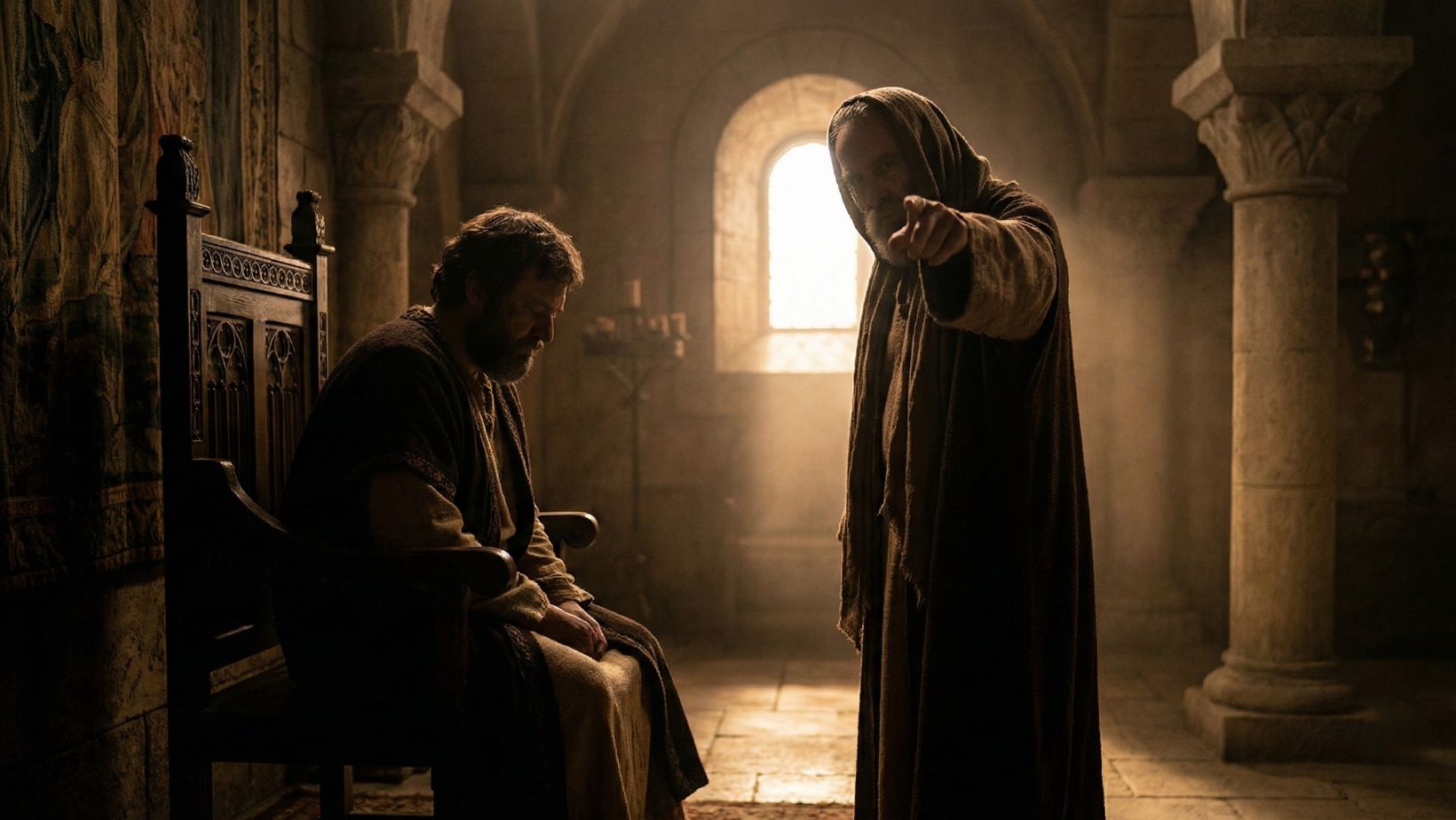
2 Samuel 12 records the divine confrontation and the painful consequences of David’s sin. After months of silence and suppression (during which David likely wrote Psalm 32), God sends the prophet Nathan to pierce the King’s conscience. Through a masterful parable, Nathan traps David into condemning himself. David’s confession is immediate—”I have sinned against the Lord”—and while he is forgiven and spared the death penalty, the consequences are severe: violence will plague his family, his wives will be shamed publicly, and the child conceived in adultery will die. The chapter chronicles the heartbreaking death of the infant, David’s profound theology of grief and hope, the birth of Solomon as a sign of restored grace, and finally, David’s return to his duties as king with the conquest of Rabbah.
1. Nathan’s Parable and David’s Judgment (2 Samuel 12:1–6 NLT)
1 So the Lord sent Nathan the prophet to tell David this story: “There were two men in a certain town. One was rich, and one was poor. 2 The rich man owned a great many sheep and cattle. 3 The poor man owned nothing but one little lamb he had bought. He raised that little lamb, and it grew up with his children. It ate from the man’s own plate and drank from his cup. He cuddled it in his arms like a baby daughter. 4 One day a guest arrived at the home of the rich man. But instead of killing an animal from his own flock or herd, he took the poor man’s lamb and killed it and prepared it for his guest.” 5 David was furious. “As surely as the Lord lives,” he vowed, “any man who would do such a thing deserves to die! 6 He must repay four lambs to the poor man for the one he stole and for having no pity.”
Commentary:
- The Approach (v. 1): Nathan displays immense wisdom and courage. Confronting a king who has already killed to protect his secret is dangerous. Instead of a direct accusation, he uses a judicial parable to bypass David’s defenses.
- The Emotional Hook (v. 3): The details of the “little lamb” are calculated to evoke empathy. It “ate from the man’s plate” and was “like a daughter.” This mirrors Uriah’s devotion to Bathsheba.
- The Crime (v. 4): The rich man’s sin was not just theft, but an abuse of power and a lack of empathy. He had plenty (David had many wives) but took the poor man’s only joy (Uriah’s only wife).
- David’s Outrage (v. 5–6): David’s reaction is explosive. His conscience, dormant regarding his own sin, is hypersensitive to injustice in others.
Insight: We are often most critical of the sins in others that we are currently excusing in ourselves. David hated the “rich man” because the rich man was a mirror he didn’t yet recognize.
2. The Indictment and Consequences (2 Samuel 12:7–15a NLT)
7 Then Nathan said to David, “You are the man! The Lord, the God of Israel, says: ‘I anointed you king of Israel and saved you from the power of Saul. 8 I gave you your master’s house and his wives and the kingdoms of Israel and Judah. And if that had not been enough, I would have given you much, much more. 9 Why, then, have you despised the word of the Lord and done this horrible deed? For you have murdered Uriah the Hittite with the sword of the Ammonites and stolen his wife. 10 From this time on, your family will live by the sword because you have despised me by taking Uriah’s wife to be your own. 11 “‘This is what the Lord says: Because of what you have done, I will cause your own household to rebel against you. I will give your wives to another man before your very eyes, and he will go to bed with them in public view. 12 You did it secretly, but I will make this happen to you openly in the sight of all Israel.’” 13 Then David confessed to Nathan, “I have sinned against the Lord.” Nathan replied, “Yes, but the Lord has forgiven you, and you won’t die for this sin. 14 Nevertheless, because you have shown utter contempt for the word of the Lord by doing this, your child will die.” 15 After Nathan returned to his home, the Lord sent a deadly illness to the child of David and Uriah’s wife.
Commentary:
- The Reveal (v. 7): “You are the man!” This is the climax of the confrontation. The trap snaps shut.
- God’s Generosity vs. David’s Greed (v. 8): God lists His blessings: Anointing, deliverance, the kingdom, and the royal harem.
- Despising the Lord (v. 9–10): God equates David’s actions with “despising” His word and “despising” His person. Sin is not just breaking a rule; it is an insult to the Relationship.
- The Four Judgments (v. 10–12):
- The Sword: “The sword will never leave your house.” Violence will plague his dynasty (Absalom, Adonijah).
- Internal Rebellion: “Your own household to rebel.” (Fulfilled by Absalom).
- Public Humiliation: His wives will be taken in “public view.” (Fulfilled when Absalom sleeps with David’s concubines on the roof in 2 Samuel 16—the same roof where David looked at Bathsheba).
- Death of the Child: The immediate consequence (v. 14).
- Confession and Atonement (v. 13):
- David offers no excuses (unlike Saul in 1 Samuel 15). He simply says, “I have sinned.”
- “The Lord has forgiven you”: This is immediate grace.
- “You won’t die”: Under the Law (Leviticus 20:10, Numbers 35:31), adultery and murder were capital offenses with no sacrifice available. God sets aside the death penalty by His sovereign grace, but not the disciplinary consequences.
Insight: Forgiveness cancels the eternal penalty of sin (separation from God), but it does not always cancel the temporal consequences (pain, loss, fallout).
3. The Death of the Child and David’s Grief (2 Samuel 12:15b–23 NLT)
15 …The Lord sent a deadly illness to the child of David and Uriah’s wife. 16 David begged God to spare the child. He went without food and lay all night on the bare ground. 17 The elders of his household pleaded with him to get up and eat with them, but he refused. 18 Then on the seventh day the child died. David’s advisers were afraid to tell him. “He wouldn’t listen to reason while the child was alive,” they said. “What will he do when we tell him the child is dead? He might do something desperate.” 19 When David saw them whispering, he realized what had happened. “Is the child dead?” he asked. “Yes,” they replied, “he is dead.” 20 Then David got up from the ground, washed himself, put on lotions, and changed his clothes. He went to the Tabernacle and worshiped the Lord. After that, he returned to the palace and was served food and ate. 21 His advisers were amazed. “We don’t understand you,” they told him. “While the child was still living, you wept and refused to eat. But now that the child is dead, you have stopped your mourning and are eating again.” 22 David replied, “I fasted and wept while the child was alive, for I said, ‘Perhaps the Lord will be gracious to me and let the child live.’ 23 But why should I fast when he is dead? Can I bring him back again? I will go to him one day, but he cannot return to me.”
Commentary:
- Intercession (v. 16): David fights for the child’s life. He understands that God’s threats are often warnings that can be averted by repentance (like Nineveh or Hezekiah). He hopes for a “Who knows?” (v. 22).
- The Reality of Death (v. 18): The child dies on the seventh day (before circumcision), emphasizing he died without the covenant sign, yet belongs to God.
- David’s Reaction (v. 20):
- Worship: Upon hearing the news, David does not get bitter; he worships. He accepts God’s final answer, even though it is “No.”
- Restoration: He washes and eats. He refuses to mourn excessively for what cannot be changed.
- Theology of Hope (v. 23): “I will go to him one day.”
- This is one of the strongest Old Testament evidences for the belief in the afterlife and the salvation of infants. David is confident he will be reunited with the child in the presence of God.
Insight: True faith accepts God’s “No” as readily as His “Yes.” David’s worship in the face of death shows that his repentance was genuine—he loves the Giver more than the gift.
4. The Birth of Solomon (2 Samuel 12:24–25 NLT)
24 Then David comforted Bathsheba, his wife, and slept with her. She became pregnant and gave birth to a son, and David named him Solomon. The Lord loved the child 25 and sent word through Nathan the prophet that they should name him Jedidiah (which means “beloved of the Lord”), as the Lord had commanded.
Commentary:
- Comfort (v. 24): David comforts Bathsheba. She is the victim of this entire tragedy—losing a husband and a child.
- Solomon (Shlomo): His name is derived from Shalom (Peace). It signifies that peace is restored between God and David.
- Jedidiah: God gives the boy a nickname through Nathan: Jedidiah, meaning “Beloved of Yahweh.”
- Grace: It is astounding that the next King (and ancestor of Jesus) comes from this union, which began in adultery. God does not just forgive; He redeems the mess and builds the future out of the wreckage.
Insight: God’s grace is scandalous. He chooses the son of Bathsheba to be the heir, proving that our past failures do not disqualify us from God’s future purposes.
5. Victory at Rabbah (2 Samuel 12:26–31 NLT)
26 Meanwhile, Joab was fighting against Rabbah of the Ammonites, and he captured the royal fortifications. 27 Joab sent messengers to tell David, “I have fought against Rabbah and captured its water supply. 28 Now bring the rest of the army and capture the city. Otherwise, I will capture it and get credit for the victory.” 29 So David gathered the rest of the army and went to Rabbah, and he fought against it and captured it. 30 David removed the crown from the king’s head, and it was placed on his own head. The crown was made of gold and set with gems, and it weighed about seventy-five pounds. David took a vast amount of plunder from the city. 31 He also made the people of Rabbah serve as slaves with saws, iron picks, and iron axes, and to work in brick kilns. That is how he dealt with the people of all the Ammonite towns. Then David and all the army returned to Jerusalem.
Commentary:
- Joab’s Loyalty (v. 26–28): Joab has nearly taken the city (specifically the “Royal City” or water supply). He pauses and calls for David.
- The Crown of Milcom (v. 30): The Hebrew text can be read as the crown of “their king” (Malcam) or the crown of “Milcom” (their idol god). The immense weight (75 pounds/1 talent) suggests it was likely on a statue of an idol, not a human head. David placing it on his head symbolizes Yahweh’s victory over the Ammonite gods.
- Labor (v. 31): The translation varies. Some see this as torture, but the NLT (“made the people… serve as slaves”) suggests conscripted labor. David puts them to work with tools to rebuild and serve the empire.
Insight: The chapter ends where the previous one should have begun: with David at war, leading his people. Life goes on, and duty returns.
Theological Significance of 2 Samuel 12
- The Exposure of Sin: “Be sure your sin will find you out” (Numbers 32:23). God loves His children too much to let them live in unconfessed sin. He sends “Nathans” to confront us.
- The Cost of Forgiveness: Forgiveness is free to the sinner but costly to the Redeemer. Here, the innocent child dies so the guilty father can live. This foreshadows the Gospel: The Son of David (Jesus) dies so that we (the adulterers/murderers at heart) can live.
- The Doctrine of Infants: David’s confidence (“I will go to him”) provides theological comfort that infants who die are gathered to God.
- Redemptive Grace: The birth of Solomon shows that God can bless the result of a situation He originally forbade. He is the master of making beauty from ashes.
Practical Applications
- Listen to “Nathan”: Who is the person in your life who has permission to say, “You are the man”? If you don’t have one, you are in danger.
- Own Your Sin: When confronted, do not blame-shift (like Adam or Saul). Simply say, “I have sinned.” It is the only path to restoration.
- Accepting Consequences: We must accept that being forgiven does not mean escaping the mess we made. We must walk through the consequences with humility, trusting God is with us in the valley.
- Worship in Loss: When God doesn’t answer our prayers the way we want, the right response is worship, not resentment.
- Stop Trying to Pay: David wanted to pay “fourfold” (v. 6). We cannot pay for our sins. We can only accept God’s grace and the price He paid.







Leave a Reply