
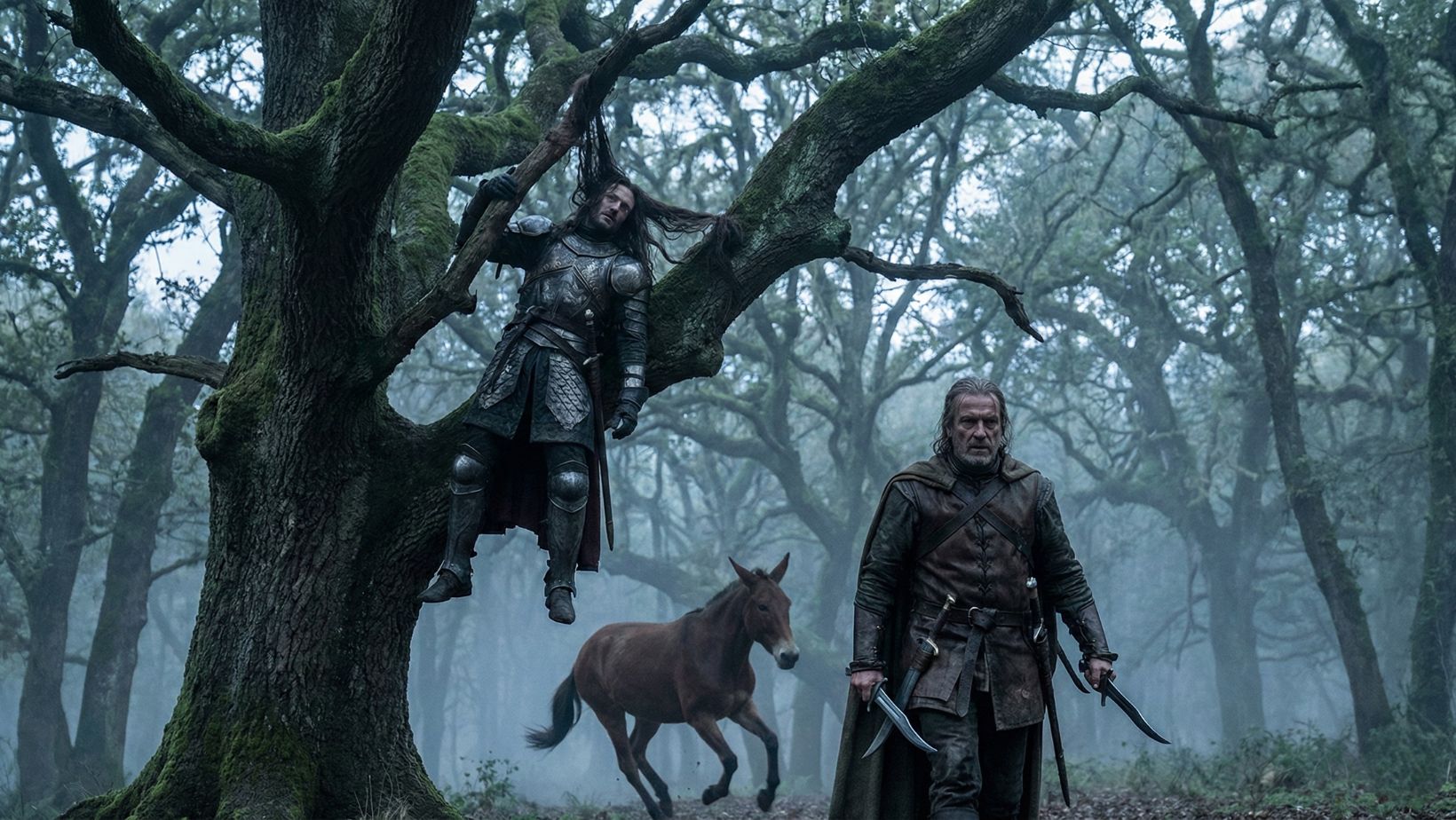
2 Samuel 18 is the tragic climax of Absalom’s rebellion. The civil war culminates in a decisive battle in the Forest of Ephraim, where David’s experienced generals crush the rebel army. However, the military victory is overshadowed by personal tragedy. Despite David’s explicit command to “deal gently” with Absalom, Joab ruthlessly executes the prince when he is found caught in a tree. The chapter ends not with a victory parade, but with the wailing of a brokenhearted father, “O Absalom, my son, my son!” It is a profound exploration of the cost of sin, the ruthlessness of justice, and the agony of parental love.
1. The Battle in the Forest of Ephraim (2 Samuel 18:1–8 NLT)
1 David now mustered the men who were with him and appointed generals and captains to lead them. 2 He sent the troops out in three groups: Joab led one third, Joab’s brother Abishai… led another third, and Ittai the Gittite led the last third. And the king told his men, “I am going out with you.” 3 “No!” the men exclaimed. “You must not go out with us. If we flee, they won’t care. And if half of us die, they won’t care. But you are worth ten thousand of us, and it is better that you stay here in the city and send help if we need it.” … 5 The king gave this command to Joab, Abishai, and Ittai: “For my sake, deal gently with young Absalom.” And all the troops heard the king give this order to his commanders. 6 So the battle began in the forest of Ephraim… 7 There the army of Israel was defeated by David’s men, and it was a great slaughter that day, with twenty thousand men killed. 8 The battle raged all across the countryside, and more men died because of the forest than were killed by the sword.
Commentary:
- David’s Strategy (v. 1-2): David organizes his forces into three divisions—a classic tactical formation. He entrusts leadership to his most loyal commanders: Joab (ruthless competence), Abishai (fierce loyalty), and Ittai (faithful foreigner).
- “Deal Gently” (v. 5): This command is the emotional core of the chapter.
- The Forest of Ephraim (v. 6-8): The terrain fought for David.
- Absalom’s army was larger but inexperienced in guerrilla warfare.
- David’s men were wilderness experts.
- “The forest devoured more than the sword” (v. 8): This suggests treacherous terrain (ravines, thickets, pits) where fleeing rebels fell to their deaths or got trapped. Nature itself seemed to fight against the unnatural rebellion of a son against his father.
Insight: David wins the war because he has better generals and the favor of God, but his heart is not in the victory. His only concern is the safety of the enemy leader.
2. The Death of Absalom (2 Samuel 18:9–18 NLT)
9 During the battle, Absalom happened to come upon some of David’s men. He tried to escape on his mule, but as he rode beneath the thick branches of a great oak, his hair got caught in the tree. His mule kept going and left him dangling in the air. 10 One of David’s men saw what had happened and told Joab, “I saw Absalom dangling from a great oak.” 11 “What?” Joab demanded. “You saw him there and didn’t kill him? …” 12 “I would not kill the king’s son for even a thousand pieces of silver,” the man replied to Joab. “We all heard the king say… ‘For my sake, please don’t harm young Absalom.’” 14 “Enough of this nonsense!” Joab said. Then he took three daggers and plunged them into Absalom’s heart as he dangled, still alive, in the great oak. 15 Ten of Joab’s young armor bearers then surrounded Absalom and killed him. … 17 They took Absalom’s body and threw it into a deep pit in the forest and piled a great heap of stones over it. 18 During his lifetime, Absalom had built a monument to himself in the King’s Valley, for he said, “I have no son to carry on my name.” …
Commentary:
- The Trap (v. 9): Absalom is caught by his head (likely his heavy hair, mentioned in Ch. 14:26) in a Terebinth/Oak tree.
- Irony: The very hair that was his pride became his snare. The mule (symbol of royalty) walks away, leaving him “suspended between heaven and earth”—rejected by both.
- The Soldier’s Integrity (v. 12): An ordinary soldier refuses to kill Absalom because he takes the King’s word seriously. He fears David more than he fears Joab.
- Joab’s Ruthlessness (v. 14): Joab has no such scruples. He ignores the King’s command to save the Kingdom.
- He uses three javelins/darts.
- He strikes the heart.
- His armor bearers finish the job, ensuring collective responsibility.
- The Burial (v. 17-18):
- The Pit: Instead of a royal tomb, Absalom is thrown into a pit like a criminal (Achan, Joshua 7:26).
- The Heap of Stones: A sign of detestation.
- The Monument: The narrator notes the irony. Absalom built a pillar to remember his name because he had “no son” (implying the sons mentioned in 14:27 died young). He wanted a monument of glory but received a pile of shame.
Insight: Absalom’s death is the literal fulfillment of the “sword” promised in Chapter 12. Violence begets violence. Joab acts as the brutal executioner of God’s judgment, even while disobeying his King.
3. The Runners: Ahimaaz and the Cushite (2 Samuel 18:19–32 NLT)
19 Then Ahimaaz son of Zadok said, “Let me run to the king with the good news that the Lord has saved him…” 20 “No,” Joab told him, “it wouldn’t be good news to the king that his son is dead. You can be my messenger another time, but not today.” 21 Then Joab said to a man from Cush, “Go tell the king what you have seen.” … 22 But Ahimaaz continued to plead with Joab, “Whatever happens, please let me run behind the Cushite.” … 23 “Run then!” Joab replied. So Ahimaaz started out… and he passed the Cushite. … 28 Ahimaaz called out to the king, “All is well!” He bowed before the king… “Praise to the Lord your God, who has handed over the rebels who dared to stand against my lord the king.” 29 “What about young Absalom?” the king demanded. “Is he all right?” Ahimaaz replied, “When Joab told me to come, there was a lot of commotion. I didn’t know what was happening.” … 31 Then the man from Cush arrived and said, “Good news for my lord the king! …” 32 “What about young Absalom?” the king demanded. “Is he all right?” And the Cushite replied, “May all of your enemies… be as that young man is!”
Commentary:
- Ahimaaz (v. 19): He is eager to bring “good news” (gospel) of victory. He sees the battle politically (rebels defeated).
- Joab’s Wisdom (v. 20): Joab knows David better. He knows this is not good news to a father. He tries to protect Ahimaaz from the King’s wrath by sending an expendable foreigner (the Cushite/Ethiopian).
- The Race (v. 23): Ahimaaz outruns the Cushite (taking the route via the plain of Jordan vs. the hills). It builds tension.
- The Evasion (v. 29): When David asks the only question that matters (“Is Absalom safe?”), Ahimaaz lies or evades (“I saw a commotion”). He lacks the courage to break the heart of the King.
- The Cushite’s Truth (v. 32): The Cushite delivers the news tactfully but clearly: “May all your enemies be as that young man is.” He frames the death as justice.
Insight: David sits between the two gates, waiting. He doesn’t care about the throne; he cares about the son. The scene highlights the solitude of leadership.
4. The King’s Lament (2 Samuel 18:33 NLT)
33 The king was overcome with emotion. He went up to the room over the gateway and burst into tears. And as he went, he cried, “O my son Absalom! My son, my son Absalom! If only I had died instead of you! O Absalom, my son, my son!”
Commentary:
- The Cry: The Hebrew is raw and rhythmic. Beni Avshalom, beni, beni Avshalom. The repetition of “my son” (5 times) reveals the depth of his agony.
- Substitutionary Desire: “If only I had died instead of you!”
- The Tragedy: David could defeat Goliath, the Philistines, and Saul, but he could not save his son from himself.
Insight: This lament is one of the most poignant moments in Scripture. It points us to a Greater Father who did give His life for His rebellious children. David cried, “Would that I had died for you,” but could not do it. Jesus Christ effectively says, “I have died for you,” and actually did it.
Theological Significance of 2 Samuel 18
- The Cost of Sin: The sword has now devoured three of David’s sons (the baby, Amnon, Absalom). God’s forgiveness is real, but the harvest of sin is also real.
- The Two Trees: Absalom dies on a tree, cursed by the law (Deuteronomy 21:23). He is a type of anti-Christ who dies in his rebellion. Jesus dies on a tree, taking the curse for us.
- Justice vs. Mercy: The chapter presents the tension between the demands of the state (Justice/Joab) and the heart of the father (Mercy/David). In the Gospel, these meet at the Cross.
Practical Applications
- “Deal Gently”: Even in conflict, we should seek to deal gently with the person, even while opposing their error. Mercy triumphs over judgment.
- The Danger of Pride: Absalom’s hair (pride) caught him. The things we boast in often become the things that destroy us.
- Loyalty to Truth: The soldier who refused the bribe (v. 12) showed higher integrity than the general. Sometimes we must disobey immediate pressure to obey higher principles.
- Parental Grief: For parents who have “prodigals,” David’s cry resonates. It is okay to grieve the loss of a child, even if that child was lost to their own bad choices.
Sermon Titles
- Caught in the Oak.
- Deal Gently for My Sake.
- The Forest Fought for Them.
- Would that I Had Died for You.
- The Long Run of Ahimaaz.







Leave a Reply