
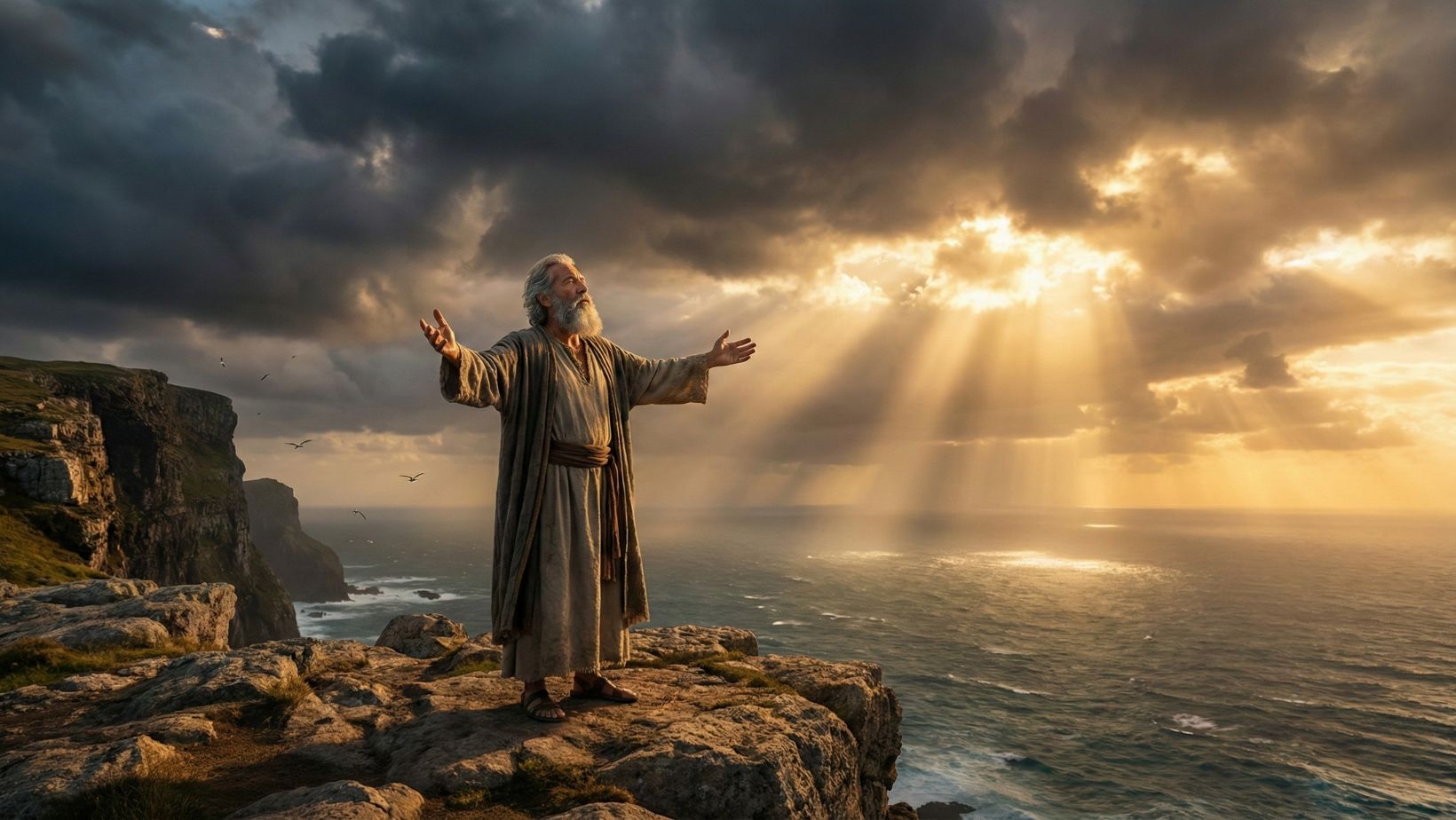
2 Samuel 22 is a magnificent song of praise, virtually identical to Psalm 18. It serves as a lyrical retrospective of David’s life, placed near the end of the book to summarize his career not through the lens of history, but through the lens of worship. David looks back on decades of running from Saul, fighting Philistines, and navigating civil war, and he concludes one thing: “The Lord is my rock.” The song moves from desperate distress to dramatic deliverance, portraying God as a cosmic warrior who rides the clouds to rescue His servant. It stands as a theological anchor, testifying that David’s victories were never about his own strength, but about God’s sovereign delight in him.
1. The Lord is My Rock (2 Samuel 22:1–7 NLT)
1 David sang this song to the Lord on the day the Lord rescued him from all his enemies and from Saul. 2 He sang: “The Lord is my rock, my fortress, and my savior; 3 my God is my rock, in whom I find protection. He is my shield, the power that saves me, and my place of safety. He is my refuge, my savior, the one who saves me from violence. 4 I called on the Lord, who is worthy of praise, and he saved me from my enemies. 5 “The waves of death overwhelmed me; floods of destruction swept over me. 6 The grave wrapped its ropes around me; death laid a trap in my path. 7 But in my distress I cried out to the Lord; yes, I prayed to my God for help. He heard me from his sanctuary; my cry reached his ears.
Commentary:
- The Context (v. 1): The superscription links this song to deliverance from “all his enemies and from Saul.” This suggests it was likely composed earlier in his life (perhaps after Saul’s death) but placed here by the editor to summarize his reign.
- Metaphors of Security (v. 2–3): David uses eight metaphors to describe God:
- Rock (Sela): Immovable, a place to stand.
- Fortress (Matsud): A mountain stronghold (Masada comes from this root).
- Savior (Palat): Deliverer.
- Shield: Defense against arrows.
- Horn (Power that saves): Strength/offense (like a bull’s horn).
- High Tower (Place of safety): Observation and distance from danger.
- Refuge: A hiding place.
- Savior from violence: Specific rescue from bloodthirsty men.
- The Distress (v. 5–6): David describes his peril as being drowned (“waves of death”) or hunted (“traps”). “Floods of destruction” (literally Belial) refers to ungodly chaos.
- The Cry (v. 7): The turning point is prayer. David is on earth, distress is all around, but his cry reaches the “sanctuary” (Temple/Heaven).
Insight: David does not say “God gives me a rock.” He says, “God is my rock.” His security is not a thing God provides, but God Himself.
2. The Cosmic Warrior Appears (2 Samuel 22:8–20 NLT)
8 “Then the earth shook and trembled; the foundations of the heavens quaked because he was angry. 9 Smoke poured from his nostrils; fierce flames leaped from his mouth. Glowing coals blazed forth from him. 10 He opened the heavens and came down; dark storm clouds were beneath his feet. 11 Mounted on a mighty angelic being, he flew, soaring on the wings of the wind. 12 He shrouded himself in darkness, veiling his approach with dense rain clouds. 13 A brilliant light flashed from his presence… 14 The Lord thundered from heaven; the voice of the Most High resounded. 15 He shot arrows and scattered his enemies; his lightning flashed, and they were confused. 16 Then at the command of the Lord, at the blast of his breath, the bottom of the sea could be seen, and the foundations of the earth were laid bare. 17 “He reached down from heaven and rescued me; he drew me out of deep waters. 18 He rescued me from my powerful enemies, from those who hated me and were too strong for me. … 20 He led me to a place of safety; he rescued me because he delights in me.
Commentary:
- Theophany (v. 8–16): God’s response to David’s prayer is depicted as a cosmic cataclysm.
- Imagery: Earthquakes, smoke, fire, and darkness. This language echoes Mount Sinai (Exodus 19).
- The Cherub (v. 11): God is pictured riding a “mighty angelic being” (Cherub), moving with the speed of the wind.
- Weaponry: Thunder, lightning (arrows), and breath.
- The Personal Rescue (v. 17): After the earth-shattering entrance, the action becomes tenderly personal. “He reached down… he drew me out.”
- The Motive (v. 20): Why did God do this? Not because David was useful, or strong, or perfect. “Because he delights in me.” This is the core of David’s theology—grace.
Insight: The Creator of the Universe rips the sky open to save one man. It shows the immense value God places on His covenant partner.
3. David’s Integrity and God’s Justice (2 Samuel 22:21–30 NLT)
21 “The Lord rewarded me for doing right; he restored me because of my innocence. 22 For I have kept the ways of the Lord; I have not turned from my God to follow evil. 23 I have followed all his regulations; I have never abandoned his decrees. 24 I am blameless before God; I have kept myself from sin. 25 The Lord rewarded me for doing right. He has seen my innocence. 26 “To the faithful you show yourself faithful; to those with integrity you show integrity. 27 To the pure you show yourself pure, but to the crooked you show yourself shrewd. 28 You rescue the humble, but your eyes watch the proud and humiliate them. 29 O Lord, you are my lamp. The Lord lights up my darkness. 30 In your strength I can crush an army; with my God I can scale any wall.
Commentary:
- The Problem of Innocence (v. 21–25): David claims, “I am blameless” and “rewarded for doing right.”
- Tension: How can the adulterer and murderer (Bathsheba/Uriah) say this?
- Resolution: David is likely speaking of his conduct toward his enemies (Saul/Absalom). He never raised his hand against the Lord’s Anointed. Or, he is speaking of his overall covenant faithfulness—he never worshiped idols. He was a sinner, but not an apostate.
- Reciprocal Justice (v. 26–27): God mirrors human character.
- To the faithful -> Faithful.
- To the crooked (perverse) -> Shrewd (He outwits them). God entraps the wicked in their own schemes (like Ahithophel).
- The Lamp (v. 29): In Chapter 21, the men called David the “Lamp of Israel.” Here, David corrects them: “O Lord, YOU are my lamp.”
Insight: David claims righteousness not as sinlessness, but as wholeheartedness. He kept the covenant path, and when he fell off, he repented and got back on.
4. The God Who Equips (2 Samuel 22:31–51 NLT)
31 “God’s way is perfect. All the Lord’s promises prove true. He is a shield for all who look to him for protection. 32 For who is God except the Lord? Who but our God is a solid rock? 33 God is my strong fortress, and he makes my way perfect. 34 He makes me as surefooted as a deer, enabling me to stand on mountain heights. 35 He trains my hands for battle; he strengthens my arm to draw a bronze bow. 36 You have given me your shield of victory; your help has made me great. … 40 You have armed me with strength for the battle; you have subdued my enemies under my feet. … 44 “You gave me victory over my accusers. You preserved me as the ruler of nations; people I don’t even know now serve me. … 47 “The Lord lives! Praise to my Rock! May God, the Rock of my salvation, be exalted! 48 He is the God who pays back those who harm me; he brings down the nations under me… 50 For this, O Lord, I will praise you among the nations; I will sing praises to your name. 51 You give great victories to your king; you show unfailing love to your anointed, to David and all his descendants forever.”
Commentary:
- The Source of Skill (v. 33–35): David was a talented warrior, but he attributes his physical skills to God.
- Agility: “Surefooted as a deer.”
- Strength: “Draw a bronze bow” (a superhuman feat).
- Skill: “Trains my hands for battle.”
- “Your Help Has Made Me Great” (v. 36): The Hebrew word for “help” here (anavah) usually means “gentleness” or “humility.” It implies God stooped down to make David great.
- Victory over Nations (v. 44–46): David moves from personal survival to imperial conquest. He mentions ruling nations he “doesn’t even know,” referring to the vast expansion of his empire (Ch. 8).
- Messianic Conclusion (v. 51): The song ends with a look to the future.
- “To David and all his descendants forever.” The word “descendants” (seed) links this to the Davidic Covenant (2 Sam 7) and ultimately to Jesus Christ (Romans 15:9 quotes verse 50).
Insight: The song begins with “The Lord is my Rock” (v. 2) and ends with “Praise to my Rock” (v. 47). It is a complete cycle of praise, framing David’s entire existence within the stability of God.
Theological Significance of 2 Samuel 22
- The Warrior God: This chapter corrects the view of God as a passive observer. He is actively involved in history, fighting for His people with the ferocity of a storm.
- Grace-Based Delight: Verse 20 (“He rescued me because he delights in me”) is the antidote to legalism. We are saved not because we are valuable to God’s workforce, but because we are precious to God’s heart.
- Messianic Hope: David understands that his victories are not just for him. They are for the “Anointed” (Messiah) and his “seed” forever. The stability of David’s kingdom points to the eternal stability of Christ’s kingdom.
Practical Applications
- Look Back to Worship: We often look back to regret or to reminisce. David looks back to worship. Take time to review your life history and identify the “rocks” and “fortresses” where God held you.
- “He Delights in Me”: When you feel unworthy or defeated by sin, meditate on verse 20. If you are in Christ, God delights in you—not your performance, but you.
- God Trains Your Hands: Whatever your skill (business, art, parenting), realize that God is the one who “trains your hands.” Attribute your success to His equipping grace.
- The Light in Darkness: When life feels dark (v. 29), don’t try to light your own fire. Declare, “You, O Lord, are my lamp.”







Leave a Reply