
2 Samuel 23 serves as an appendix to David’s history, containing two distinct sections: David’s “Last Words” (a poetic oracle) and the “Hall of Fame” of his Mighty Men. The “Last Words” are not his literal final sentences (which are in 1 Kings 2), but his final prophetic testament concerning the nature of righteous kingship and God’s everlasting covenant. The second half of the chapter catalogs the heroic exploits of the warriors who helped establish David’s kingdom. From killing giants to defending lentil fields, these narratives highlight that David’s success was built on the loyalty and valor of those around him. The chapter ends on a haunting note: the final name in the list of heroes is Uriah the Hittite, a permanent reminder of David’s greatest failure amidst his greatest triumphs.
1. The Last Words of David (2 Samuel 23:1–7 NLT)
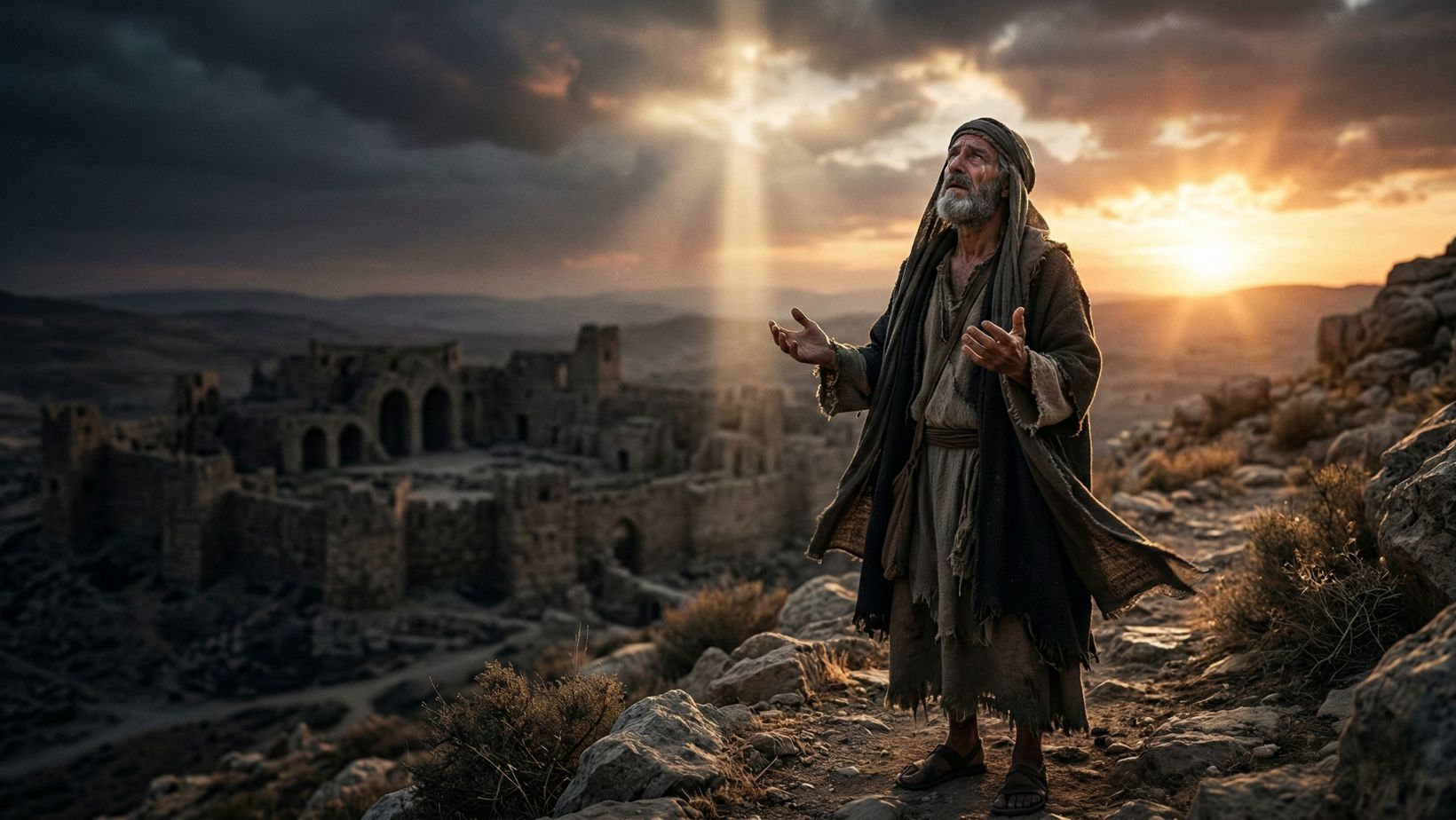
1 These are the last words of David: “David, the son of Jesse, speaks—the man who was raised up so high, the man anointed by the God of Jacob, the sweet psalmist of Israel: 2 “The Spirit of the Lord speaks through me; his words are upon my tongue. 3 The God of Israel spoke. The Rock of Israel said to me: ‘The one who rules righteously, who rules in the fear of God, 4 is like the light of morning at sunrise, like a morning without clouds, like the gleaming of the sun on new grass after rain.’ 5 “Is it not my family God has chosen? Yes, he has made an everlasting covenant with me. His agreement is arranged and guaranteed in every detail. He will ensure my safety and success. 6 “But the godless are like thorns to be thrown away, for they tear the hand that touches them. 7 One must use iron tools to chop them down; they will be totally consumed by fire.”
Commentary:
- Prophetic Oracle (v. 1–2): David speaks as a prophet. He claims direct inspiration (“The Spirit of the Lord speaks through me”). He identifies himself by his humble origin (“son of Jesse”) and his divine elevation (“raised up high”).
- The Ideal King (v. 3–4): The “Rock of Israel” gives a simile for the Messiah.
- The Everlasting Covenant (v. 5):
- David asks, “Is it not my family?” He knows his house is not perfect (Amnon, Absalom, Adonijah), yet he rests in the fact that the covenant is “guaranteed in every detail.”
- It depends on God’s arrangement, not David’s performance.
- The Fate of the Wicked (v. 6–7): The “godless” (Belial) are like thorns. You cannot handle them with bare hands; you need “iron tools” (judgment/weapons). This suggests that a righteous king must also be a judge who destroys evil.
Insight: David admits his family hasn’t fully lived up to the ideal of verses 3-4, yet he dies confident in the “everlasting covenant” (v. 5) that will one day produce the perfect King who will.
2. The Three Mighty Men (2 Samuel 23:8–12 NLT)
8 These are the names of David’s mightiest warriors. The first was Jashobeam the Hacmonite, who was leader of the Three—the three mightiest warriors among David’s men. He once used his spear to kill 800 enemy warriors in a single battle. 9 Next in rank among the Three was Eleazar son of Dodai, a descendant of Ahoah. Once Eleazar and David stood together against the Philistines when the entire Israelite army had fled. 10 He killed Philistines until his hand was too tired to lift his sword, and it was actually stuck to the sword. The Lord gave him a great victory that day. The rest of the army did not return until it was time to collect the plunder! 11 Next in rank was Shammah son of Agee from Harar. One time the Philistines gathered at Lehi and attacked a field full of lentils. The Israelite army fled, 12 but Shammah held his ground in the middle of the field and beat back the Philistines. So the Lord brought about a great victory.
Commentary:
- The Structure: David’s army had a hierarchy: The Three (Top Tier), The Thirty (Elite Guard), and the general army.
- Jashobeam (Josheb-basshebeth): The master of mass combat. Killing 800 men implies supernatural endurance and skill.
- Eleazar: The master of persistence.
- Situation: The army fled. He stood alone with David.
- Result: His hand “stuck to the sword.” A physiological reaction (cramp/rigor) caused by gripping a weapon for hours without letting go.
- Shammah: The master of defensive ground.
- The Setting: A “field full of lentils” (peasant food).
- The Principle: The army ran, thinking a patch of lentils wasn’t worth dying for. Shammah stood his ground because it was God’s land (part of the inheritance). He proved that faithfulness in small things brings “great victory.”
Insight: These men are defined by their refusal to retreat when the majority fled. True courage is often a solitary act.
3. The Water from Bethlehem (2 Samuel 23:13–17 NLT)
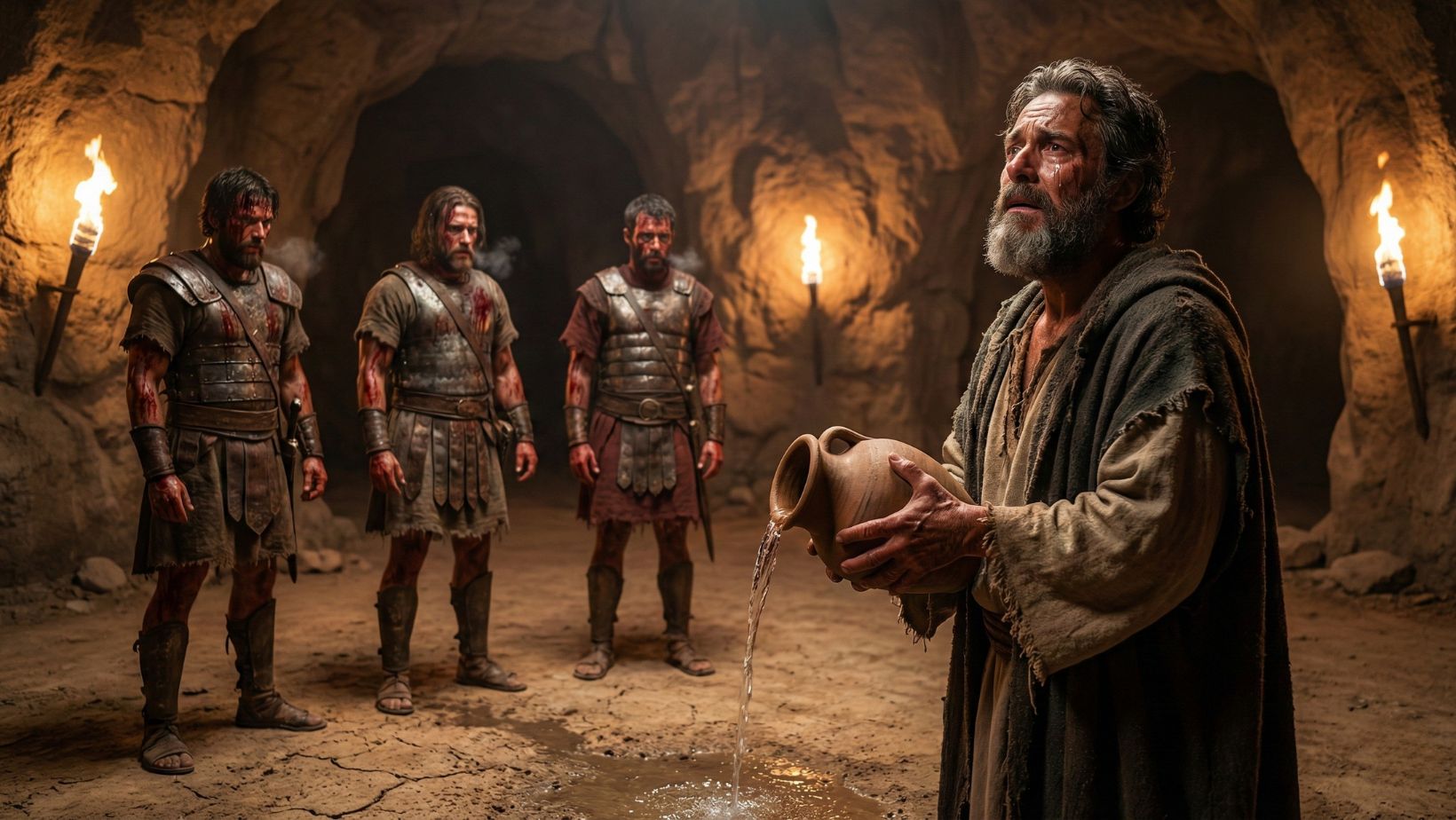
13 Once during the harvest, when David was at the cave of Adullam, the Philistine army was camped in the valley of Rephaim. The Three (who were among the Thirty—an elite group among David’s fighting men) went down to meet him there. 14 David was staying in the stronghold at the time, and a Philistine detachment had occupied the town of Bethlehem. 15 David remarked longingly to his men, “Oh, how I would love some of that good water from the well by the gate in Bethlehem.” 16 So the Three broke through the Philistine lines, drew some water from the well by the gate in Bethlehem, and brought it back to David. But he refused to drink it. Instead, he poured it out as an offering to the Lord. 17 “The Lord forbid that I should drink this!” he exclaimed. “This water is as precious as the blood of these men who risked their lives to bring it to me.” So David did not drink it. These are examples of the exploits of the Three.
Commentary:
- The Context (v. 13): This flashback likely occurs early in David’s career (Adullam days). The Philistines occupy his hometown, Bethlehem.
- The Wish (v. 15): David expresses a nostalgic craving. He isn’t ordering a mission; he is just sighing for the taste of home.
- The Devotion (v. 16): The Three hear the sigh as a command. They risk death, breaking through enemy lines just to get a cup of water. This shows their intense love for their leader.
- The Libation (v. 16–17): David refuses to drink.
- Why? If he drinks it, he treats their lives as a commodity for his pleasure.
- Action: He “poured it out to the Lord.” By turning it into a drink offering, he elevates their act from a service to a man into a sacrifice to God. He declares the water too holy for human consumption.
Insight: This is one of the most poignant moments in David’s life. It shows a leader who values the lives of his men more than his own gratification.
4. Abishai and Benaiah (2 Samuel 23:18–23 NLT)
18 Abishai son of Zeruiah, the brother of Joab, was the leader of the Thirty. He once used his spear to kill 300 enemy warriors in a single battle. It was by such feats that he became as famous as the Three. 19 Abishai was the most famous of the Thirty and was their commander, though he was not one of the Three. 20 There was also Benaiah son of Jehoiada, a valiant warrior from Kabzeel. He did many heroic deeds, which included killing two champions of Moab. Another time, on a snowy day, he chased a lion down into a pit and killed it. 21 Once, armed only with a club, he killed a great Egyptian warrior who was armed with a spear. Benaiah wrenched the spear from the Egyptian’s hand and killed him with it. 22 Deeds like these made Benaiah as famous as the three mightiest warriors. 23 He was more honored than the other members of the Thirty, though he was not one of the Three. And David made him captain of his bodyguard.
Commentary:
- Abishai (v. 18): Joab’s brother. He was the commander of the Thirty but didn’t quite reach the level of the first Three (Jashobeam, Eleazar, Shammah).
- Benaiah (v. 20): A rising star who will become Solomon’s commander-in-chief.
- The Lion: Killing a lion in a pit on a snowy day is a vivid detail. The snow (rare in Israel) implies poor footing and visibility. The pit implies close quarters with no escape. It demonstrates Benaiah’s initiative—he went down to the threat.
- The Egyptian: He disarmed a giant with a stick (club) and killed him with his own weapon.
Insight: Benaiah’s greatness lay in his offensive mindset. Whether it was a lion or a giant, he ran toward the danger, not away from it.
5. The Thirty (2 Samuel 23:24–39 NLT)
24 Other members of the Thirty included: Asahel, Joab’s brother; Elhanan son of Dodo from Bethlehem; 25 Shammah from Harod; Elika from Harod; 26 Helez from Pelon; Ira son of Ikkesh from Tekoa; 27 Abiezer from Anathoth; Sibbechai from Hushah; 28 Zalmon from Ahoah; Maharai from Netophah; 29 Heled son of Baanah from Netophah; Ithai son of Ribai from Gibeah (in the land of Benjamin); 30 Benaiah from Pirathon; Hiddai from the ravines of Gaash; 31 Abi-albon from Arbah; Azmaveth from Bahurim; 32 Eliahba from Shaalbon; the sons of Jashen; Jonathan; 33 Shammah from Harar; Ahiam son of Sharar from Harar; 34 Eliphelet son of Ahasbai from Maacah; Eliam son of Ahithophel the Gilonite; 35 Hezro from Carmel; Paarai from Arab; 36 Igal son of Nathan from Zobah; the son of Hagri; 37 Zelek from Ammon; Naharai from Beeroth, the armor bearer of Joab son of Zeruiah; 38 Ira the Ithrite; Gareb the Ithrite; 39 and Uriah the Hittite. There were thirty-seven in all.
Commentary:
- The Roll Call: This list immortalizes the men who built the kingdom. It includes Israelites and foreigners (Zelek the Ammonite, Uriah the Hittite), showing David’s ability to inspire loyalty across ethnic lines.
- Notable Names:
- Asahel (v. 24): Joab’s brother who was killed by Abner (2 Sam 2). He is honored here posthumously.
- Eliam (v. 34): The son of Ahithophel and the father of Bathsheba. This name links the heroes to the tragedy of the rebellion.
- The Final Name (v. 39): “Uriah the Hittite.”
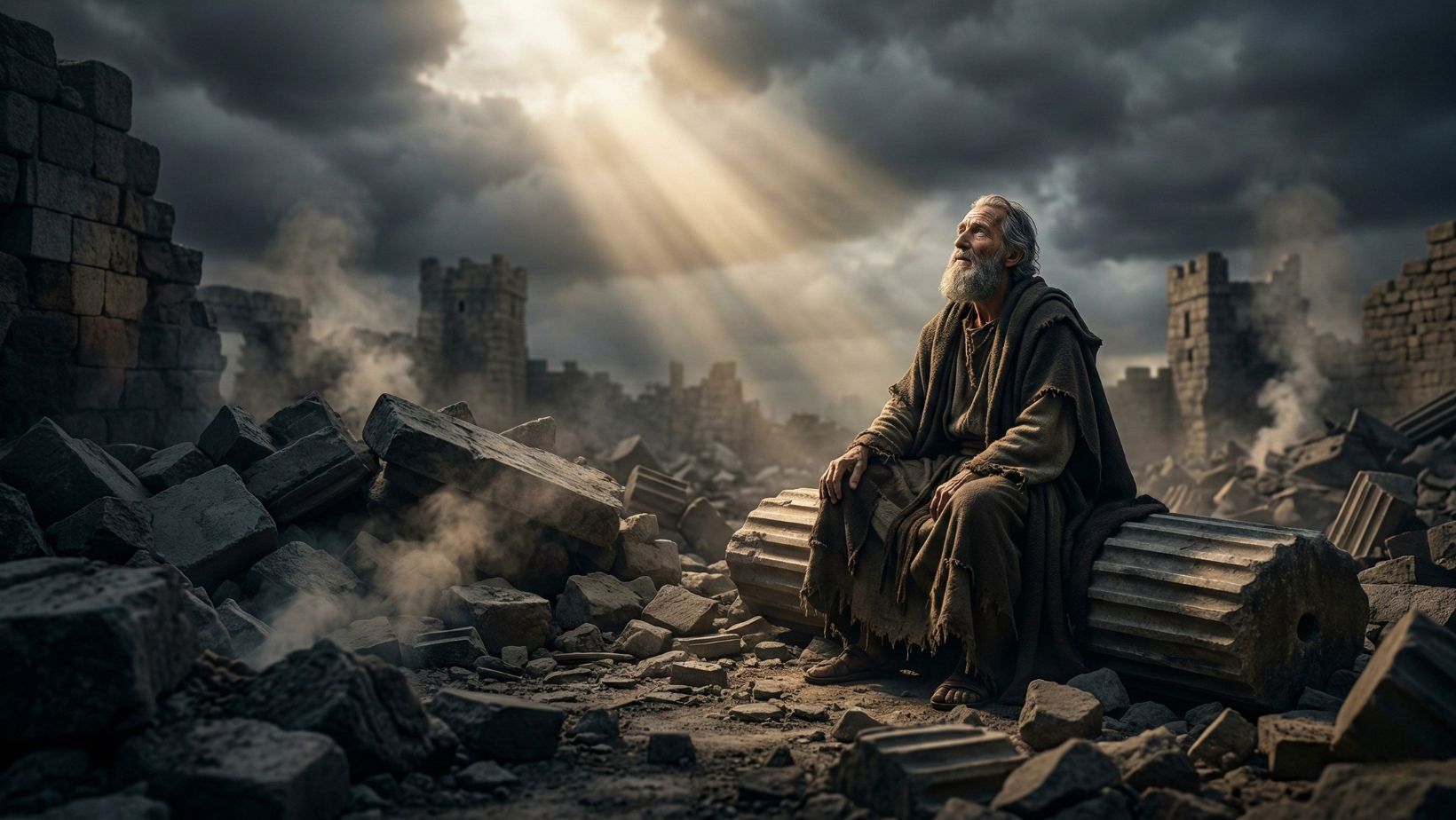
Insight: God remembers what we forget. While David received forgiveness, the history books (and God’s memory) retain the name of the faithful soldier he betrayed. It is a sobering end to the list of glory.
Theological Significance of 2 Samuel 23
- The Ideal King: David’s oracle (v. 3-4) sets the standard for the Messianic King—one who rules in the “fear of God” and brings life like the sun/rain. Jesus fulfills this where David failed.
- The Everlasting Covenant: Despite the failures of David’s house (evident in the list ending with Uriah), the covenant (v. 5) stands firm. Salvation rests on God’s promise, not human perfection.
- Corporate Victory: David is the famous King, but the text goes to great lengths to show he did not build the kingdom alone. God uses a community of “mighty men” (and women) to establish His purposes.
- Sacrifice: David pouring out the water teaches that life is sacred and belongs to God alone. It points to Christ, who poured out His life as a drink offering for the world.
Practical Applications
- Defend Your Lentil Field: Like Shammah, we are often called to defend things that look insignificant to others (a marriage, a child’s heart, a small ministry). If God gave it to you, stand your ground.
- Hand Cleaved to the Sword: Eleazar didn’t stop until his hand froze to the weapon. In spiritual warfare or difficult seasons of work, we need a “grip” that refuses to let go until the victory is won.
- Chase the Lion: Like Benaiah, we cannot wait for perfect conditions (“snowy day”) to do hard things. We must face our fears (lions) proactively.
- Remember Uriah: The inclusion of Uriah warns us that our sins against others are recorded. We should treat every “soldier” in God’s army with the dignity they deserve, for they are mighty in His sight.
Sermon Titles
- Sunrise and Thorns: The Two Kingdoms.
- A Lion in a Pit on a Snowy Day.
- The Patch of Lentils.
- Water Too Expensive to Drink.
- The Last Name on the List.





Leave a Reply