
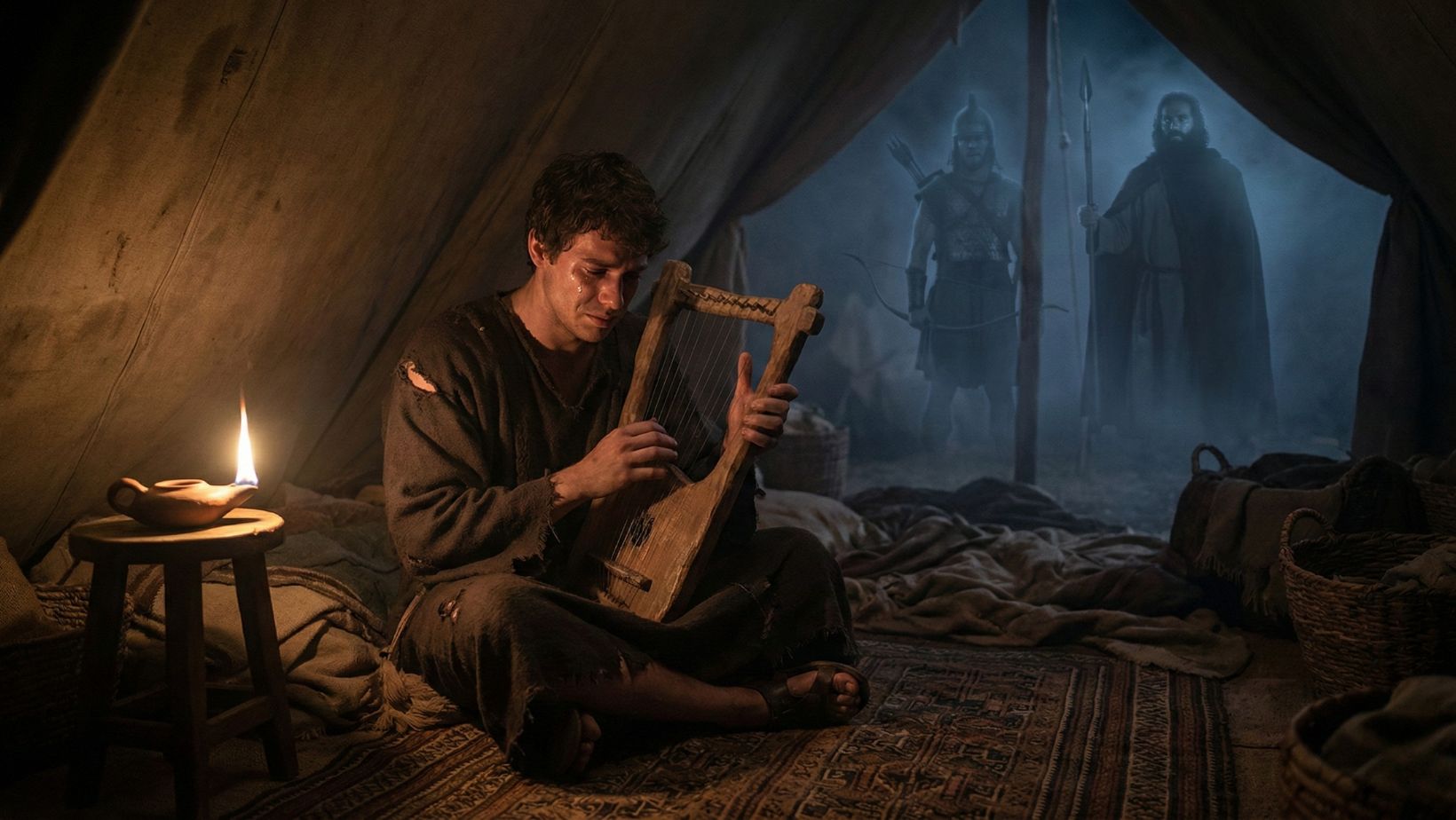
The Song of the Bow (Hebrew: Keshet) is one of the most poignant and artistically sophisticated elegies in the Hebrew Bible. Recorded in 2 Samuel 1:17–27, it is a lament composed by David upon hearing of the deaths of King Saul and his son Jonathan at the Battle of Mount Gilboa. Unlike many biblical psalms that focus on God’s relationship with man, this song is a raw, human expression of national grief, military loss, and personal heartbreak. It serves as a historical masterpiece, documenting the transition from the chaotic period of the judges to the establishment of the Davidic monarchy, marked not by celebration, but by weeping.
Quick Facts
- Title: The Song of the Bow (or simply “The Bow”)
- Author: David
- Scripture: 2 Samuel 1:17–27
- Genre: Qinah (Dirge / Lamentation)
- Occasion: The death of Saul and Jonathan
- Source Text: Originally recorded in the “Book of Jashar”
- Key Refrain: “How the mighty have fallen!”
- Primary Themes: Grief, honor, national tragedy, covenant friendship
Title & Origin
The Name: The song is titled “The Bow” (Keshet). Scholars propose two main reasons for this title:
- Reference to Jonathan: It honors Jonathan, who was famous for his skill with the bow (v. 22), unlike Saul who was associated with the spear or sword.
- Instructional Use: David commanded that the “people of Judah be taught the use of the bow” (v. 18). Some translations interpret this as teaching them this song titled “The Bow,” serving as a martial anthem to inspire the troops after a crushing defeat.
The Book of Jashar: The text notes that this song was written in the “Book of Jashar” (Book of the Upright). This was a lost ancient sourcebook of Israelite heroic poetry, which also contained Joshua’s command for the sun to stand still.
Biblical Context
The Battle of Gilboa: The Philistines engaged Israel in a massive battle on Mount Gilboa. The Israelite army fled, Saul’s sons were killed, and Saul, critically wounded by archers, fell upon his own sword to avoid capture and torture.
The Amalekite Messenger: A young man came to David in Ziklag, claiming to have delivered the final blow to Saul, hoping for a reward. Instead of rewarding him, David executed him for daring to touch the “Lord’s Anointed,” then immediately launched into this lament.
Structure of the Lament
The poem is structured in three distinct movements, bound together by the recurring refrain.
1. The Call to Mourn (vv. 19–20): David begins by stating the tragedy and demanding silence in enemy cities to protect Israel’s honor.
2. The Curse on Nature (v. 21): David projects his grief onto the physical landscape, cursing the mountain where the king fell.
3. The Eulogy of the Warriors (vv. 22–24): He praises the military prowess of Saul and Jonathan and calls on the women of Israel to weep for the prosperity Saul provided.
4. The Personal Cry for Jonathan (vv. 25–26): The song narrows from national tragedy to intense personal loss regarding his best friend.
Detailed Exegesis & Analysis
The Refrain:
“How the mighty have fallen!” (vv. 19, 25, 27)
This phrase anchors the poem. It is a cry of disbelief and devastation. The “mighty” (gibborim) refers to the elite warriors. The repetition emphasizes the total collapse of Israel’s defense.
Prohibition of Enemy Joy:
“Tell it not in Gath, publish it not in the streets of Ashkelon…” (v. 20)
Gath and Ashkelon were major Philistine cities. In a shame/honor culture, the military defeat was compounded by the shame of the enemy’s mockery. David wishes to suppress the news to prevent the “daughters of the Philistines” from rejoicing over God’s people.
The Curse on Gilboa:
“Ye mountains of Gilboa, let there be no dew, neither let there be rain, upon you…” (v. 21)
David employs a “pathetic fallacy,” attributing human emotion to nature. He curses the land to be barren because the “shield of the mighty” was vilely cast away there. The shield of Saul was “not anointed with oil”—meaning it was left to rust and dry out, treating the king as a common soldier rather than God’s chosen.
“Saul and Jonathan were lovely and pleasant in their lives, and in their death they were not divided.” (v. 23)
Despite Saul’s persecution of David, this song contains absolutely no malice. David chooses to remember Saul only for his victories and his bond with Jonathan. He describes them as swifter than eagles and stronger than lions, emphasizing their warrior virtues.
The Tribute to Jonathan:
“I am distressed for thee, my brother Jonathan: very pleasant hast thou been unto me: thy love to me was wonderful, passing the love of women.” (v. 26)
This is the emotional climax. David calls Jonathan “brother,” signifying a covenant bond. The comparison to the “love of women” is not erotic; in the ancient context, it highlights that their political and spiritual loyalty transcended the natural, biological bond of marriage. It was a love of choice and spirit, unmarred by the jealousy that often plagues royal courts.
Theological & Historical Significance
Respect for the Anointed: The song cements David’s theology regarding leadership. Even though Saul was rejected by God, he was still the Anointed One (Mashiach). David’s refusal to celebrate Saul’s death set a precedent for how Israel should treat its leaders.
Validating Grief: The Bible includes this song to show that grief is a proper, holy response to loss. Even a man of great faith like David was not immune to deep sorrow.
The Rise of Judah: By teaching this song to the “children of Judah,” David was unifying his own tribe in a shared cultural memory of the previous regime, preparing them to lead the nation.
Symbolism
The Shield: Represents divine protection. Its “casting away” symbolizes the withdrawal of God’s covering over Saul. The Eagle and Lion: Traditional Near Eastern symbols of supreme power and speed, applied here to the fallen heroes. Dew and Rain: Symbols of divine blessing and life. Withholding them signifies that the land is now accursed by the blood spilled upon it.







Leave a Reply