
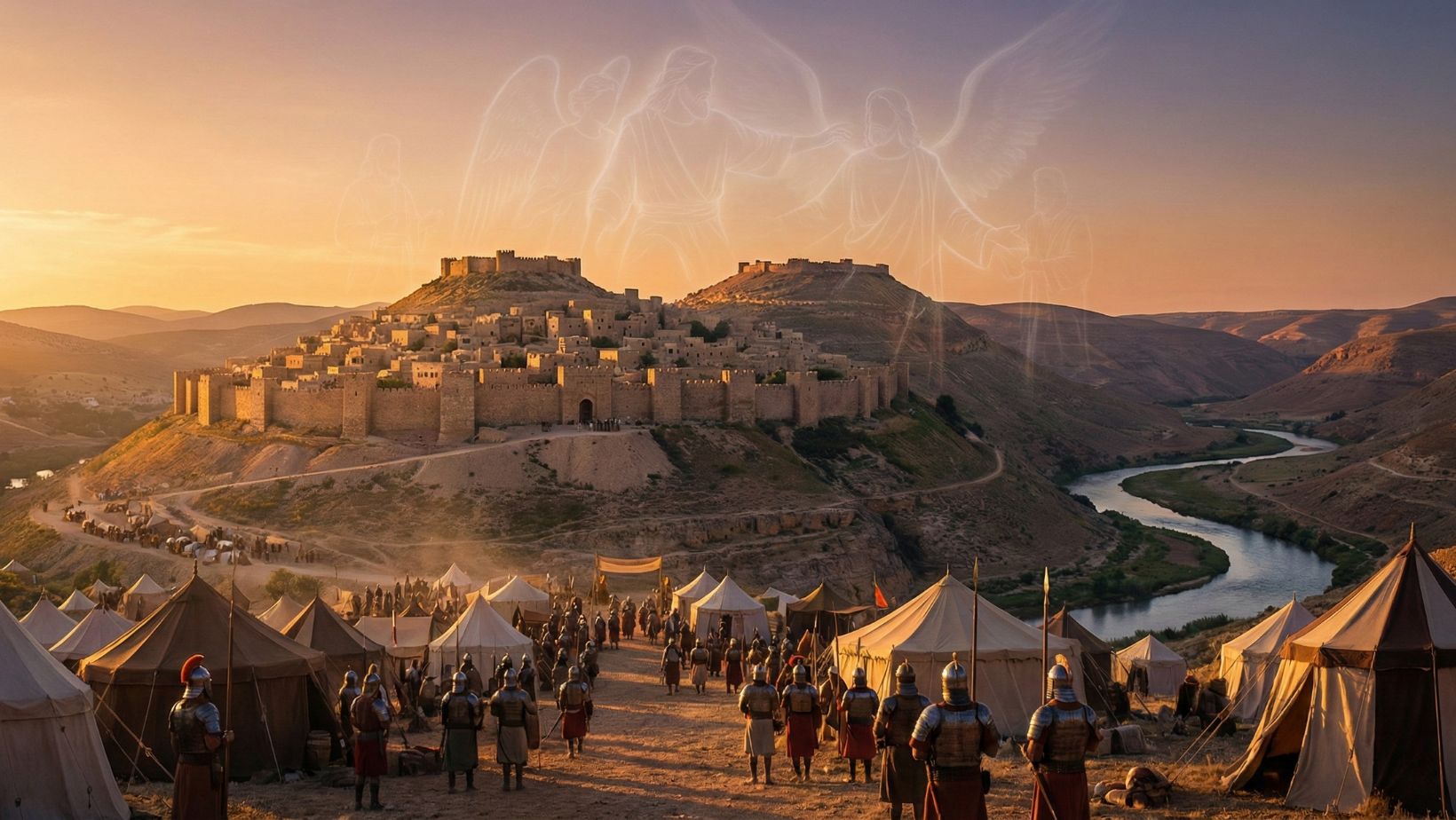
Mahanaim is a city of profound historical duality—a place of refuge for exiles and a fortress for kings in distress. Situated east of the Jordan River in the territory of Gilead, it served as the capital for Ishbosheth during the civil war and later as the sanctuary for King David during Absalom’s rebellion. Its name, meaning “Two Camps,” originates from a mystical encounter by the patriarch Jacob, setting the tone for a location where the spiritual and physical realms often intersected. Throughout biblical history, Mahanaim represents God’s provision in the wilderness when all other doors have closed.
Quick Facts
- Name: Mahanaim (Hebrew: Machanayim)
- Meaning: “Two Camps” or “Double Camp”
- Region: Gilead (East of the Jordan River)
- Tribe: Gad (assigned to the Levites of the clan of Merari)
- Key Figures: Jacob, Abner, Ishbosheth, King David, Barzillai
- Major Events: Jacob meets angels; Ishbosheth is crowned; David flees here from Absalom
- Status: Levitical City and City of Refuge
Name Meaning
“Two Camps”: The name is a dual form in Hebrew (-ayim suffix). It was named by Jacob in Genesis 32:2 when he saw the angels of God meeting him. He exclaimed, “This is God’s camp!” and named the place Mahanaim, likely signifying the “two camps” present: his own earthly camp of family and flocks, and the invisible heavenly camp of God’s angels protecting him.
Geography / Location
Site: While the exact archaeological site is debated, it is widely identified with Tell edh-Dhahab (The Mound of Gold) on the northern bank of the Jabbok River. Strategic Importance: Located near the border of Gad and Manasseh, it controlled the main trade route from the Jordan Valley up to the King’s Highway. Its strong fortifications and ample water supply from the Jabbok made it an ideal capital for governments in exile.
Biblical Era / Context
Patriarchal Age: The site of Jacob’s wrestling with God and reconciliation with Esau. United Monarchy: The pivotal stronghold during the civil wars of both Saul’s succession and David’s reign.
Major Roles / Identity
The Angelic Gateway: The place where the supernatural realm became visible to Jacob, reassuring him before his terrifying reunion with Esau. The Levitical City: Assigned to the Merarite Levites (Joshua 21:38), it was a center of religious instruction and administration in the Transjordan. The Capital of Resistance:
- For Ishbosheth: It was the capital of the “Kingdom of Israel” while David ruled Judah from Hebron.
- For David: It was his headquarters and safe haven when his son Absalom usurped the throne in Jerusalem.
Key Character Traits (The City)
Protective: It consistently sheltered God’s anointed ones (Jacob, Ishbosheth, David) during their most vulnerable moments. Loyal: The region of Gilead, and Mahanaim specifically, remained fiercely loyal to the house of Saul and later transferred that deep loyalty to David. Generous: When David arrived hungry and weary, the wealthy men of Mahanaim (Shobi, Machir, and Barzillai) provided beds, basins, wheat, barley, honey, and cheese for the entire army.
Main Life Events
Jacob’s Vision (Genesis 32): Returning from Padan-aram, Jacob was met by “angels of God.” This divine encounter gave him the courage to face his brother Esau.
Abner Crowns Ishbosheth (2 Samuel 2): After the Philistines overran western Israel, Abner brought Saul’s son across the Jordan to Mahanaim, making it the acting capital of free Israel.
David’s Flight (2 Samuel 17): Driven out of Jerusalem by Absalom, David crossed the Jordan and came to Mahanaim. Here, he organized his forces under Joab, Abishai, and Ittai for the decisive battle in the Wood of Ephraim.
The Death of Absalom: The news of Absalom’s death was brought to David at the gate of Mahanaim. The chamber over the gate became the site of David’s famous grief: “O my son Absalom, my son, my son Absalom!” (2 Samuel 18:33).
Solomon’s Administration (1 Kings 4): Under Solomon, it became the headquarters for one of the twelve administrative districts of Israel, governed by Ahinadab.
Major Relationships
Jacob: The founder of the city’s spiritual identity. Barzillai the Gileadite: An elderly, wealthy man of Mahanaim who sustained David. His loyalty was so great that David later charged Solomon to care for Barzillai’s sons. The Two Kings: Both Ishbosheth and David found that when Jerusalem (or the west) was lost, Mahanaim was the fortress that held the kingdom together.
Notable Passages
Genesis 32:1–2: “And Jacob went on his way, and the angels of God met him. And when Jacob saw them, he said, This is God’s host: and he called the name of that place Mahanaim.”
2 Samuel 17:27–29: “And it came to pass, when David was come to Mahanaim… [they] brought beds, and basins, and earthen vessels, and wheat… for David, and for the people that were with him, to eat.”
2 Samuel 18:24: “And David sat between the two gates: and the watchman went up to the roof over the gate unto the wall…”
Legacy & Impact
The Theology of “Two Camps”: Mahanaim teaches that for every earthly struggle (one camp), there is a corresponding spiritual reality (the other camp) fighting on behalf of the believer. Sanctuary: It established the Transjordan not just as “cattle country,” but as a vital strategic reserve for the survival of the nation of Israel.
Symbolism / Typology
The Gate: The “two gates” of Mahanaim symbolize the threshold between safety and danger, life and death. It was here David waited to hear if he had won the war but lost his son. Provision in the Wilderness: The feast provided by Barzillai typifies God’s table prepared in the presence of enemies (Psalm 23).







Leave a Reply