
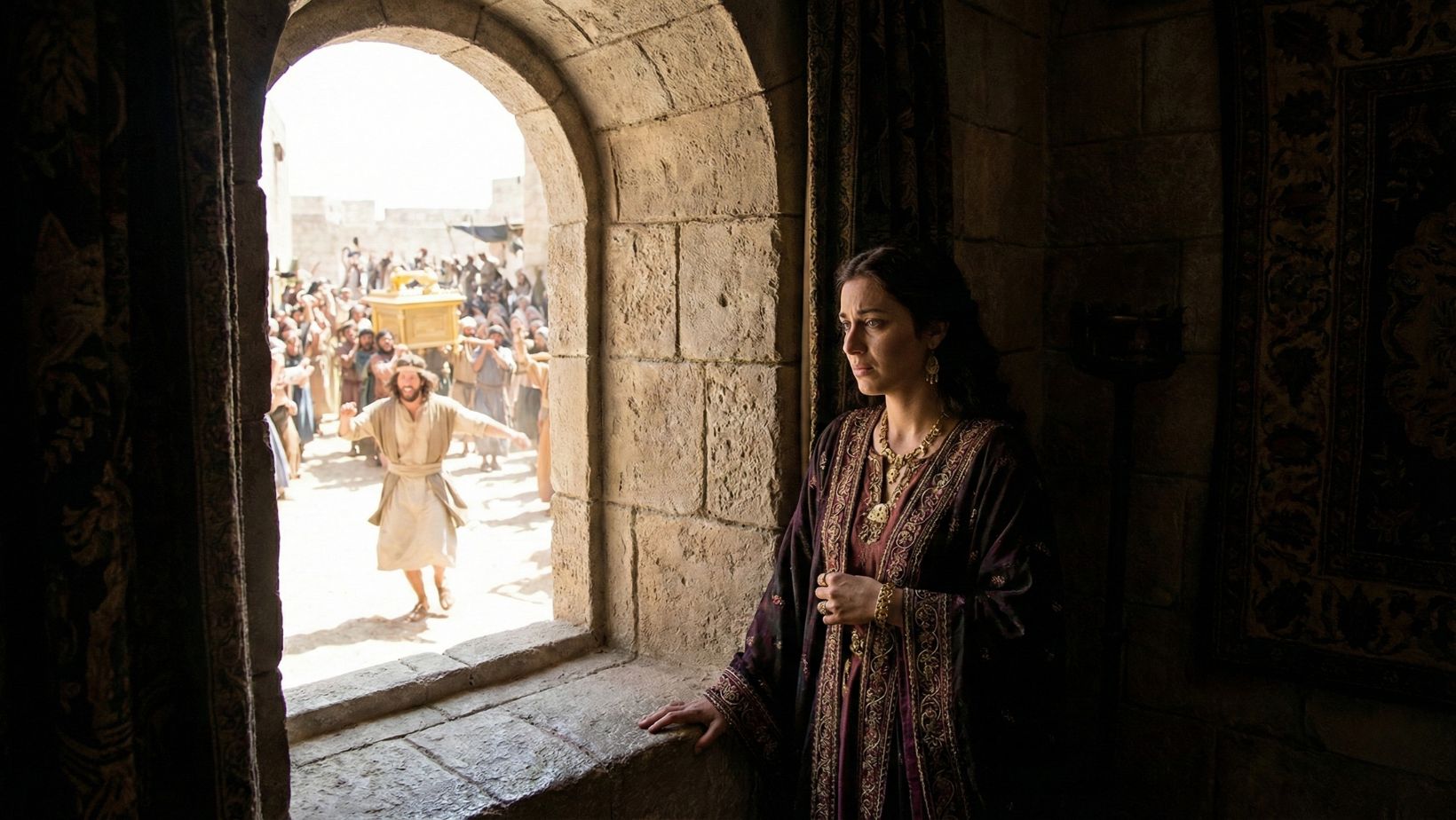
Michal is a complex and tragic figure in the Old Testament, representing the turbulent transition between the House of Saul and the House of David. As the younger daughter of King Saul and the first wife of King David, she is the only woman in the Hebrew Bible explicitly described as loving a man before marriage. Her story begins with romance and daring rescue but descends into political pawning, estrangement, and bitterness. While she once saved David’s life, she ultimately could not understand his heart for worship, leading to a final rift that left her childless and the two royal houses permanently separated.
- Name: Michal (Hebrew: Mikhal, meaning “Who is like God?”)
- Tribe/Nation: Benjamin (Israelite)
- Era: United Monarchy (~1000 BCE)
- Father: King Saul
- Husbands: David (first and third), Paltiel (second)
- Home: Gibeah (Saul’s capital) → Jerusalem
- Books: 1 Samuel, 2 Samuel, 1 Chronicles
- Key Virtues: Courage, decisiveness, loyalty (initially)
- Key Flaws: Pride, concern for appearances, lack of spiritual depth
- Legacy: The severing of the line between Saul and David
- Symbol: The Window — representing her perspective as an observer rather than a participant in God’s work
Name Meaning
“Michal” is likely a shortened form of “Michael,” a rhetorical question meaning “Who is like God?” Ironically, while her name points to God, her narrative often revolves around human politics, royal dignity, and the struggle for earthly status.
Lineage / Family Background
Father: Saul, the first King of Israel, whose erratic behavior deeply affected her life
Siblings: Jonathan (David’s best friend), Ish-bosheth, and Merab
Husband (First): David, whom she loved and married after he paid a bride price of 100 Philistine foreskins
Husband (Second): Paltiel (or Palti), to whom Saul gave her after David fled; he reportedly loved her deeply and followed her weeping when she was taken back
Children: Scripturally recorded as having “no child to the day of her death” (2 Samuel 6:23), marking the end of the union between Saul and David’s lines
Biblical Era / Context
Time: The United Monarchy, spanning the reign of Saul and the rise of David
Setting: Begins in the royal courts of Gibeah, moves to the wilderness years, and concludes in the City of David (Jerusalem)
Cultural Context: Women in royalty were often used as political pawns to secure alliances. Michal was caught in the deadly rivalry between her father (the current king) and her husband (the future king).
Major Roles / Identity
The King’s Daughter: Raised in the first royal court of Israel, accustomed to dignity and protocol
The Rescuer: Risked her life to save David from Saul’s assassins
The Political Pawn: Married to David to entrap him, given to Paltiel to spite David, and reclaimed by David to legitimize his claim to the throne
The Critic: The voice of establishment dignity opposing David’s uninhibited worship
Key Character Traits
Decisive: She acted quickly to deceive her father’s guards and lower David out of a window
Protective: Willing to lie to King Saul to ensure David’s safety
Proud: Valued the external dignity of royalty; she found David’s behavior “vulgar” when he humbled himself before God
Bitter: Her journey from a woman in love to a woman who “despised him in her heart” suggests deep emotional wounding
Main Life Events
Marriage to David: Saul offered Michal to David, hoping the dangerous bride price (Philistine foreskins) would kill him; instead, David succeeded, and she became his wife (1 Samuel 18:20–27)
The Great Escape: When Saul sent men to kill David, Michal lowered him from a window and placed an idol (teraphim) with goat hair in the bed to delay the guards (1 Samuel 19:11–17)
Given to Paltiel: During David’s exile, Saul declared the marriage void and gave Michal to Paltiel (1 Samuel 25:44)
Forced Return: David demanded Michal’s return as a condition for peace with the North; she was taken from a weeping Paltiel (2 Samuel 3:13–16)
The Ark’s Arrival: Michal watched from a window as David danced before the Ark of the Covenant; she despised his lack of royal decorum (2 Samuel 6:16)
Confrontation and Judgment: She rebuked David for “uncovering himself” like a commoner; David retorted that his worship was for God, not people. The text notes she remained childless thereafter (2 Samuel 6:20–23)
Major Relationships
David: A tragic arc from genuine love and protection to political maneuvering and finally mutual contempt
Saul: She defied her father to save her husband, yet she inherited her father’s concern for public image and dignity
Paltiel: Her second husband, who showed genuine affection for her, following her weeping when she was taken away
Jonathan: Her brother, who loved David spiritually and fraternally, contrasting Michal’s romantic and later political connection to him
Notable Passages
1 Samuel 18:20: “Now Michal, Saul’s daughter, loved David.” (The only time a woman is explicitly said to love a man in the Hebrew Bible)
1 Samuel 19:12: “So Michal let David down through a window, and he fled and escaped and got away.”
2 Samuel 6:16: “As the ark of the LORD came into the city of David, Michal the daughter of Saul looked out of the window… and she despised him in her heart.”
2 Samuel 6:21–22: David’s response: “It was before the LORD… I will become even more undignified than this, and I will be humiliated in my own eyes.”
Legacy & Impact
Michal serves as a sobering reminder that loving God’s anointed is not the same as loving God.
She represents the friction between tradition/formality (Saul’s reign) and Spirit-led authenticity (David’s reign).
Her barrenness signifies God’s judgment on the house of Saul; there would be no king who united the blood of Saul and David.
Symbolism / Typology
The Window: A recurring motif in her life. She saves David through a window (action/love) but later judges him from a window (separation/pride). It symbolizes the bystander who observes worship but does not participate.
Barrenness: Spiritual sterility resulting from pride and a critical spirit toward genuine worship.
Idol in the Bed: Reveals that despite being David’s wife, she held onto household idols (teraphim), hinting at a heart not fully aligned with Yahweh alone.
Extra-Biblical References
Josephus: Elaborates on her marriage to Paltiel, suggesting it was a forced political move by Saul.
Rabbinic Tradition (Midrash): Some sources attempt to defend her, suggesting she was critical of David because she felt his behavior violated the modesty required of a king. Other traditions discuss the “five sons of Michal” mentioned in 2 Samuel 21:8 (KJV), often interpreting them as Merab’s sons whom Michal raised as her own, demonstrating her capacity for care despite her own barrenness.







Leave a Reply