
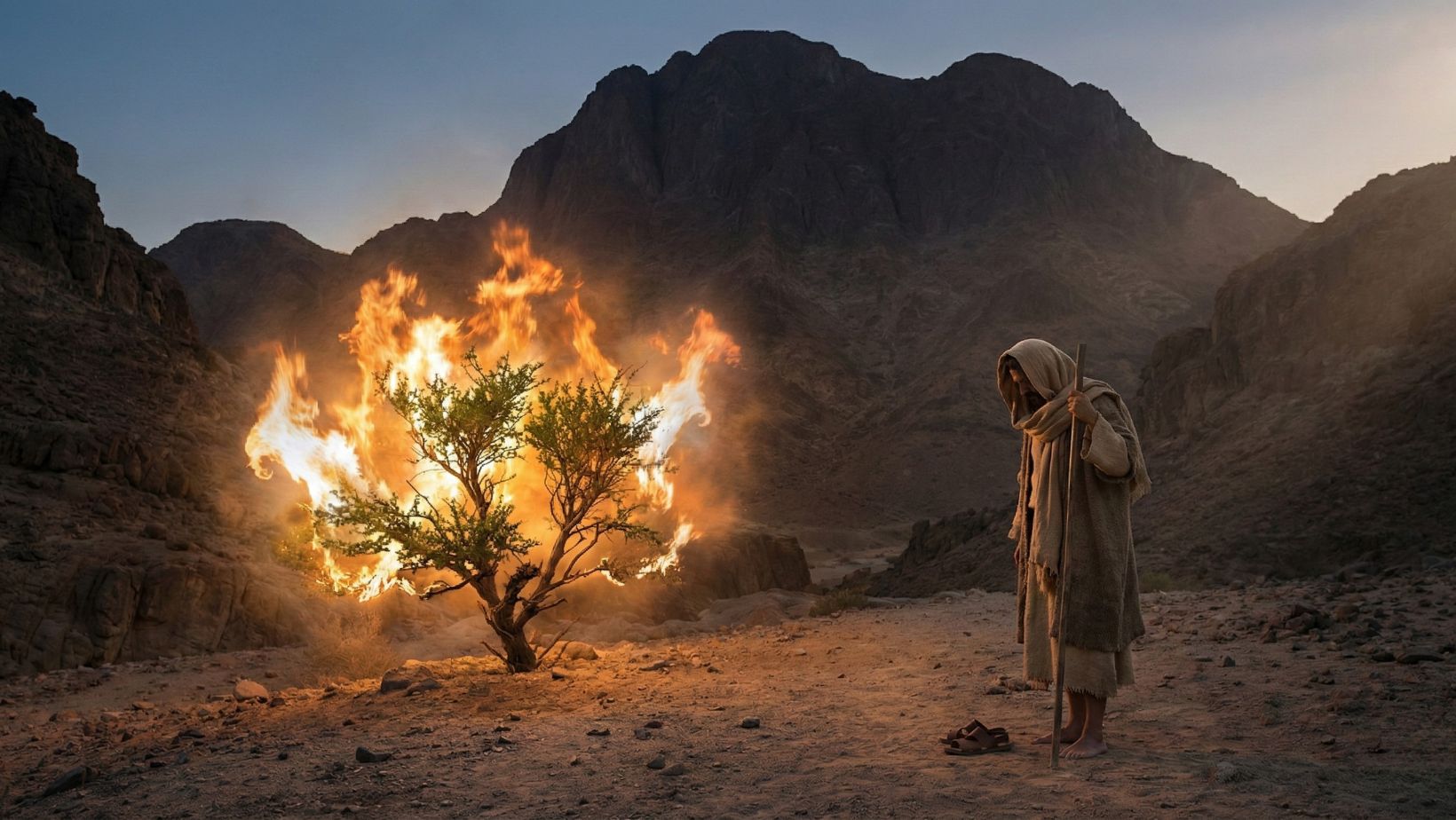
Exodus 3 records one of the most significant theological events in the Old Testament: the call of Moses and the revelation of the divine name, Yahweh. After forty years of silence and obscurity as a shepherd in Midian, Moses encounters the living God at Mount Horeb (Sinai). The narrative shifts from human effort to divine initiative. God reveals Himself not as a new deity, but as the God of the Patriarchs who has seen Israel’s suffering and has “come down” to rescue them. The chapter centers on the dialogue between a reluctant Moses and a holy God, culminating in the disclosure of God’s personal name, “I AM WHO I AM,” and the outlining of the plan for the Exodus.
1. The Burning Bush (Exodus 3:1–6 NLT)
1 One day Moses was tending the flock of his father-in-law, Jethro, the priest of Midian. He led the flock far into the wilderness and came to Sinai, the mountain of God. 2 There the angel of the Lord appeared to him in a blazing fire from the middle of a bush. Moses stared in amazement. Though the bush was engulfed in flames, it didn’t burn up. 3 “This is amazing,” Moses said to himself. “Why isn’t that bush burning up? I must go see it.” 4 When the Lord saw Moses coming to take a closer look, God called to him from the middle of the bush, “Moses! Moses!” “Here I am!” Moses replied. 5 “Do not come any closer,” the Lord warned. “Take off your sandals, for you are standing on holy ground.” 6 “I am the God of your father—the God of Abraham, the God of Isaac, and the God of Jacob.” When Moses heard this, he covered his face because he was afraid to look at God.
Commentary:
- The Setting (v. 1): Moses is at “Horeb” (synonymous with Sinai in the NLT text here), called “the mountain of God.” This indicates that the location was already considered sacred or would become so retrospectively. He is “far into the wilderness,” emphasizing his isolation and separation from Egypt.
- The Angel of the LORD (v. 2): The figure is identified first as the “angel of the Lord” (Malakh Yahweh) and then in verse 4 as “God” (Elohim) and “Lord” (Yahweh). This interchangeability suggests a Theophany (a visible manifestation of God) or, specifically, a Christophany (a pre-incarnate appearance of Christ), acting as the visible agent of the invisible God.
- The Sign (v. 2-3): The miracle is not the fire itself, but the preservation of the bush.
- Symbolism: The bush likely represents Israel—lowly, thorny, and common. The fire represents the affliction of Egypt and the holiness of God. Just as the bush burns but is not consumed, Israel is suffering in the “furnace” of Egypt but is not destroyed because God is in their midst.
- The Call (v. 4): God waits for Moses to turn aside before speaking. The repetition of his name, “Moses! Moses!”, implies urgency and intimacy (similar to “Abraham, Abraham” in Gen 22:11 or “Saul, Saul” in Acts 9:4).
- Holy Ground (v. 5): This is the first occurrence of the word “holy” (qodesh) in the Bible describing a place. Holiness is not inherent to the soil; it is derivative of God’s presence.
- Removing Sandals (v. 5): A sign of humility and servitude. It acknowledges that Moses has no “rights” here; he is a guest in the King’s throne room.
- Continuity (v. 6): God identifies Himself not as a new god of the desert, but as the God of the ancestors. This links the Exodus directly to the Covenants of Genesis.
- Moses’ Reaction (v. 6): Fear. In the ancient world, seeing a deity was often believed to result in death. Moses hides his face, showing appropriate reverence.
Insight: God often meets us in the mundane duties of life (tending sheep). He uses the ordinary (a bush) to reveal the extraordinary (His glory).
2. The Divine Commission (Exodus 3:7–12 NLT)
7 Then the Lord told him, “I have certainly seen the oppression of my people in Egypt. I have heard their cries of distress because of their harsh slave drivers. Yes, I am aware of their suffering. 8 So I have come down to rescue them from the power of the Egyptians and lead them out of Egypt into their own fertile and spacious land. It is a land flowing with milk and honey—the land where the Canaanites, Hittites, Amorites, Perizzites, Hivites, and Jebusites now live. 9 Look! The cry of the people of Israel has reached me, and I have seen how harshly the Egyptians abuse them. 10 Now go, for I am sending you to Pharaoh. You must lead my people Israel out of Egypt.” 11 But Moses protested to God, “Who am I to appear before Pharaoh? Who am I to lead the people of Israel out of Egypt?” 12 God answered, “I will be with you. And this is your sign that I am the one who has sent you: When you have brought the people out of Egypt, you will worship God at this very mountain.”
Commentary:
- The Anthropomorphisms (v. 7-8): God uses sensory language to describe His engagement: He has seen, heard, known (aware), and come down. This refutes the idea of a distant, deistic God. He is intimately involved in human suffering.
- The Destination (v. 8): The promise includes both deliverance from Egypt and entrance into Canaan.
- “Flowing with milk and honey”: An idiom for pastoral abundance (milk from goats/sheep) and agricultural richness (honey/nectar from dates or figs).
- The List of Nations: The mention of the six nations (Canaanites, etc.) indicates the land is currently occupied, foreshadowing the conquest.
- The Great Commission (v. 10): The command is abrupt: “Now go.” God acts through human agency. He comes down (v. 8), but He sends Moses (v. 10).
- Moses’ First Objection (v. 11): “Who am I?” Moses looks at his own resume—a fugitive, a shepherd, a forgotten prince—and feels inadequate. He has lost the self-confidence he had 40 years prior (Ex 2:12).
- The Divine Answer (v. 12): God does not boost Moses’ self-esteem (“You are great, Moses!”). Instead, He shifts the focus to Himself: “I will be with you.” The sufficiency for the task lies in the Sender, not the sent.
- The Future Sign (v. 12): The sign is retrospective. Moses must obey by faith first; the proof will be when they return to this very mountain (Sinai) to worship. This promise guarantees success.
Insight: God’s call is rarely based on our ability but always on His availability. When we ask “Who am I?”, God answers “I AM.”
3. The Revelation of the Name (Exodus 3:13–15 NLT)
13 But Moses protested, “If I go to the people of Israel and tell them, ‘The God of your ancestors has sent me to you,’ they will ask me, ‘What is his name?’ Then what should I tell them?” 14 God replied to Moses, “I Am Who I Am. Say this to the people of Israel: I Am has sent me to you.” 15 God also said to Moses, “Say this to the people of Israel: Yahweh, the God of your ancestors—the God of Abraham, the God of Isaac, and the God of Jacob—has sent me to you. This is my eternal name, my name to remember for all generations.”
Commentary:
- The Question of Authority (v. 13): In Egypt, to know a god’s name was to understand their nature and potentially invoke their power. Moses anticipates the Israelites will ask, “Which god is this? Is He stronger than the gods of Egypt?”
- I AM WHO I AM (v. 14): Hebrew: Ehyeh asher Ehyeh. This is the most profound revelation of God in the Old Testament.
- Self-Existence: He depends on nothing for His existence. He simply IS.
- Immutability: He does not change.
- Undefined: He cannot be defined or controlled by human terms; He defines Himself.
- Yahweh (v. 15): The name “Yahweh” (often rendered LORD in all caps in English Bibles) is derived from the verb hayah (to be). It is the third-person form of “I AM.”
- Eternal Memorial (v. 15): This name is not temporary. It is His character forever.
Insight: By revealing His name, God makes Himself accessible and vulnerable to His people. He is not just “The Force” or “The Creator”; He is a Person with a name who can be called upon.
4. The Strategy for Deliverance (Exodus 3:16–22 NLT)
16 “Now go and call together all the elders of Israel. Tell them, ‘The Lord, the God of your ancestors—the God of Abraham, Isaac, and Jacob—has appeared to me. He told me, “I have been watching closely, and I see how the Egyptians are treating you. 17 I have promised to rescue you from your oppression in Egypt. I will lead you to a land flowing with milk and honey—the land where the Canaanites, Hittites, Amorites, Perizzites, Hivites, and Jebusites now live.”’ 18 “The elders of Israel will accept your message. Then you and the elders must go to the king of Egypt and tell him, ‘The Lord, the God of the Hebrews, has met with us. So please let us take a three-day journey into the wilderness to offer sacrifices to the Lord, our God.’ 19 “But I know that the king of Egypt will not let you go unless a mighty hand forces him. 20 So I will raise my hand and strike the Egyptians, performing all kinds of miracles among them. Then at last he will let you go. 21 And I will cause the Egyptians to look favorably on you. They will give you gifts when you go so you will not leave empty-handed. 22 Every Israelite woman will ask for articles of silver and gold and fine clothing from her Egyptian neighbors and from the foreign women who live in their houses. You will dress your sons and daughters with these, stripping the Egyptians of their wealth.”
Commentary:
- Collaborative Leadership (v. 16): Moses is not to act as a lone ranger. He must gather the “elders,” respecting the existing tribal leadership structure.
- The Initial Request (v. 18): They are to ask for a “three-day journey.”
- Diplomacy: This is a modest, reasonable request to test Pharaoh’s heart. If he refuses a religious holiday, he proves himself unreasonable and tyrannical, justifying the severe judgment that follows.
- Truth: They did intend to go three days to Sinai to worship.
- Divine Foreknowledge (v. 19): God predicts Pharaoh’s resistance. The conflict is not a surprise failure of diplomacy; it is a scripted confrontation to display God’s “mighty hand.”
- Plundering the Egyptians (v. 21-22):
- Justice: This is not theft; it is back pay for 400 years of unpaid slave labor.
- Victory: In ancient warfare, the victor plunders the defeated. Israel will leave Egypt not as escaping refugees, but as a victorious army laden with spoils.
- Materials for Worship: This gold and silver will later be used to build the Tabernacle (Exodus 25).
Insight: God’s plan includes the conflict. He knows the obstacles before we encounter them and has already planned the victory (and the provision) on the other side.
Theological Significance of Exodus 3
- The Holiness of God: The burning bush introduces the concept that God is dangerously holy. He must be approached with reverence (sandals off). This sets the tone for the Tabernacle and Levitical laws.
- Aseity (Self-Existence): The name “I AM” teaches that God is the uncreated Creator. He is the only necessary being in the universe; everything else is contingent upon Him.
- Soteriology (Salvation): The pattern of salvation is established: God sees suffering -> God comes down -> God sends a deliverer -> God brings them out -> God brings them in.
- The Angel of the LORD: This chapter provides one of the strongest evidences for the divinity of the “Angel of the LORD,” as He speaks as Yahweh and receives worship.
Practical Applications
- Responding to “Who am I?”: When we feel inadequate for God’s work, we must remember that our identity is anchored in His presence (“I will be with you”). Our insufficiency is the canvas for His all-sufficiency.
- Reverence in Worship: We must recover a sense of “holy ground.” Approaching God requires a shedding of our “sandals”—our pride, our agenda, and our casualness.
- God’s Timing: Moses spent 40 years thinking he was somebody (Egypt), 40 years learning he was nobody (Midian), so he could spend 40 years seeing what God can do with a nobody (Exodus). God’s preparation time is never wasted.
- The God Who Speaks: God is not silent. He speaks into our wilderness if we are willing to “turn aside” and look.
Final Insight
Exodus 3 is the pivot point of the Old Testament. It transforms a fugitive shepherd into a prophet and a tribal family into a theocratic nation. It reveals that the solution to human oppression is not political revolution, but divine intervention. The fire in the bush was a picture of God’s nature: intense, holy, self-sustaining, and present with His people in their pain.
Possible Sermon Titles from the Chapter
- The God of the Burning Bush.
- Holy Ground in a Wilderness.
- I AM: The Name that Changes Everything.
- When God Interrupts Your Routine.
- Excuse Me, Lord: Dealing with Spiritual Inadequacy.
- Turning Aside to See.







Leave a Reply