
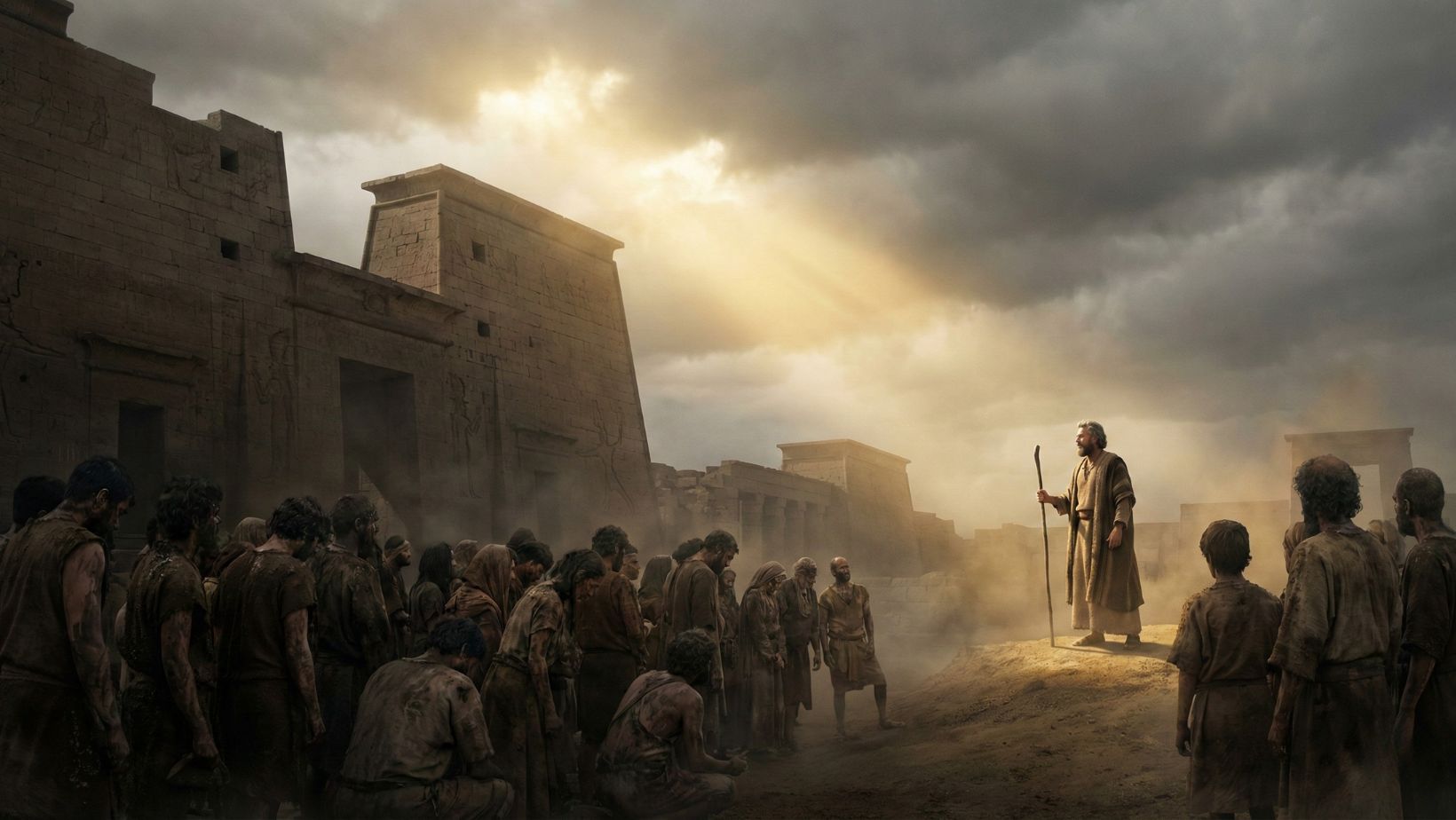
Exodus 6 marks a critical turning point in the deliverance of Israel. Following Moses’ initial failure to persuade Pharaoh—which resulted in increased hardship for the Israelites—Moses questions God’s intent. Chapter 6 opens with God’s powerful reassurance, anchored in His covenant name, Yahweh. God promises seven “I will” statements that guarantee redemption, regardless of current circumstances. The chapter also provides a strategic genealogy of Reuben, Simeon, and especially Levi, establishing the priestly lineage of Moses and Aaron. It concludes by reiterating the divine mandate: despite Moses’ insecurities and “faltering lips,” the mission to confront Pharaoh and lead Israel out of Egypt remains unchanged.
1. The Promise of Deliverance (Exodus 6:1–9 NLT)
1 Then the Lord said to Moses, “Now you will see what I will do to Pharaoh. When he feels the force of my strong hand, he will let the people go. In fact, he will force them to leave his land!” 2 And God said to Moses, “I am Yahweh—‘the Lord.’ 3 I appeared to Abraham, to Isaac, and to Jacob as El-Shaddai—‘God Almighty’—but I did not reveal my name, Yahweh, to them. 4 And I reaffirmed my covenant with them. I promised to give them the land of Canaan, where they were living as foreigners. 5 You can be sure that I have heard the groans of the people of Israel, who are now slaves to the Egyptians. And I am well aware of my covenant with them. 6 Therefore, say to the people of Israel: ‘I am the Lord. I will free you from your oppression and will rescue you from your slavery in Egypt. I will redeem you with a powerful arm and great acts of judgment. 7 I will claim you as my own people, and I will be your God. Then you will know that I am the Lord your God who has freed you from your oppression in Egypt. 8 I will bring you into the land I swore to give to Abraham, Isaac, and Jacob. I will give it to you as your very own possession. I am the Lord!’” 9 So Moses told the people of Israel what the Lord had said, but they refused to listen anymore. They had become too discouraged by the brutality of their slavery.
Commentary:
- The Shift in Perspective (v. 1): God responds to Moses’ complaint (from Chapter 5) not with a rebuke, but with a revelation of power. The “strong hand” of Pharaoh will be overwhelmed by the “strong hand” of God.
- The Revelation of the Name (v. 2–3): God identifies Himself as Yahweh. While the patriarchs knew the name, they had not experienced the character of the name—the Promise-Keeper and Deliverer. They knew Him as El-Shaddai (God Almighty, the Provider), but Moses’ generation would know Him as the active Redeemer.
- The Seven “I Wills” (v. 6–8): This section contains seven distinct promises that form the backbone of Jewish redemption theology:
- I will bring you out.
- I will free you from slavery.
- I will redeem you.
- I will take you as my own people.
- I will be your God.
- I will bring you into the land.
- I will give it to you as a possession.
- The Psychology of Oppression (v. 9): The Israelites’ refusal to listen is a realistic portrayal of trauma. The “brutality of their slavery” (literally “shortness of spirit”) made them unable to process hope. Physical suffering often creates a spiritual deafness.
2. The Command Reinstated (Exodus 6:10–13 NLT)
10 Then the Lord said to Moses, 11 “Go back to Pharaoh, the king of Egypt, and tell him to let the people of Israel leave his country.” 12 “But Lord!” Moses objected. “My own people won’t listen to me anymore; how can I expect Pharaoh to listen? I am such a clumsy speaker!” 13 But the Lord spoke to Moses and Aaron and gave them orders for the Israelites and for Pharaoh, the king of Egypt. The Lord commanded them to lead the people of Israel out of Egypt.
Commentary:
- The Persistent Mandate (v. 11): Despite the internal failure (Israel not listening) and the external obstacle (Pharaoh), God does not change the plan. Divine commands are based on God’s sovereignty, not human receptivity.
- Moses’ Insecurity (v. 12): Moses uses a Hebrew idiom often translated as “uncircumcised lips” (rendered here as “clumsy speaker”). He argues from logic: if his friends won’t listen, why would his enemies?
- The Charge (v. 13): God “gave them orders.” This marks a transition from a suggestion or a request to a formal commission. Moses and Aaron are now officially the commanders of the Exodus.
3. The Genealogy of Moses and Aaron (Exodus 6:14–27 NLT)
14 These are the ancestors of some of the clans of Israel: The sons of Reuben, Israel’s oldest son, were Hanoch, Pallu, Hezron, and Carmi. Their descendants became the clans of Reuben. 15 The sons of Simeon were Jemuel, Jamin, Ohad, Jakin, Zohar, and Shaul (whose mother was a Canaanite woman). Their descendants became the clans of Simeon. 16 These are the descendants of Levi, listed according to their family records. The sons of Levi were Gershon, Kohath, and Merari. (Levi lived to be 137 years old.) 17 The descendants of Gershon included Libni and Shimei, each of whom is the ancestor of a clan. 18 The descendants of Kohath included Amram, Izhar, Hebron, and Uzziel. (Kohath lived to be 133 years old.) 19 The descendants of Merari included Mahli and Mushi. These are the clans of the Levites, listed according to their family records. 20 Amram married his father’s sister, Jochebed, and she gave birth to his sons, Aaron and Moses. (Amram lived to be 137 years old.) 21 The sons of Izhar were Korah, Nepheg, and Zicri. 22 The sons of Uzziel were Mishael, Elzaphan, and Sithri. 23 Aaron married Elisheba, the daughter of Amminadab and sister of Nahshon, and she gave birth to Nadab, Abihu, Eleazar, and Ithamar. 24 The sons of Korah were Assir, Elkanah, and Abiasaph. Their descendants became the clans of the Korahites. 25 Eleazar, son of Aaron, married one of the daughters of Putiel, and she gave birth to his son, Phinehas. These are the ancestors of the Levite families, listed according to their clans. 26 The Aaron and Moses named in this list are the same ones to whom the Lord said, “Lead the people of Israel out of Egypt like an army.” 27 They are the ones who spoke to Pharaoh, the king of Egypt, to tell him to let the people of Israel leave Egypt. These are the same Moses and Aaron.
Commentary:
- The Purpose of the List: In ancient literature, genealogies validate authority. This list proves that Moses and Aaron are not random rebels but legitimate leaders within the covenant line of Israel.
- Focus on Levi (v. 16–25): While Reuben and Simeon (the first and second sons) are mentioned briefly, the text narrows its focus on Levi (the third son). This establishes the Levitical Priesthood.
- The Line of Aaron (v. 23): Special attention is given to Aaron’s sons. This is crucial because Aaron’s line would hold the High Priesthood for centuries.
- The Parenthetical Note (v. 26–27): The text explicitly links the “historical” figures of the genealogy to the “active” figures in the narrative to ensure there is no doubt about their identity.
4. Preparation for the Plagues (Exodus 6:28–30 NLT)
28 When the Lord spoke to Moses in the land of Egypt, 29 he said to him, “I am the Lord! Tell Pharaoh, the king of Egypt, everything I say to you.” 30 But Moses argued with the Lord, saying, “I can’t do it! I am such a clumsy speaker! Why should Pharaoh listen to me?”
Commentary:
- The Echo of Inadequacy: The chapter ends with a literary “bookend.” Despite the grand promises of verses 1–8 and the historical validation of the genealogy, Moses is still struggling with his personal limitations.
- Divine Authority vs. Human Ability: God’s response to “I can’t” is always “I am.” The emphasis remains on the speaker of the message (The Lord) rather than the messenger.
Theological Significance of Exodus 6
- Covenant Loyalty: This chapter demonstrates that God’s actions are always rooted in His previous promises. He remembers His covenant with the patriarchs even when their descendants have forgotten Him.
- The Name as Power: The transition from El-Shaddai to Yahweh signifies a transition from God as a “General Provider” to God as a “Personal Redeemer.”
- Human Frailty and Divine Will: Moses’ repeated excuses highlight a major biblical theme: God chooses the weak and the “clumsy” to confound the powerful (Pharaoh).
Practical Applications
- When God Seems Silent: Even when the situation gets worse (as it did for Israel), God is already in the process of fulfilling His “I Wills.” Hardship is often the prelude to a miracle.
- Overcoming Discouragement: The Israelites couldn’t hear the good news because of their pain. We should be patient with those in deep suffering, recognizing that trauma affects spiritual hearing.
- God’s “I Will” vs. Our “I Can’t”: Like Moses, we focus on our “clumsy lips.” God focuses on His “strong hand.” Our identity is found in His name, not our performance.
Possible Sermon Titles
- The Power of the Name.
- When “I Can’t” Meets “I Will.”
- The God of the Seven Promises.
- Spiritual Deafness in the Midst of Deliverance.
- Legitimacy in the Lineage.







Leave a Reply