
Exodus 9 records a dramatic escalation in the severity of God’s judgment. The plagues shift from discomfort and nuisance (frogs, gnats, flies) to economic devastation (livestock), physical agony (boils), and lethal environmental catastrophe (hail). This chapter marks a pivotal theological moment: for the first time, the text explicitly states that God hardened Pharaoh’s heart (v. 12), suggesting a judicial cementing of Pharaoh’s own stubborn choices. Additionally, the seventh plague (Hail) introduces a new dynamic where God offers a warning that allows believing Egyptians to escape the destruction, hinting that mercy is available even amidst judgment for those who fear the word of the Lord.
1. The Fifth Plague: Death of Livestock (Exodus 9:1–7 NLT)
1 “Go back to Pharaoh,” the Lord commanded Moses. “Tell him, ‘This is what the Lord, the God of the Hebrews, says: Let my people go, so they can worship me. 2 If you continue to hold them and refuse to let them go, 3 the hand of the Lord will strike all your livestock—your horses, donkeys, camels, cattle, sheep, and goats—with a deadly plague. 4 But the Lord will again make a distinction between the livestock of the Israelites and that of the Egyptians. Not a single one of the Israelites’ animals will die! 5 The Lord has already set the time for the plague to begin. He has declared that he will strike the land tomorrow.’” 6 And the Lord did just as he had said. The next morning all the livestock of the Egyptians died, but the Israelites didn’t lose a single animal. 7 Pharaoh sent his officials to investigate, and they discovered that the Israelites had not lost a single animal! But even so, Pharaoh’s heart remained stubborn, and he refused to let the people go.
Commentary:
- Economic Warfare (v. 3): Livestock was the measure of wealth in the ancient world. This plague struck at Egypt’s transportation (horses, camels), labor force (donkeys, oxen), and food supply (sheep, goats). It was a crushing economic blow.
- Targeting Hathor and Apis: This plague directly challenged Egyptian deities associated with livestock, specifically Hathor (cow-headed goddess of love and protection) and Apis (the sacred bull believed to be the incarnation of Ptah). The death of these animals proved their gods could not protect even their own sacred symbols.
- Total Separation (v. 4): The distinction between Goshen and Egypt is absolute here. “Not a single one” of Israel’s animals died. This supernatural protection defies epidemiology; contagious diseases do not naturally respect borders unless a divine quarantine is in place.
- Pharaoh’s Investigation (v. 7): Pharaoh verifies the miracle (“sent his officials to investigate”). He knows it is supernatural, yet his reaction is stubbornness. Proof does not always lead to faith; often, it leads to harder resistance.
2. The Sixth Plague: Unhealable Boils (Exodus 9:8–12 NLT)
8 Then the Lord said to Moses and Aaron, “Take handfuls of soot from a brick kiln, and have Moses toss it into the air while Pharaoh watches. 9 The ashes will spread like fine dust over the whole land of Egypt, causing festering boils to break out on people and animals throughout the land.” 10 So they took soot from a brick kiln and went and stood before Pharaoh. As Pharaoh watched, Moses tossed the soot into the air, and boils broke out on people and animals alike. 11 Even the magicians were unable to stand before Moses, because the boils had broken out on them and all the Egyptians. 12 But the Lord hardened Pharaoh’s heart, and just as the Lord had predicted to Moses, Pharaoh refused to listen.
Commentary:
- Symbolism of the Kiln (v. 8): The “soot from a brick kiln” is deeply ironic. The kiln was the symbol of Israel’s oppression—the place of their hard labor. Moses takes the byproduct of their slavery and turns it into the instrument of their masters’ punishment.
- Physical Agony (v. 9): This is the first plague to inflict physical pain directly on the human body. The “festering boils” (Hebrew shechin) rendered the population ritually unclean and in constant pain.
- The Magicians’ End (v. 11): This is the last mention of the magicians in the plague narrative. Previously they duplicated signs, then they conceded (“finger of God”), and now they cannot even “stand before Moses.” They are utterly defeated and humiliated.
- Divine Hardening (v. 12): This is the first time the text says, “The Lord hardened Pharaoh’s heart.” Previously, Pharaoh hardened his own heart. This suggests a “point of no return.” God confirms Pharaoh in the rebellious path he has freely chosen.
3. The Seventh Plague: Hail and Fire (Exodus 9:13–35 NLT)
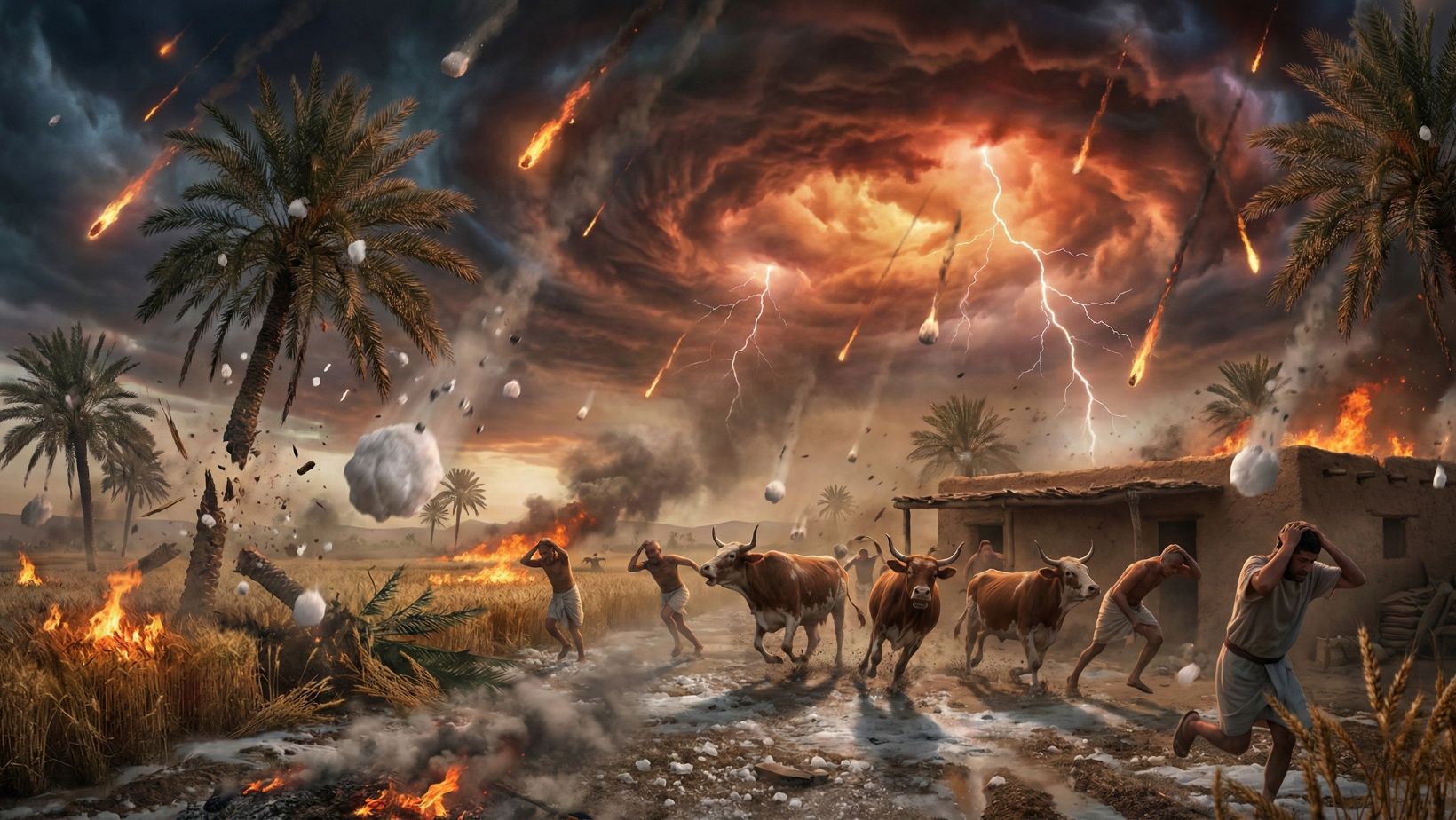
13 Then the Lord said to Moses, “Get up early in the morning and stand before Pharaoh. Tell him, ‘This is what the Lord, the God of the Hebrews, says: Let my people go, so they can worship me. 14 If you don’t, I will send more plagues on you and your officials and your people. Then you will know that there is no one like me in all the earth. 15 By now I could have lifted my hand and struck you and your people with a plague to wipe you off the face of the earth. 16 But I have spared you for a purpose—to show you my power and to spread my fame throughout the earth. 17 But you still lord it over my people and refuse to let them go. 18 So at this time tomorrow, I will send a hailstorm more devastating than any in all the history of Egypt. 19 Quick! Order your livestock and servants to come in from the fields to find shelter. Any person or animal left outside will die when the hail falls.’” 20 Some of Pharaoh’s officials were afraid because of what the Lord had said. They quickly brought their servants and livestock in from the fields. 21 But those who paid no attention to the word of the Lord left theirs out in the open. … 23 Then Moses lifted his staff toward the sky, and the Lord sent thunder and hail, and lightning flashed toward the earth. The Lord sent a tremendous hailstorm against all the land of Egypt. 24 Never in all the history of Egypt had there been a storm like that, with such devastating hail and continuous lightning. 25 It left all of Egypt in ruins. The hail struck down everything in the open field—people, animals, and plants alike. Even the trees were destroyed. 26 The only place without hail was the region of Goshen, where the people of Israel lived. 27 Then Pharaoh quickly summoned Moses and Aaron. “This time I have sinned,” he confessed. “The Lord is the righteous one, and I and my people are guilty. 28 Plead with the Lord to stop this terrible thunder and hail. I will let you go; you don’t need to stay any longer.” … 31 (All the flax and barley were ruined by the hail, because the barley had formed heads and the flax was budding. 32 But the wheat and the emmer wheat were spared, because they had not yet sprouted.) … 34 But when Pharaoh saw that the rain, hail, and thunder had stopped, he and his officials sinned again, and Pharaoh again became stubborn. 35 Because his heart was hard, Pharaoh refused to let the people leave, just as the Lord had predicted through Moses.
Commentary:
- Global Purpose (v. 16): God explains why He hasn’t destroyed Pharaoh instantly. He is using Pharaoh as a backdrop to display His power to the whole world. Paul quotes this verse in Romans 9:17 to discuss election and sovereignty.
- The Option of Mercy (v. 19-21): For the first time, God offers a way of escape. Those who “feared the word of the Lord” (v. 20) could save their servants and remaining livestock. This creates a division within Egypt—not based on ethnicity, but on faith in God’s word.
- Nature of the Storm (v. 24): This was not ordinary weather. It was “hail and fire” (lightning) mixed together. In a land with very little rain, this was apocalyptic. It targeted Nut (goddess of the sky) and Isis and Seth (gods of crops and storms).
- Pharaoh’s Confession (v. 27): Pharaoh sounds repenant: “I have sinned… The Lord is righteous.” However, verse 34 reveals this was “foxhole religion”—repentance born of fear, not transformation. As soon as the consequence ceased, the conviction vanished.
- Agricultural Detail (v. 31-32): The text provides specific details about the crops. Flax (for linen clothing) and barley (for beer and bread for the poor) were destroyed. Wheat (for the wealthy) was spared because it matures later. This suggests God left them with something, perhaps to give one final chance for repentance before the locusts took the rest.
Theological Significance of Exodus 9
- God as the Owner of the Earth: The phrase “The earth is the Lord’s” (v. 29) challenges the Egyptian worldview that Pharaoh owned the land. The plagues prove that Yahweh controls the soil, the sky, the animals, and the health of the people.
- The hardening of the Heart: This chapter provides a case study in the psychology of sin. Repeated rejection of truth calcifies the conscience. Eventually, God gives the sinner over to their own desires (Romans 1:24), resulting in a “hardened” state where repentance is no longer sought.
- Mercy in Judgment: Even in His wrath, God remembers mercy. By warning the Egyptians about the hail, He shows that His desire is not death, but recognition of His lordship. Anyone—Hebrew or Egyptian—who feared His word found safety.
Practical Applications
- Fear God, Not Circumstances: The Egyptians who feared God’s word saved their households. We must learn to act on God’s warnings even when they seem unlikely or inconvenient.
- The Danger of Temporary Repentance: We must examine our own hearts. Do we only repent when “it thunders”—when we are in trouble? True repentance changes behavior even when the sun comes out again.
- God Uses Even Resistance: Pharaoh’s rebellion only served to amplify God’s glory. We can be encouraged that even when powerful forces oppose the Gospel, God is sovereignly using them to advance His ultimate purpose.







Leave a Reply