
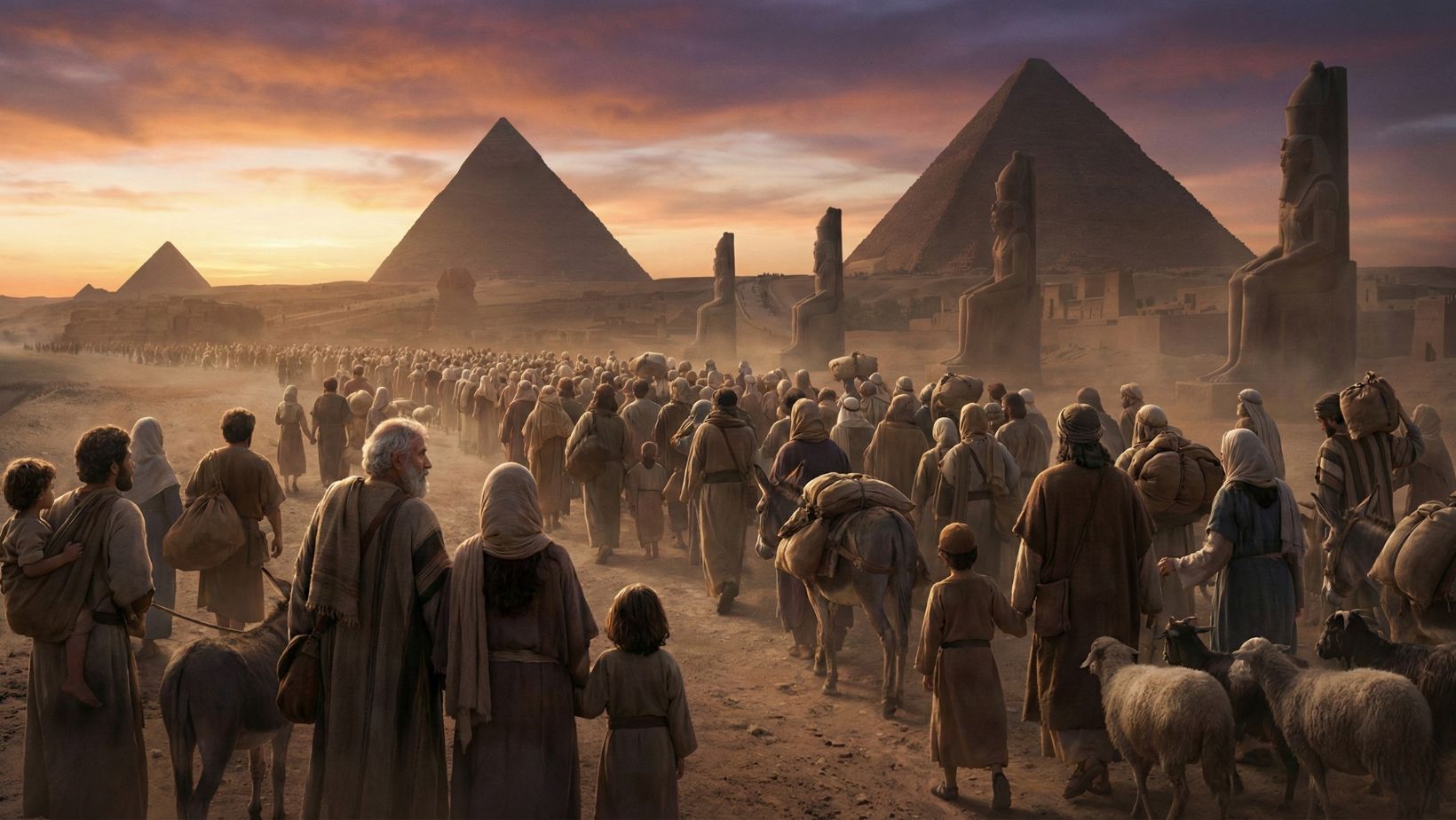
Exodus 12 is the theological and historical pivot point of the Old Testament. It marks the transition of the Israelites from a family of slaves to a redeemed nation. After nine devastating plagues, God institutes the Passover—a perpetual memorial of His judgment passing over those marked by the blood of the lamb. This chapter details the specific sacrificial requirements, the suddenness of the Midnight Cry, and the Great Exodus itself. It serves as the ultimate “Type” or shadow of the New Testament Gospel: redemption through the blood of an innocent substitute.
1. The Institution of the Passover (Exodus 12:1–13 NLT)
1 While the Israelites were still in the land of Egypt, the Lord gave the following instructions to Moses and Aaron: 2 “From now on, this month will be the first month of the year for you. 3 Announce to the whole community of Israel that on the tenth day of this month each family must choose a lamb or a young goat for a sacrifice, one animal for each household. 4 If a family is too small to eat a whole animal, let them share with a neighbor family nearby. Divide the animal according to the size of each family and how much they can eat. 5 The animal you select must be a 1-year-old male, either a sheep or a goat, with no defects. 6 Take special care of this chosen animal until the evening of the fourteenth day of this first month. Then the whole assembly of the community of Israel must slaughter their lamb or young goat at twilight. 7 They are to take some of the blood and smear it on the sides and top of the doorframes of the houses where they eat the animal. 8 That same night they must roast the meat over a fire and eat it along with bitter herbs and bread made without yeast. 9 Do not eat any of the meat raw or boiled in water. The whole animal—including the head, legs, and internal organs—must be roasted over a fire. 10 Do not leave any of it until the next morning. Burn whatever is not eaten before morning. 11 These are your instructions for eating this meal: Be fully dressed, wear your sandals, and carry your walking stick in your hand. Eat the meal with urgency, for this is the Lord’s Passover. 12 On that night I will pass through the land of Egypt and strike down every firstborn son and firstborn male animal in the land of Egypt. I will execute judgment against all the gods of Egypt, for I am the Lord! 13 But the blood on your doorframes will serve as a sign, marking the houses where you are staying. When I see the blood, I will pass over you. This plague of death will not touch you when I strike the land of Egypt.”
Commentary:
- A New Calendar (v. 2): Redemption redefines time. God commands that this month (Abib/Nisan) become the “first month.” For the believer, life truly begins at the moment of deliverance.
- The Selection of the Lamb (v. 3-5): The lamb had to be a “1-year-old male… with no defects.” This typifies perfection. It had to be kept for four days (v. 6), allowing the family to ensure its purity and perhaps develop an emotional connection, emphasizing the cost of the sacrifice.
- The Application of Blood (v. 7): It was not enough for the lamb to die; its blood had to be applied to the doorframes. In Christian theology, this mirrors the personal application of faith in the sacrifice of Christ.
- The Manner of the Meal (v. 8-11): * Bitter Herbs: Represented the bitterness of slavery.
- Unleavened Bread: Symbolized the haste of their departure (no time for dough to rise) and spiritual purity (leaven often represents sin).
- Ready for Travel: They ate with sandals on and staffs in hand, signifying a people ready to leave the world’s systems at a moment’s notice.
- Judgment on Gods (v. 12): This was not just a strike against humans, but a polemic against “all the gods of Egypt.” Each plague had targeted a specific Egyptian deity; the final plague targeted Pharaoh himself, who was considered a god, and his heir.
2. The Festival of Unleavened Bread (Exodus 12:14–20 NLT)
14 “This is a day to remember. Each year, from generation to generation, you must celebrate it as a special festival to the Lord. This is a law for all time. 15 For seven days the bread you eat must be made without yeast. On the first day of the festival, remove every trace of yeast from your homes. Anyone who eats bread made with yeast during seven days of the festival will be cut off from the community of Israel. 16 On the first day of the festival and again on the seventh day, all the people must prepare for an official day for holy assembly. No work of any kind may be done on these days except in the preparation of food. 17 Celebrate this Festival of Unleavened Bread, for it will remind you that I brought your forces out of the land of Egypt on this very day. This festival will be a permanent law for you; celebrate this day from generation to generation. 18 The bread you eat must be made without yeast from the evening of the fourteenth day of the first month until the evening of the twenty-first day of that same month. 19 During those seven days, there must be no trace of yeast in your homes. Anyone who eats anything made with yeast during this week will be cut off from the community of Israel. These regulations apply both to the foreigners living among you and to the native-born Israelites. 20 During those days you must not eat anything made with yeast. Wherever you live, eat only bread made without yeast.”
Commentary:
- Commemoration (v. 14): The Passover was not a one-time event but a “permanent law.” It served as the foundational “national holiday” that defined Israel’s identity.
- The Symbolism of Yeast (v. 15): Yeast (leaven) causes bread to puff up. In Scripture, it often symbolizes pride, sin, or the corrupting influence of the world (1 Corinthians 5:6-8). Removing it symbolized a consecrated life.
- The Consequence (v. 19): Being “cut off” (excommunication or death) highlights the gravity of holiness. To participate in the redemption of the lamb but refuse to put away the “leaven” of Egypt was a contradiction God would not permit.
3. Instructions to the Elders (Exodus 12:21–28 NLT)
21 Then Moses called all the elders of Israel together and said to them, “Go, pick out a lamb or young goat for each of your families, and slaughter the Passover animal. 22 Drain the blood into a basin. Then take a cluster of hyssop branches and dip it into the blood. Brush the hyssop across the top and sides of the doorframes of your houses. And no one may go out through the door until morning. 23 For the Lord will pass through the land to strike down the Egyptians. But when he sees the blood on the top and sides of the doorframe, the Lord will pass over the door. He will not permit the destroyer to come into your houses to destroy you. 24 Remember, these instructions are a permanent law that you and your descendants must observe forever. 25 When you enter the land the Lord has promised to give you, you will continue to observe this ceremony. 26 Then your children will ask, ‘What does this ceremony mean?’ 27 And you will reply, ‘It is the Passover sacrifice to the Lord, for he passed over the houses of the Israelites in Egypt. And though he struck the Egyptians, he spared our families.’” When Moses had finished speaking, all the people bowed down to the ground and worshiped. 28 So the people of Israel did just as the Lord had commanded through Moses and Aaron.
Commentary:
- The Hyssop (v. 22): Hyssop was a common, humble shrub. Its use here and later in purification rites (Psalm 51:7) signifies that the means of applying God’s grace is accessible and simple.
- Protection Under the Blood (v. 23): The “destroyer” (Hebrew mashchit) is the agent of judgment. Safety was found only behind the blood-stained door. It wasn’t the goodness of the people inside that saved them, but the blood on the outside.
- Parental Responsibility (v. 26-27): God designed the ritual to provoke curiosity in children. The Passover was an educational tool to ensure that the story of God’s grace was passed to the next generation.
4. The Tenth Plague: Death of the Firstborn (Exodus 12:29–36 NLT)
29 And at midnight the Lord struck down all the firstborn sons in the land of Egypt, from the firstborn son of Pharaoh, who sat on his throne, to the firstborn son of the prisoner in the dungeon. Even the firstborn of their livestock were killed. 30 Pharaoh and all his officials and all the people of Egypt woke up during the night, and loud wailing was heard throughout the land of Egypt. There was not a single house where someone had not died. 31 Pharaoh sent for Moses and Aaron during the night. “Get out!” he commanded. “Leave my people—and take the rest of the Israelites with you! Go and worship the Lord as you have requested. 32 Take your flocks and herds, as you said, and be gone. And bless me, too, when you leave.” 33 All the Egyptians urged the people of Israel to get out of the land as quickly as possible, for they thought, “We will all die!” 34 The Israelites took their bread dough before yeast was added. They wrapped their kneading boards in their cloaks and carried them on their shoulders. 35 And the people of Israel did as Moses had instructed; they asked the Egyptians for clothing and articles of silver and gold. 36 The Lord caused the Egyptians to look favorably on the Israelites, and they gave the Israelites whatever they asked for. So they stripped the Egyptians of their wealth!
Commentary:
- The Midnight Cry (v. 29-30): The judgment was universal and impartial. From the palace to the dungeon, Egypt felt the weight of their defiance against God. The “loud wailing” contrasts with the silence in the blood-marked Israelite homes.
- Pharaoh’s Broken Pride (v. 31-32): The man who once asked “Who is the Lord?” (Exodus 5:2) now begs for a blessing from Moses. He grants total unconditional release.
- Plundering the Egyptians (v. 35-36): This was not theft; it was “back wages” for centuries of forced labor. God ensured His people did not leave their period of suffering empty-handed. This wealth would later be used to build the Tabernacle.
5. The Exodus Begins (Exodus 12:37–42 NLT)
37 That night the people of Israel left Rameses and started for Succoth. There were about 600,000 men, plus all the women and children. 38 A mixed multitude of others went with them, along with vast flocks of livestock and herds. 39 For bread they baked flat cakes from the dough without yeast they had brought from Egypt. It was made without yeast because the people were driven out of Egypt in such a hurry that they had no time to prepare food or other supplies. 40 The people of Israel had lived in Egypt for 430 years. 41 In fact, it was on the last day of the 430th year that all the Lord’s forces left the land. 42 On this night the Lord kept his promise to bring his people out of the land of Egypt. So this night belongs to him, and it must be commemorated every year by all the Israelites from generation to generation.
Commentary:
- The Magnitude (v. 37): 600,000 men suggests a total population of 2 to 3 million people. This fulfills God’s promise to Abraham to make him a “great nation.”
- The Mixed Multitude (v. 38): Not all who left were Israelites. Some Egyptians and other foreigners, seeing the power of Yahweh, chose to join the Exodus. This hints at the future inclusion of the Gentiles.
- God’s Timetable (v. 40-41): The mention of “430 years” to the very day emphasizes God’s absolute sovereignty over history. He is never late; His promises are kept with surgical precision.
6. Restrictions for the Passover (Exodus 12:43–51 NLT)
43 Then the Lord said to Moses and Aaron, “These are the instructions for the festival of Passover. No outsiders are allowed to eat the Passover meal. 44 But any slave who has been purchased may eat it if he has been circumcised. 45 Temporary residents and hired servants may not eat it. 46 Each Passover lamb must be eaten in one house. Do not carry any of its meat outside, and do not break any of its bones. 47 The whole community of Israel must celebrate this festival. 48 If there are foreigners living among you who want to celebrate the Lord’s Passover, let all their males be circumcised. Only then may they celebrate the Passover with you like any native-born Israelite. But no uncircumcised male may ever eat the Passover meal. 49 This instruction applies to everyone, whether a native-born Israelite or a foreigner living among you.” 50 So all the people of Israel did just as the Lord had commanded through Moses and Aaron. 51 On that very day the Lord brought the people of Israel out of the land of Egypt like an army.
Commentary:
- Covenant Membership (v. 43-48): The Passover was a covenant meal. To participate, one had to be part of the covenant community (marked by circumcision). However, it was not exclusionary based on race; any foreigner could join if they committed to the covenant.
- The Unbroken Bones (v. 46): This is a specific prophetic detail. None of the lamb’s bones were to be broken. The New Testament highlights this was fulfilled in Jesus’ crucifixion (John 19:33-36), where His legs were not broken like the others.
- The Lord’s Army (v. 51): Israel is no longer described as a group of slaves, but as the “Lord’s forces” or “army.” God’s redemption changes a person’s status and identity.
Theological Significance
- Substitutionary Atonement: The core message is that death is coming for all, but God provides a substitute. The lamb dies so the firstborn can live.
- Christ our Passover: The New Testament explicitly identifies Jesus as “our Passover lamb” (1 Corinthians 5:7).
- The Concept of “Passover”: The Hebrew word Pesach implies God “hovering over” or protecting the house, not just skipping it.
Practical Applications
- Applied Faith: Knowing about the blood wasn’t enough; the Israelites had to apply it. We must personally respond to God’s grace.
- Leaving Egypt: We are called to leave our “Egypt” (sin/the world) in haste, not lingering in the places of our former bondage.
- The Importance of Memory: We must intentionally create “memorials” (like Communion/The Lord’s Supper) to remember what God has done for us.







Leave a Reply