
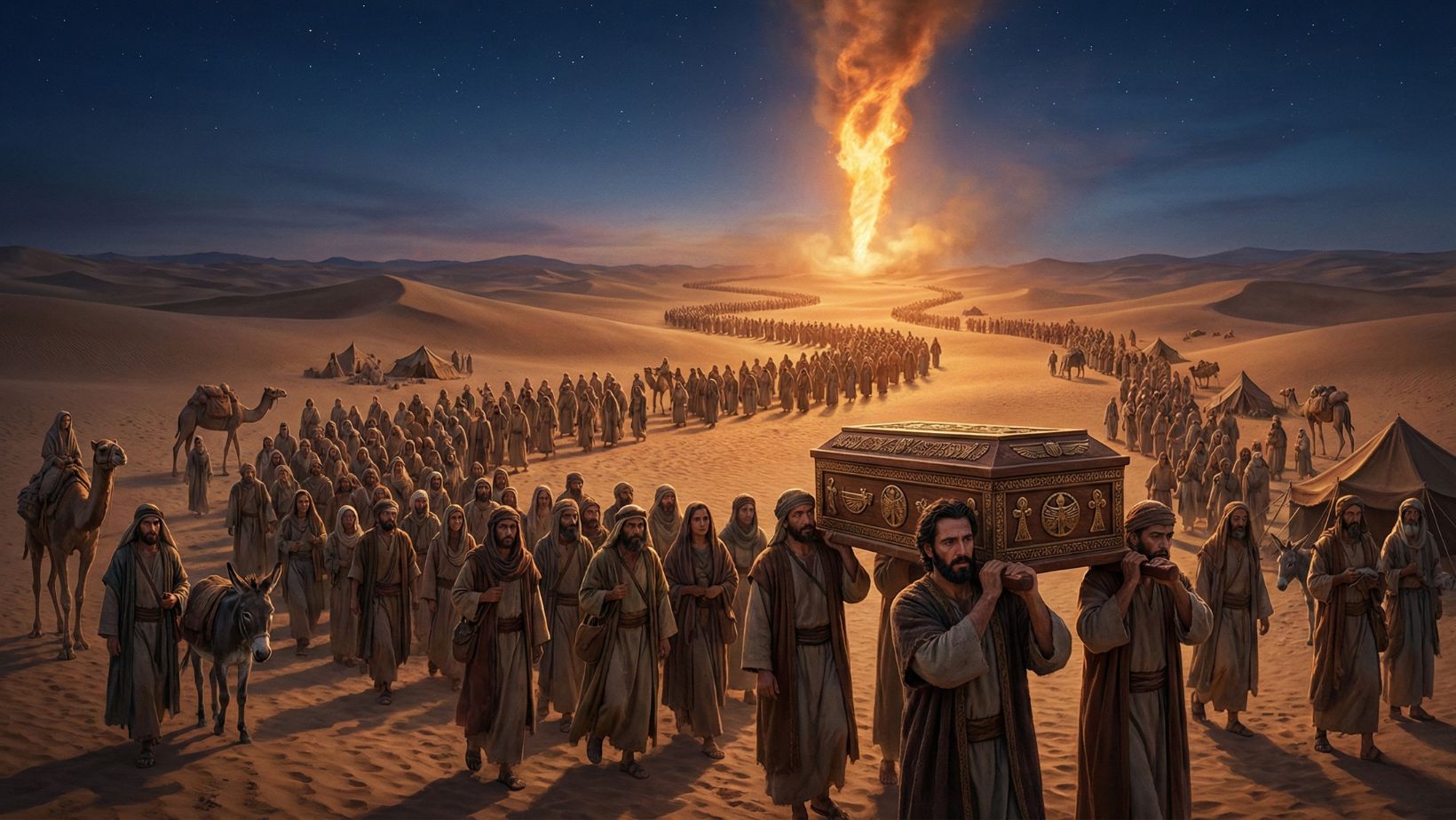
Exodus 13 serves as a bridge between the immediate aftermath of the Passover in Egypt and the beginning of the wilderness journey. Having been spared by the blood of the lamb, Israel is now called to a life of consecration. The chapter focuses on three main elements: the consecration of the firstborn to God as a permanent memorial of the Passover, the establishment of the Festival of Unleavened Bread as a lasting ordinance, and the initial stages of the Exodus journey. It highlights God’s strategic leadership, as He deliberately guides the people away from the direct war-prone coastal route, leading them instead toward the Red Sea, accompanied by the visible manifestations of His presence—the pillar of cloud by day and the pillar of fire by night.
1. Dedication of the Firstborn and the Feast of Unleavened Bread (Exodus 13:1–10 NLT)
1 Then the Lord said to Moses, 2 “Dedicate to me every firstborn among the Israelites. The first offspring to be born, of both humans and animals, belongs to me.” 3 So Moses said to the people, “This is a day to remember forever—the day you left Egypt, the place of your slavery. Today the Lord has brought you out by the power of his mighty hand. (Remember, eat no food containing yeast.) 4 On this day in early spring, in the month of Abib, you have been set free. 5 You must celebrate this festival in this month in future years, when the Lord brings you into the land of the Canaanites, Hittites, Amorites, Hivites, and Jebusites. This is the land he swore to give your ancestors, a land flowing with milk and honey. 6 For seven days the bread you eat must be made without yeast. Then on the seventh day, celebrate a feast to the Lord. 7 Eat bread without yeast during those seven days. In fact, there must be no yeast bread or any yeast at all found within your borders. 8 “On the thirteenth day, explain to your children, ‘I am doing this because of what the Lord did for me when I left Egypt.’ 9 This annual festival will be a visible sign to you, like a mark branded on your hand or your forehead. Let it remind you always to recite this teaching of the Lord: ‘With a strong hand, the Lord rescued you from Egypt.’ 10 So observe the decree of this festival at the appointed time each year.
Commentary:
- Principle of the Firstborn (v. 1-2): God claims ownership of the firstborn. Since God spared the firstborn of Israel during the tenth plague while destroying the firstborn of Egypt, the Israelite firstborn now belong to Him by right of redemption. This establishes the principle that the “first” of everything (fruits, income, offspring) represents the whole and belongs to God.
- The Power of Memory (v. 3): Moses commands the people to “remember forever.” The Hebrew imperative zakhar implies not just mental recall, but active reenactment. The exodus is not just history; it is the foundational identity of the nation.
- Yeast as Symbolism (v. 3, 7): The prohibition of yeast (leaven) is reiterated. Yeast often symbolizes corruption or sin in Scripture, but here it primarily represents haste—they left so quickly their bread did not have time to rise. Removing it symbolizes a break from their old life in Egypt.
- The Land of Promise (v. 5): The commands are linked to the future settlement in Canaan. The list of nations (Canaanites, Hittites, etc.) serves as a reminder that God’s promise to the patriarchs (Abraham, Isaac, Jacob) is now being fulfilled.
- Generational Transfer (v. 8): The instruction “explain to your children” establishes the family table as the primary school of theology. Faith is preserved through storytelling. The father is instructed to make it personal: “what the Lord did for me,” even though the children and future generations were not physically there.
- The Mark on Hand and Forehead (v. 9): This metaphorical language suggests that the Law should guide their actions (hand) and their thoughts (forehead/between the eyes). This verse is the biblical basis for tefillin (phylacteries) worn by Orthodox Jews, though in this context, the “sign” is likely the observance of the festival itself.
- Reciting the Teaching (v. 9): The purpose of the ritual is that the “teaching of the Lord” (Torah) remains in their mouths. Ritual serves to preserve the Word.
Insight: The text emphasizes that freedom is not an end in itself; freedom is for the purpose of worship. Israel is liberated from Pharaoh so they can be dedicated to Yahweh.
2. The Law of Redemption (Exodus 13:11–16 NLT)
11 “This is what you must do when the Lord fulfills the promise he swore to you and to your ancestors. When he gives you the land where the Canaanites now live, 12 you must present all firstborn sons and firstborn male animals to the Lord, for they belong to him. 13 A firstborn donkey may be bought back from the Lord by presenting a lamb or young goat in its place. But if you do not buy it back, you must break its neck. However, you must buy back every firstborn son. 14 “And in the future, your children will ask you, ‘What does all this mean?’ Then you will tell them, ‘With the power of his mighty hand, the Lord brought us out of Egypt, the place of our slavery. 15 Pharaoh stubbornly refused to let us go, so the Lord killed every firstborn male throughout the land of Egypt, both people and animals. That is why I now sacrifice all the firstborn males to the Lord—except that the firstborn sons are always bought back.’ 16 This ceremony will be like a mark branded on your hand or your forehead. It is a reminder that the power of the Lord’s mighty hand brought us out of Egypt.”
Commentary:
- Distinction between Clean and Unclean (v. 13):
- Clean animals (cattle, sheep, goats): The firstborn must be sacrificed to God.
- Unclean animals (donkeys): A donkey cannot be sacrificed. It must be “redeemed” (bought back) with a lamb. If not redeemed, it must be killed (neck broken) so the owner profits nothing from it.
- Human sons: Like the donkey, humans are “unclean” in the sense that they cannot be sacrificed. They must be redeemed. This serves as a stark contrast to pagan religions of the time that practiced child sacrifice (e.g., to Molech). God demands the life, but provides a substitute.
- The Cost of Redemption (v. 13): The donkey represents the beast of burden—valuable for work. The law teaches that one cannot keep what belongs to God without paying a redemption price. This foreshadows the concept of substitutionary atonement.
- Catechesis (v. 14): Again, the text anticipates the curiosity of children: “What does all this mean?” The ritual is designed to provoke questions, providing parents a natural opportunity to teach the theology of judgment and salvation.
- Pharaoh’s Stubbornness (v. 15): The text recalls the “hardness” of Pharaoh’s heart. The death of the Egyptian firstborn is the context for the dedication of the Israelite firstborn. One group died under judgment; the other lives under redemption.
- Visual Reminders (v. 16): The repetition of the “mark” on the hand and forehead reinforces the necessity of internalizing God’s law. It is not enough to perform the ritual; the truth of it must be bound to the person’s identity.
Insight: The juxtaposition of the firstborn son and the firstborn donkey is striking. Both must be redeemed by a lamb. This humbles humanity, reminding Israel that they, like the unclean donkey, are only acceptable to God through the price of a substitute (the lamb).
3. God’s Strategic Guidance: The Pillar of Cloud and Fire (Exodus 13:17–22 NLT)
17 When Pharaoh finally let the people go, God did not lead them along the main road that runs through Philistine territory, even though that was the shortest route. God said, “If the people are faced with a battle, they might change their minds and return to Egypt.” 18 So God led them in a roundabout way through the wilderness toward the Red Sea. Thus the Israelites left Egypt like an army ready for battle. 19 Moses took the bones of Joseph with him, for Joseph had made the sons of Israel swear to do this. He said, “God will certainly come to help you. When he does, you must take my bones with you from this place.” 20 The Israelites left Succoth and camped at Etham on the edge of the wilderness. 21 The Lord went ahead of them. He guided them during the day with a pillar of cloud, and he provided light at night with a pillar of fire. This allowed them to travel by day or by night. 22 And the Lord did not remove the pillar of cloud or pillar of fire from its place in front of the people.
Commentary:
- The Route Avoided (v. 17): The “main road through Philistine territory” is known historically as the Via Maris (Way of the Sea). It was a major trade route heavily fortified with Egyptian military outposts and led directly into the land of the warlike Philistines.
- Divine Psychology (v. 17): God acknowledges the fragility of the Israelites’ faith. Though they are called an “army” (v. 18), they possess a slave mentality. Early warfare would likely cause them to retreat to the “safety” of slavery in Egypt. God’s detour is an act of mercy, not a delay.
- The Wilderness Road (v. 18): God leads them toward the Yam Suph (Red Sea or Sea of Reeds). This route leads them into a geographical trap (the sea on one side, desert on the other), setting the stage for the miracle in Chapter 14.
- Ready for Battle (v. 18): The NLT phrase “like an army ready for battle” (translating the Hebrew chamushim) suggests they were organized, marching in ranks, or perhaps lightly armed. They were not a disorderly mob, despite their internal fear.
- Joseph’s Bones (v. 19): This fulfills the oath recorded in Genesis 50:24-25. Carrying Joseph’s bones (a mummy) served as a tangible connection to the past promises. Joseph believed in the Exodus centuries before it happened; carrying his bones was an act of faith that the destination (Canaan) was guaranteed.
- The Theophany (v. 21-22):
- The Pillar: This was not a weather phenomenon but a manifestation of God’s presence (Theophany).
- Function: It provided guidance (showing the way), protection (shielding from sun/enemies), and light (allowing night travel).
- Significance: In the ancient world, generals guided armies with signals of smoke and fire. Here, Yahweh serves as the General of the Hosts of Israel, personally leading the trek.
- Continuous Presence (v. 22): The text emphasizes that the pillar “did not remove” itself. God’s presence was constant, regardless of the people’s behavior.
Insight: The “shortcut” is often a trap. The Via Maris was the shortest distance between two points, but it was the quickest way back to slavery. God’s “long way around” was the only way to true freedom. He leads us not by the fastest route, but by the one that prepares us to sustain the blessing.
Theological Significance of Exodus 13
- The Theology of Redemption: The chapter establishes that redemption requires a price. The firstborn belongs to God, and if he is to live, a substitute must be offered. This establishes the sacrificial system that culminates in Christ.
- Catechesis and Memory: Biblical faith is not intuitive; it must be taught. The repeated commands to “tell your son” emphasize that revelation is historical. If one generation fails to tell the story, the next generation forgets who they are.
- Sanctification: Being “brought out” (justification/deliverance) must be followed by being “set apart” (sanctification). The Feast of Unleavened Bread symbolizes the removal of the old life to walk in newness.
- Divine Accompaniment: The pillar of cloud and fire signifies that God is not a distant deity. He is Immanuel (God with us), guiding, protecting, and dwelling among His people in their wilderness wanderings.
Practical Applications
- Understanding God’s “No”: When God blocks an “easy” path (like the road to the Philistines), it is often for our protection. We may want the shortcut, but God knows we aren’t ready for the battles that lie on that road.
- The Importance of Ritual: We need tangible reminders (communion, baptism, regular worship) to keep the “yeast” of the world from infecting our lives. Without intentional “remembering,” we drift.
- Parental Responsibility: Parents are the primary spiritual instructors of their children. We must be ready to answer the question, “What does this mean?” with a personal testimony of God’s grace.
- Giving God the First: The principle of the firstborn challenges us to give God the first of our time, resources, and energy, not the leftovers. What we dedicate to Him is blessed; what we withhold often withers.
Final Insight
Exodus 13 marks the transition from the event of salvation to the lifestyle of the saved. It reveals a God who is detailed in His demands for holiness (the removal of yeast) yet incredibly gentle in His leadership (avoiding war). He claims the firstborn not to rob parents, but to remind them that life itself is a gift from the One who leads them by fire and cloud.







Leave a Reply