
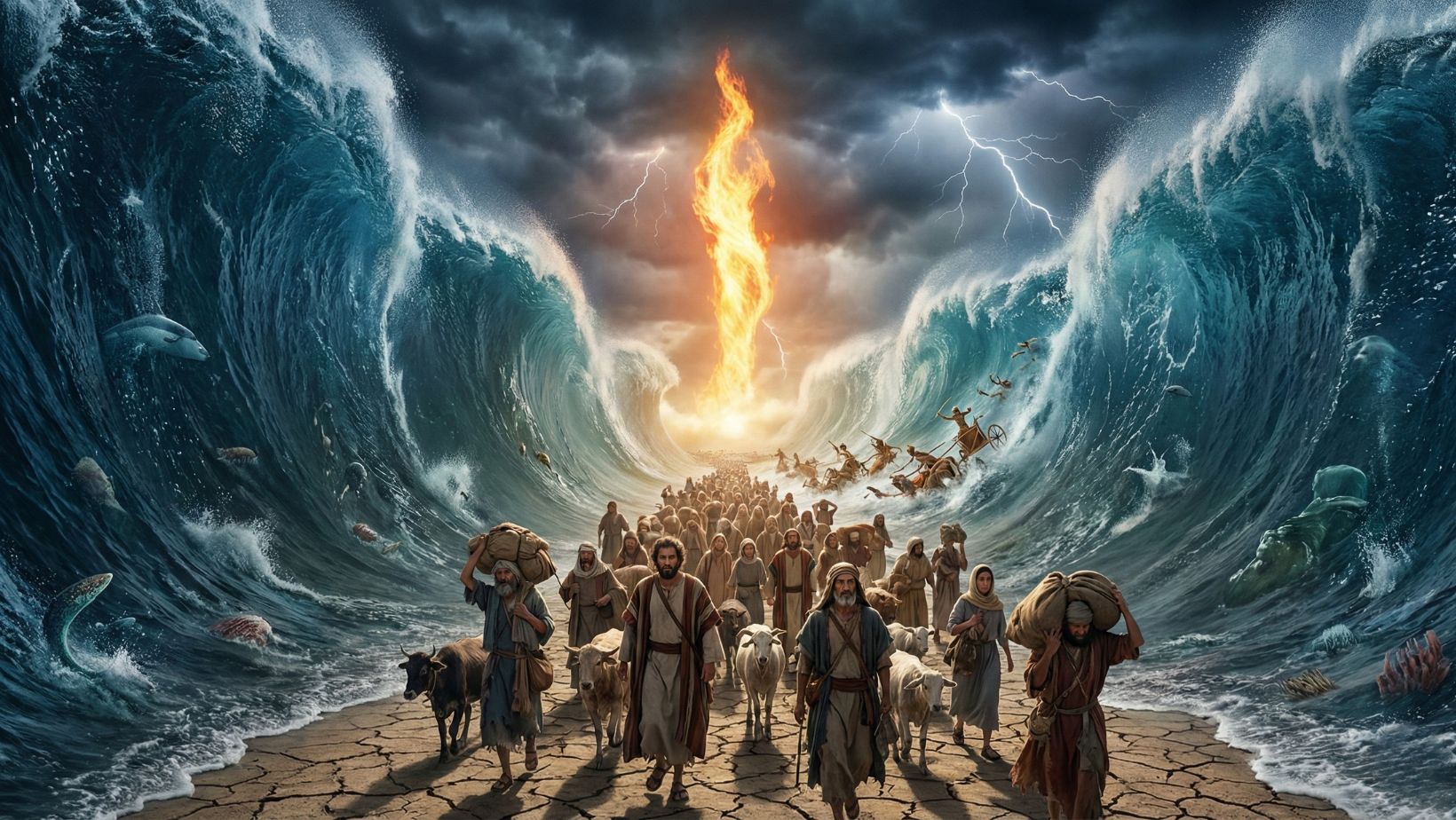
Exodus 14 is the dramatic climax of the deliverance narrative. Having escaped the ten plagues, the Israelites find themselves trapped between the impassable Red Sea and the approaching Egyptian army. This chapter marks the definitive transition from slavery to freedom, orchestrated entirely by Yahweh. It highlights the stark contrast between human panic and divine sovereignty. The narrative moves from God setting a trap for Pharaoh, to the terrified cries of the Israelites, the resolute leadership of Moses, and finally, the miraculous parting of the waters that saves Israel and destroys the pursuing army. It is a story of “standing still” to see the salvation of the Lord.
1. The Divine Stratagem (Exodus 14:1–4 NLT)
1 Then the Lord gave these instructions to Moses: 2 “Order the Israelites to turn back and camp by Pi-hahiroth between Migdol and the sea. Camp there along the shore, opposite Baal-zephon. 3 Then Pharaoh will think, ‘The Israelites are confused. They are trapped in the wilderness!’ 4 And once again I will harden Pharaoh’s heart, and he will chase after you. I have planned this in order to display my glory through Pharaoh and his whole army. After this the Egyptians will know that I am the Lord!” So the Israelites camped there as they were told.
Commentary:
- Geographical Specificity (v. 2): God gives precise coordinates—Pi-hahiroth, Migdol, and Baal-zephon.
- Turn Back: The command to “turn back” implies a deviation from the direct route (the Via Maris or “Way of the Philistines”) toward a dead-end.
- Baal-zephon: This name refers to a deity (Baal of the North), believed by sailors to control the sea and storms. By camping opposite this shrine, Yahweh is setting the stage to defeat not just Pharaoh, but the Egyptian gods of the sea.
- The Trap (v. 3): God intentionally makes Israel look vulnerable. From a military standpoint, their position was suicidal—pinnned against the water with no escape route.
- “Confused”: Pharaoh interprets their erratic movement as a lack of leadership and direction. He believes the desert itself has “shut them in.”
- Purpose of Hardening (v. 4): The hardening of Pharaoh’s heart is not arbitrary; it is for the purpose of glory (Hebrew kabod, meaning weight or heaviness).
Insight: God sometimes leads His people into impossible situations not to destroy them, but to demonstrate His power. What looks like a tactical error to the enemy is often a strategic trap set by God.
2. The Pursuit of Pharaoh (Exodus 14:5–9 NLT)
5 When the king of Egypt was told that the people had fled, Pharaoh and his officials changed their minds. “What have we done, letting all those Israelite slaves get away?” they asked. 6 So Pharaoh harnessed his chariot and called up his troops. 7 He took with him 600 of Egypt’s best chariots, along with the rest of the chariots of Egypt, each with its commander. 8 The Lord hardened the heart of Pharaoh, the king of Egypt, so he chased after the people of Israel, who had left with fists raised in defiance. 9 The Egyptians chased after them with all the forces in Pharaoh’s army—all his horses and chariots, his charioteers, and his troops. The Egyptians caught up with the people of Israel as they were camped beside the shore near Pi-hahiroth, across from Baal-zephon.
Commentary:
- Economic Regret (v. 5): The motivation shifts from grief (over the firstborn) to economic loss. The realization sets in: “What have we done?” They had just voluntarily released their entire workforce.
- Military Might (v. 6-7):
- Chariots: The chariot was the “tank” of ancient warfare—fast, mobile, and terrifying to infantry.
- “Best Chariots”: The number 600 represents the elite corps. This was an overwhelming show of force against a group of fleeing slaves carrying children and livestock.
- Fists Raised (v. 8): The NLT translates the Hebrew idiom “with a high hand” as “fists raised in defiance.” It depicts confidence and boldness. Israel left Egypt not sneaking out, but marching out. This confidence, however, would soon evaporate.
- The Closing Gap (v. 9): The speed of the chariots allowed the Egyptians to quickly close the gap, catching Israel at their most vulnerable moment: camped and hemmed in by the sea.
Insight: Old bondages often make one last attempt to reclaim us just as we step into freedom. The enemy rarely gives up territory without a final counter-attack.
3. Panic and Accusation (Exodus 14:10–12 NLT)
10 As Pharaoh approached, the people of Israel looked up and panicked when they saw the Egyptians overtaking them. They cried out to the Lord, 11 and they said to Moses, “Why did you bring us out here to die in the wilderness? Were there no graves in Egypt? What have you done to us? Why did you make us leave Egypt? 12 Didn’t we tell you this would happen while we were still in Egypt? We said, ‘Leave us alone! Let us be slaves to the Egyptians. It’s better to be a slave in Egypt than a corpse in this wilderness!’”
Commentary:
- Visual Trigger (v. 10): The sight of the dust clouds and glinting chariots caused immediate psychological collapse. The “high hand” of verse 8 drops instantly.
- Sarcastic Complaint (v. 11): The Israelites use biting sarcasm: “Were there no graves in Egypt?” Egypt was famous for its necropolises and obsession with death (pyramids, tombs). They imply Moses brought them to the desert because Egypt’s cemeteries were full.
- Slave Mentality (v. 12): Fear causes regression. They rewrite history, claiming they wanted to stay slaves.
- Selective Memory: They conveniently forget the groaning, the whips, and the straw quotas (Exodus 2:23).
- Survival vs. Freedom: In the face of death, they value mere survival (slavery) over the risk required for freedom.
Insight: Fear distorts memory. When we are afraid, we often romanticize our past bondage because it feels safer than the unknown risks of faith.
4. Moses’ Stand and God’s Command (Exodus 14:13–18 NLT)
13 But Moses told the people, “Don’t be afraid. Just stand still and watch the Lord rescue you today. The Egyptians you see today will never be seen again. 14 The Lord himself will fight for you. Just stay calm.” 15 Then the Lord said to Moses, “Why are you crying out to me? Tell the people to get moving! 16 Pick up your staff and raise your hand over the sea. Divide the water so the Israelites can walk through the middle of the sea on dry ground. 17 And I will harden the hearts of the Egyptians, and they will charge in after the Israelites. My great glory will be displayed through Pharaoh and his troops, his chariots, and his charioteers. 18 When my glory is displayed through them, all Egypt will see my glory and know that I am the Lord!”
Commentary:
- Three Commands of Faith (v. 13-14): Moses, though likely internally terrified, stands as a rock for the people.
- “Don’t be afraid”: Stop the panic.
- “Stand still”: Stop running; hold your ground.
- “Watch”: Be a spectator to God’s work.
- Divine Warrior (v. 14): “The Lord himself will fight for you.” This introduces the concept of Yahweh as a warrior. The people’s only job is to be silent (Hebrew harash – be deaf/dumb/silent).
- God’s Rebuttal (v. 15): God interrupts Moses’ prayer. There is a time for prayer and a time for action. “Why are you crying out to me? Tell the people to get moving!”
- The Mechanism of Miracle (v. 16): God uses human agency (Moses’ staff) to trigger divine power.
- “Dry Ground”: The promise isn’t just a path, but a dry path, emphasizing the completeness of the miracle. Mud would have been just as deadly as water for a moving caravan.
- Certainty of Victory (v. 17-18): God reiterates that the Egyptians will pursue to their own doom. The hardening of hearts ensures they will act irrationally, driving heavy chariots into the seabed.
Insight: Faith is not passivity; it is active obedience. Sometimes we wait for God to move, while God is waiting for us to step forward.
5. The Angel and the Cloud (Exodus 14:19–20 NLT)
19 Then the angel of God, who had been leading the people of Israel, moved to the rear of the camp. The pillar of cloud also moved from the front and stood behind them. 20 The cloud settled between the Egyptian and Israelite camps. As darkness fell, the cloud turned to fire, lighting up the night. But the Egyptians and Israelites did not approach each other all night.
Commentary:
- Rear Guard (v. 19): The visible presence of God (Angel/Cloud) shifts from guiding the front to protecting the rear. God places Himself between His people and their enemy.
- Dual Nature of the Cloud (v. 20):
Insight: God is both our Vanguard (leader) and our Rear Guard (protector). When the enemy is too close, God interposes Himself as a shield.
6. The Crossing (Exodus 14:21–22 NLT)
21 Then Moses raised his hand over the sea, and the Lord opened up a path through the water with a strong east wind. The wind blew all that night, turning the seabed into dry land. 22 So the people of Israel walked through the middle of the sea on dry ground, with walls of water on each side!
Commentary:
- The East Wind (v. 21): God uses natural means (wind) to accomplish supernatural ends. The wind blew “all that night,” indicating a process rather than an instantaneous “poof.”
- Walls of Water (v. 22): The text is explicit—this was not merely a marsh or a tide going out. There were “walls” (Hebrew homah) on the right and left. This imagery contradicts liberal interpretations of a shallow “Reed Sea” crossing where the water was only ankle-deep.
- Dry Ground: Repeated for emphasis. The seabed, usually silty and soft, was miraculously firm to support millions of people and livestock.
Insight: The path to freedom often leads through the obstacle, not around it. God makes a way where there is physically no way.
7. The Destruction of the Egyptians (Exodus 14:23–28 NLT)
23 Then the Egyptians—all of Pharaoh’s horses, chariots, and charioteers—chased them into the middle of the sea. 24 But just before dawn the Lord looked down on the Egyptian army from the pillar of fire and cloud, and he threw their forces into total confusion. 25 He twisted their chariot wheels, making their chariots difficult to drive. “Let’s get out of here—away from these Israelites!” the Egyptians shouted. “The Lord is fighting for them against Egypt!” 26 When all the Israelites had reached the other side, the Lord said to Moses, “Raise your hand over the sea again. Then the waters will rush back and fall on the chariots and charioteers.” 27 So as the sun began to rise, Moses raised his hand over the sea, and the water rushed back into its usual place. The Egyptians tried to escape, but the Lord swept them into the sea. 28 Then the waters returned and covered all the chariots and charioteers—the entire army of Pharaoh. Of all the Egyptians who had chased the Israelites into the sea, not one survived.
Commentary:
- Fatal Arrogance (v. 23): In their blind fury, the Egyptians drive onto the seabed, failing to realize the supernatural nature of the path.
- Divine Sabotage (v. 24-25):
- The Realization (v. 25): The Egyptians finally articulate the theology of the event: “The Lord is fighting for them.” They recognize Yahweh’s hand too late.
- Total Destruction (v. 28): The reversal is complete. The water that was a wall of protection for Israel becomes a weapon of execution for Egypt. “Not one survived” emphasizes the completeness of the judgment.
Insight: The enemies of God eventually recognize His power, but often only when it is too late to repent. The very things men trust in (chariots/technology) can become the source of their downfall when opposed to God.
8. The Aftermath: Fear and Faith (Exodus 14:29–31 NLT)
29 But the people of Israel had walked through the middle of the sea on dry ground, as the water stood up like a wall on both sides. 30 That is how the Lord rescued Israel from the hand of the Egyptians that day. And the Israelites saw the bodies of the Egyptians washed up on the seashore. 31 When the people of Israel saw the mighty power that the Lord had unleashed against the Egyptians, they were filled with awe before him. They put their faith in the Lord and in his servant Moses.
Commentary:
- Visual Confirmation (v. 30): Seeing the bodies washed up was gruesome but necessary. It provided physical proof that their oppressors were dead. They would never again have to fear the crack of the Egyptian whip.
- The Result (v. 31):
- Awe: They “feared” the Lord (reverential awe).
- Faith: They “believed” in the Lord.
- Leadership: Their confidence in Moses was restored.
- Summary: The chapter ends with the goal of verse 4 achieved: God’s glory is displayed, and His people know Him.
Insight: Deliverance leads to doxology (worship). The crisis was necessary to move the people from a “slave mentality” to a “faith mentality,” though their faith would be tested again soon.
Theological Significance of Exodus 14
- Salvation by Grace: Israel did nothing to save themselves. They did not fight; they only “stood still.” This is the Old Testament picture of salvation—it is entirely the work of God.
- Judgment and Mercy: The same water that saved Israel destroyed Egypt. The Gospel is a savor of life to some and death to others (2 Corinthians 2:16).
- Baptism: The New Testament interprets this event as a type of baptism (1 Corinthians 10:1-2). Passing through the water symbolizes death to the old life (Egypt) and resurrection to a new life with God.
- The Warrior God: Yahweh is revealed not just as a Creator, but as a Warrior who fights for His covenant people.
Practical Applications
- Handling Dead Ends: When we feel trapped by circumstances, we must remember that God often guides us into difficulties to display His power, not to abandon us.
- The Trap of Nostalgia: We must guard against romanticizing our past sins or “slavery” when the path of faith gets hard. The “graves of Egypt” are never better than the “wilderness with God.”
- Moving vs. Praying: There is a time to pray, but there is also a time to act. When God has given a clear command (e.g., in Scripture), we don’t need to pray for guidance; we need to move in obedience.
- God as Shield: We can rest in the fact that God stands between us and our enemies. Nothing can touch us without passing through Him first.







Leave a Reply