
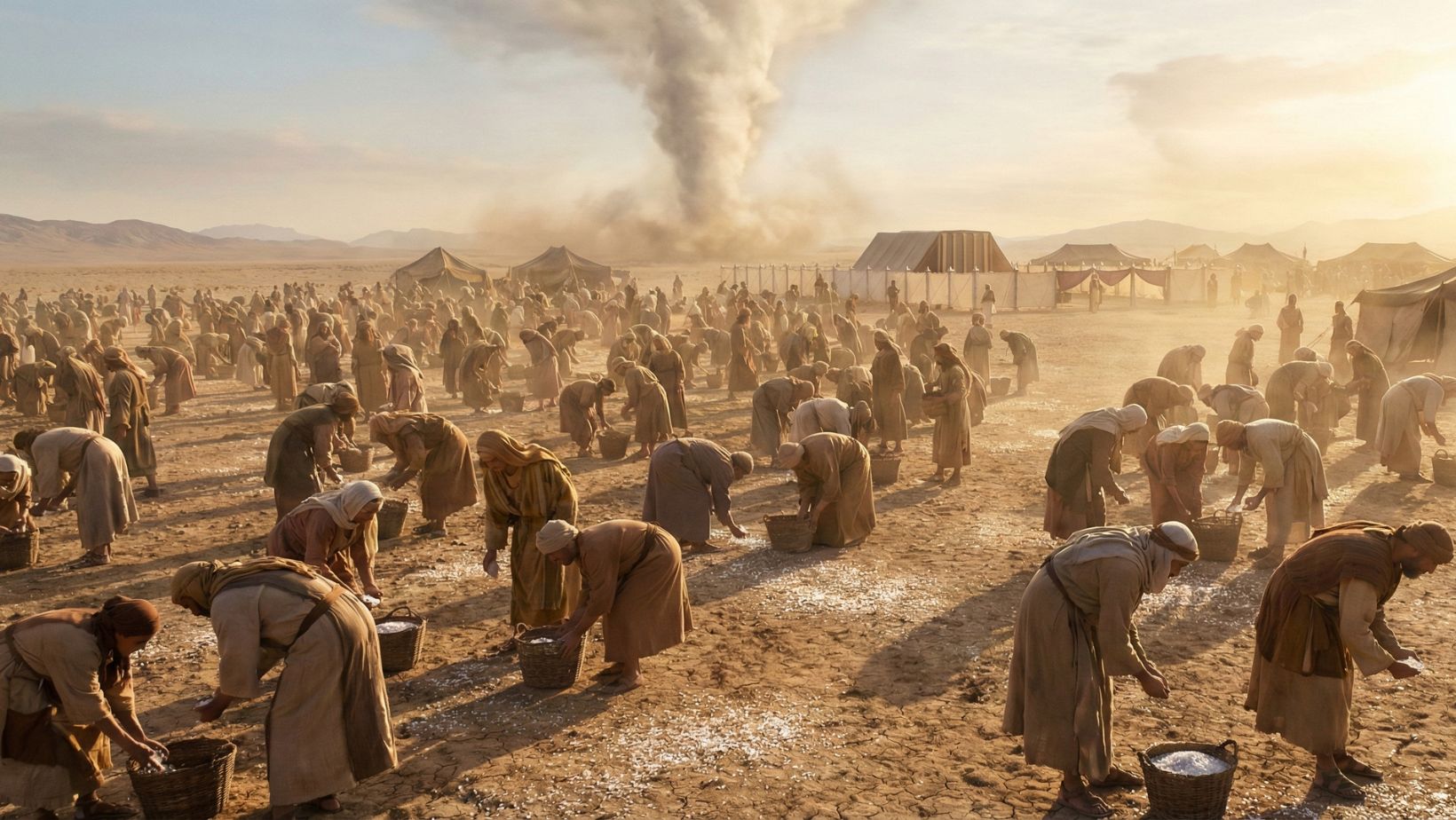
Exodus 16 captures a pivotal moment in the Israelites’ journey from Egyptian bondage to the Promised Land. Located in the wilderness of Sin, between Elim and Sinai, the community faces a crisis of sustenance. The chapter highlights the recurring theme of Israel’s “grumbling”—a vocalized lack of trust in God’s providence despite the recent miracle of the Red Sea. In response, God demonstrates His glory and sovereignty by providing manna and quail. This chapter is not merely about physical food; it establishes a divine rhythm of dependence through the Sabbath and serves as a test of obedience regarding God’s specific instructions for gathering.
1. The Crisis of Hunger and Grumbling (Exodus 16:1–3 NLT)
1 Then the whole community of Israel set out from Elim and journeyed into the wilderness of Sin, between Elim and Mount Sinai. They arrived there on the fifteenth day of the second month, one month after leaving the land of Egypt. 2 There, too, the whole community of Israel complained about Moses and Aaron. 3 “If only the Lord had killed us back in Egypt,” they moaned. “There we sat around pots filled with meat and ate all the bread we wanted. But now you have brought us into this wilderness to starve us all to death.”
Commentary:
- Timeline of Testing (v. 1): One month has passed since the Exodus. The initial euphoria of deliverance has faded, replaced by the harsh reality of the desert. The “wilderness of Sin” is a place of transition and testing.
- The Pattern of Complaint (v. 2): The Hebrew word for “complained” suggests a persistent murmuring. Instead of petitioning God in prayer, they vent their frustrations at their human leaders, Moses and Aaron.
- Selective Memory (v. 3): The Israelites romanticize their life in Egypt. They remember the “pots filled with meat” but conveniently forget the whip of the taskmaster and the infanticide. This “slave mentality” prefers the security of bondage over the risks of freedom.
- A Death Wish (v. 3): Their despair is so deep they claim they would have preferred death by the hand of the Lord in Egypt over the perceived neglect in the wilderness.
2. God’s Gracious Response and Instructions (Exodus 16:4–12 NLT)
4 Then the Lord said to Moses, “Look, I’m going to rain down food from heaven for you. Each day the people can go out and pick up as much food as they need for that day. I will test them in this to see whether or not they will follow my instructions. 5 On the sixth day they will gather food, and when they prepare it, there will be twice as much as usual.” 6 So Moses and Aaron said to all the people of Israel, “By evening you will realize it was the Lord who brought you out of the land of Egypt. 7 In the morning you will see the glory of the Lord, because he has heard your complaints, which are against him, not against us. For who are we that you should complain about us?” 8 Then Moses added, “The Lord will give you meat to eat in the evening and satisfying bread in the morning, for he has heard your complaints against him. What are we? Your complaints are not against us but against the Lord.” 9 Then Moses said to Aaron, “Announce this to the entire community of Israel: ‘Present yourselves before the Lord, for he has heard your complaints.’” 10 And as Aaron gave this message to the whole community of Israel, they looked out toward the wilderness. There they could see the glory of the Lord appearing in the cloud. 11 Then the Lord said to Moses, 12 “I have heard the people’s complaints. Now tell them, ‘In the evening you will have meat to eat, and in the morning you will have all the bread you want. Then you will know that I am the Lord your God.’”
Commentary:
- Bread from Heaven (v. 4): God answers their grumbling not with judgment, but with a miracle. The phrase “rain down food” emphasizes that the source is entirely supernatural and divine.
- The Daily Test (v. 4): The manna is a curriculum for faith. By giving only enough for one day, God forces Israel into a state of daily dependence. This is the Old Testament foundation for the “daily bread” requested in the Lord’s Prayer.
- The Target of Grumbling (v. 8): Moses clarifies a vital spiritual principle: complaining against God’s appointed leaders is ultimately a complaint against God’s sovereignty.
- The Appearance of Glory (v. 10): The “glory of the Lord” appearing in the cloud served as a visual rebuke to their unbelief and a confirmation of His presence.
- The Purpose of Provision (v. 12): The ultimate goal of the food is relational: “Then you will know that I am the Lord your God.” Provision is a means to revelation.
3. Quail and Manna Provided (Exodus 16:13–21 NLT)
13 That evening vast numbers of quail arrived and covered the camp. The next morning the area around the camp was wet with dew. 14 When the dew evaporated, a flaky substance as fine as frost blanketed the ground. 15 The Israelites were puzzled when they saw it. “What is it?” they asked each other. They had no idea what it was. And Moses told them, “It is the food the Lord has given you to eat. 16 These are the Lord’s instructions: Each household should gather each day as much as it needs. Pick up two quarts for each person in your household.” 17 So the people of Israel did as they were told. Some gathered a lot, some only a little. 18 But when they measured it out, everyone had just enough. Those who gathered a lot had nothing left over, and those who gathered little had enough. Each family had just what it needed. 19 Then Moses aided, “Do not keep any of it until morning.” 20 But some of them didn’t listen and kept some of it until morning. But then it was full of maggots and had a terrible smell. And Moses was very angry with them. 21 After this, the people gathered the food morning by morning, each family according to its need. And as the sun grew hot, the flakes they had not gathered melted and disappeared.
Commentary:
- The Quail (v. 13): Quails often migrate across this region, but their arrival in “vast numbers” exactly when promised marks it as a providential act of God.
- The Definition of Manna (v. 14–15): The word “Manna” comes from the Hebrew Man hu, literally meaning “What is it?” It was a unique substance—fine, flaky, and white like coriander seed (v. 31).
- The Omer Measurement (v. 16): An “omer” (translated as two quarts) was the daily portion. This established a standard of “enough”—it prevented hoarding and ensured the vulnerable were fed.
- The Miracle of Equality (v. 18): Regardless of physical strength or speed in gathering, God miraculously balanced the portions so that no one lacked and no one had a surplus.
- Consequences of Disobedience (v. 20): Hoarding the manna was an act of “functional atheism”—the belief that God might not provide tomorrow. The maggots and rot were immediate physical manifestations of spiritual decay.
4. The Sabbath and the Double Portion (Exodus 16:22–30 NLT)
22 On the sixth day, they gathered twice as much as usual—four quarts for each person instead of two. Then all the leaders of the community came and reported this to Moses. 23 He told them, “This is what the Lord commanded: Tomorrow will be a day of complete rest, a holy Sabbath day set apart for the Lord. So bake or boil as much as you want today, and set aside what is left for tomorrow.” 24 So they set some aside until morning, as Moses had commanded. And this time it did not rot or develop maggots. 25 Moses said, “Eat this food today, for today is a Sabbath day dedicated to the Lord. There will be no food on the ground today. 26 You may gather the food for six days, but the seventh day is the Sabbath. There will be no food on the ground that day.” 27 Some of the people went out anyway on the seventh day, but they found no food. 28 The Lord asked Moses, “How long will these people refuse to obey my commands and instructions? 29 They must realize that the Sabbath is the Lord’s gift to you. That is why he gives you a two-day supply on the sixth day, so there will be enough for two days. On the Sabbath day you must each stay in your place. Do not go out to pick up food on the seventh day.” 30 So the people did not gather any food on the seventh day.
Commentary:
- The Pre-Law Sabbath (v. 23): It is notable that the Sabbath is introduced here before the giving of the Ten Commandments at Sinai. It is presented as a fundamental rhythm of creation and grace.
- The Double Miracle (v. 24): The manna that rotted on other nights stayed fresh on the Sabbath. God adjusted the laws of biology to honor the law of rest.
- The Gift of Rest (v. 29): The Sabbath is described as a “gift.” For a people who had been slaves—where their value was tied solely to their production—the command to rest was a radical declaration of their new identity as free children of God.
- The Persistence of Rebellion (v. 27): Even after the visible miracles, some went out to gather on the seventh day. This reveals that the human heart often prioritizes “doing” over “trusting.”
5. A Jar of Manna for Posterity (Exodus 16:31–36 NLT)
31 The Israelites called the food manna. It was white like coriander seed, and it tasted like honey wafers. 32 Then Moses said, “This is what the Lord has commanded: Fill a two-quart container with manna to preserve it for your future generations. Then they can see the food I gave you in the wilderness when I set you free from Egypt.” 33 Moses said to Aaron, “Get a jar and fill it with two quarts of manna. Then put it in a sacred place before the Lord to keep it for all future generations.” 34 Aaron did just as the Lord had commanded Moses. He eventually placed it in the Ark of the Covenant—in front of the stone tablets inscribed with the terms of the covenant. 35 So the people of Israel ate manna for forty years, until they arrived at the land where they would settle. They ate manna until they came to the border of the land of Canaan. 36 (The container used to measure the manna was an omer, which was one-tenth of an ephah.)
Commentary:
- The Taste of Grace (v. 31): The description “honey wafers” suggests that God’s provision was not just functional, but pleasant. He provides for both our needs and our delight.
- A Memorial of Faithfulness (v. 32–33): The jar of manna was intended to be a permanent testimony. It stood as a silent witness that God is a provider, even in “dry” seasons of life.
- Placement in the Ark (v. 34): Along with the Law (Tablets) and Aaron’s rod, the manna was kept in the Ark. This symbolizes that God’s Word, His Authority, and His Provision are the three pillars of the covenant relationship.
- Forty Years of Consistency (v. 35): The miracle did not cease until it was no longer needed. God’s grace is sufficient for the entire duration of the journey, not just the start.
Theological Significance of Exodus 16
- Christ as the True Manna: In John 6, Jesus explicitly connects Himself to this chapter, stating, “I am the true bread from heaven.” While the manna sustained physical life temporarily, Jesus sustains spiritual life eternally.
- The Principle of Sufficiency: This chapter defines the biblical concept of “enough.” It stands against the “greed” of gathering too much and the “anxiety” of having too little.
- The Test of Obedience: The manna was a “test” (v. 4). God often uses the way we handle our physical resources to gauge our spiritual maturity and willingness to follow His “Torah” (instructions).
Practical Applications
- Daily Dependence: We are encouraged to live “one day at a time.” Worrying about tomorrow’s “manna” only leads to rot and anxiety.
- Recognizing Grumbling: We should examine our hearts for the “Egypt” we romanticize when life gets difficult. Are we complaining to people or bringing our needs to God?
- Honoring the Sabbath: Rest is not a luxury; it is a command and a gift. It is an act of faith to stop working, trusting that God’s six-day provision is enough for seven.
Possible Sermon Titles
- The Bread of the Desert.
- Grumbling vs. Grace.
- The Lab Test of the Wilderness.
- Learning the Rhythm of Rest.
- What is It? Discovering God’s Provision.







Leave a Reply