
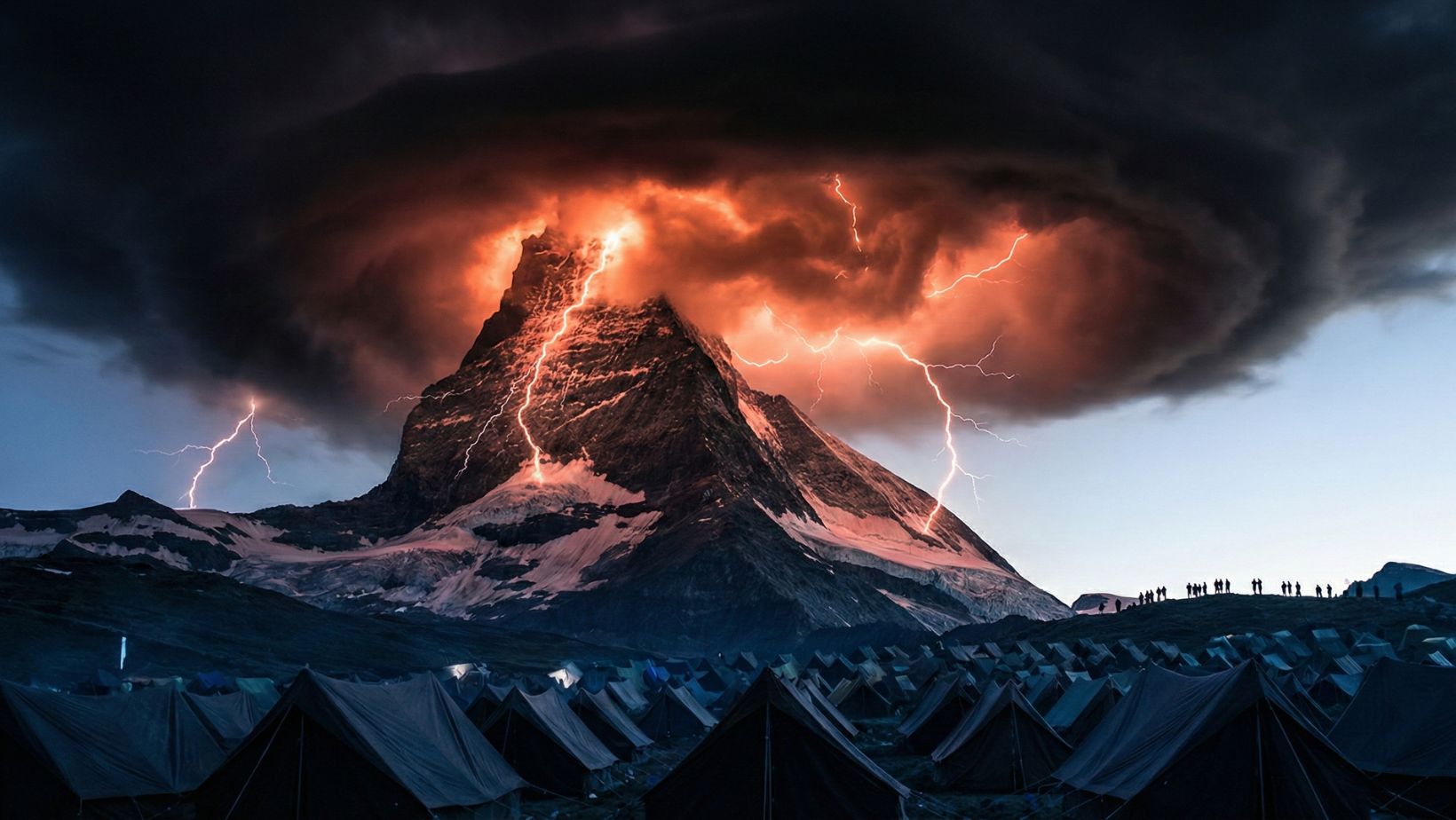
Exodus 19 marks one of the most significant turning points in redemptive history. Three months after leaving Egypt, the Israelites arrive at the foot of Mount Sinai. This chapter transitions the narrative from a story of rescue to a story of relationship. Here, God proposes a formal covenant, identifying Israel as His “treasured possession” and a “kingdom of priests.” The atmosphere is one of terrifying holiness, as the mountain is engulfed in smoke, fire, and the sound of a ram’s horn, signaling the arrival of the King. This chapter serves as the “wedding ceremony” preparation between Yahweh and His people before the giving of the Ten Commandments in chapter 20.
1. The Arrival and the Proposal (Exodus 19:1–6 NLT)
1 Exactly two months after the Israelites left Egypt, they arrived in the wilderness of Sinai. 2 After breaking camp at Rephidim, they came to the wilderness of Sinai and set up camp there at the base of Mount Sinai. 3 Then Moses went up the mountain to appear before God. The Lord called to him from the mountain and said, “Give these instructions to the family of Jacob; announce it to the descendants of Israel: 4 ‘You have seen what I did to the Egyptians. You know how I carried you on eagles’ wings and brought you to myself. 5 Now if you will obey me and keep my covenant, you will be my own special treasure from among all the peoples on earth; for all the earth belongs to me. 6 And you will be my kingdom of priests, my holy nation.’ This is the message you must give to the people of Israel.”
Commentary:
- The Setting (v. 1-2): The Israelites have traveled from the “House of Bondage” to the “House of God.” Mount Sinai becomes the geographical center of the Pentateuch, where Israel will remain for nearly a year.
- The Eagle Metaphor (v. 4): God describes His deliverance not as a forced march, but as being “carried on eagles’ wings.” This evokes an image of a mother bird supporting her young, highlighting God’s protective and uplifting grace.
- Treasured Possession (v. 5): The Hebrew word segullah refers to a king’s private, personal fortune. While God owns the whole earth, Israel is invited into a unique, intimate status of value.
- Kingdom of Priests (v. 6): This is Israel’s mission. A priest mediates between God and man. Israel was intended to be a model nation that would show the rest of the world what it looks like to live under the reign of the one true God.
- The Conditional “If” (v. 5): The covenant is based on God’s prior grace (the Exodus), but its continued blessings are tied to “obeying” and “keeping.”
2. The People’s Response and Preparation (Exodus 19:7–15 NLT)
7 So Moses returned from the mountain and called together the elders of the people and told them everything the Lord had commanded him. 8 And all the people answered together, “We will do everything the Lord has commanded.” So Moses brought the people’s answer back to the Lord. 9 Then the Lord said to Moses, “I will come to you in a thick cloud, Moses, so the people themselves can hear me when I speak with you. Then they will always trust you.” Moses told the Lord what the people had said. 10 Then the Lord said to Moses, “Go down and prepare the people for my arrival. Consecrate them today and tomorrow, and have them wash their clothes. 11 Be sure they are ready on the third day, for on that day the Lord will come down on Mount Sinai in the sight of all the people. 12 Mark off a boundary all around the mountain. Warn the people, ‘Be careful! Do not go up on the mountain or even touch its boundaries. Anyone who touches the mountain will surely be put to death. 13 No hand may touch the person or animal that crosses the boundary; instead, stone them or shoot them with arrows. They must be put to death.’ However, when the ram’s horn sounds a long blast, then the people may go up on the mountain.” 14 So Moses went down to the people. He consecrated them for the worship, and they washed their clothes. 15 He told them, “Get ready for the third day, and until then abstain from sexual intercourse.”
Commentary:
- A Willing Assembly (v. 8): The people accept the proposal with a unified “We will do everything.” They commit to the covenant before even hearing the specific laws.
- The Necessity of Consecration (v. 10): Before meeting a holy God, the people must be “consecrated.” Washing clothes was an external symbol of an internal need for spiritual cleansing.
- The Boundaries of Holiness (v. 12): God is not just a “friend” or a “provider”; He is the Consuming Fire. The death penalty for touching the mountain emphasizes the ontological gap between a sinful people and a Holy Creator.
- The Third Day (v. 11): Throughout Scripture, the “third day” is often the day of divine visitation and deliverance (foreshadowing the Resurrection).
3. The Great Theophany (Exodus 19:16–25 NLT)
16 On the morning of the third day, thunder roared and lightning flashed, and a dense cloud came down on the mountain. There was a long, loud blast from a ram’s horn, and everyone in the camp trembled. 17 Moses led the people out from the camp to meet with God, and they stood at the foot of the mountain. 18 All of Mount Sinai was covered with smoke because the Lord had descended on it in the form of fire. The smoke billowed into the sky like smoke from a brick kiln, and the whole mountain shook violently. 19 As the blast of the ram’s horn grew louder and louder, Moses spoke, and God thundered his reply. 20 The Lord came down on the top of Mount Sinai and called Moses to the top. So Moses climbed up. 21 Then the Lord told Moses, “Go back down and warn the people not to break through the boundaries to see the Lord, or many of them will die. 22 Even the priests who regularly come near to the Lord must purify themselves so that the Lord does not break out and destroy them.” 23 “But Lord,” Moses protested, “the people cannot come up to Mount Sinai. You already warned us. You told me, ‘Mark off a boundary all around the mountain to set it apart as holy.’” 24 But the Lord said, “Go down and bring Aaron back up with you. In the meantime, do not let the priests or the people break through to approach the Lord, or he will break out and destroy them.” 25 So Moses went down to the people and told them what the Lord had said.
Commentary:
- The Elements of Presence (v. 16-18): Thunder, lightning, smoke, and fire (a theophany) demonstrate God’s power over nature. This was intended to instill “the fear of the Lord,” which is the beginning of wisdom.
- The Shofar (v. 19): The “ram’s horn” (shofar) blast was supernatural, growing “louder and louder.” In the ancient world, this was the sound used to announce the arrival of a King or the start of a war.
- The Fragility of Life (v. 21): God warns Moses repeatedly to keep the people back. This isn’t because God is “mean,” but because His holiness is lethal to sin—much like the sun’s heat is lethal to anyone who tries to fly into it.
- Moses as Mediator (v. 20): Moses climbs the mountain while the people watch from below. He acts as the bridge between the Divine and the human, a role that ultimately points to Jesus Christ, the “one mediator between God and mankind” (1 Timothy 2:5).
Theological Significance of Exodus 19
- The Nature of Holiness: This chapter shatters any “casual” view of God. It establishes that while God is near (He descended), He is also “Other” (the mountain is off-limits).
- The Purpose of Redemption: God didn’t just save Israel from Egypt; He saved them for Himself. Redemption is for the sake of relationship and mission (“kingdom of priests”).
- Preparation for the Law: Before the Law is given in chapter 20, God establishes His authority and His love. The Law is not a way to earn God’s favor, but a way for a “treasured possession” to live in response to that favor.
Practical Applications
- Approaching God with Awe: While we have “boldness” to enter the throne room through Christ (Hebrews 4:16), we must never lose our sense of reverence and wonder at God’s holiness.
- Living as “Treasured”: Understanding that we are God’s “special treasure” should change our self-image and our priorities. We are called to reflect His character to a watching world.
- The Importance of Preparation: We often rush into God’s presence without “washing our clothes”—not literally, but by failing to confess sin and quiet our hearts before worship.







Leave a Reply